

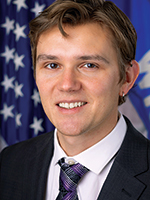
Photo of Christian Phelps
D Wisconsin Assembly · District 93 On the 2026 ballot

Rep. Christian Phelps

Compare
Total votes
244
all sessions
Attendance
100%
1 missed
Near the chamber average
With party
84%
of cast votes
Near the chamber average
Bipartisan score
8%
crosses aisle rarely
Near the chamber average
Sponsored
241
bills & resolutions
Near the chamber average
Committees
2
assignments
241 bills and resolutions

Sponsored bills

Total
241
Primary
241
Co-sponsor
0
This page
241
matching current filters
Primary AB 999
Failed · Wisconsin Assembly · Lead sponsor
Relating to: collective bargaining for employees of the University of Wisconsin Hospitals and Clinics Authority.

Maddy summaryAB 999 clarifies that employees of the University of Wisconsin Hospitals and Clinics Authority (UWHCA) are covered under collective bargaining agreements. The bill amends specific statutes (including 40.02, 40.05, and 111.02) to explicitly include UWHCA employees in provisions governing union dues, sick leave conversion, and bargaining unit structures. This ensures UWHCA staff have the same collective bargaining rights as other state employees covered under Chapter 111. The changes directly affect UWHCA employees by integrating them into existing labor frameworks without creating new rights. The bill focuses on administrative alignment within current state labor laws.

Failed Mar 23, 2026 0 co-sponsors
Primary AJR 134
Failed · Wisconsin Assembly · Lead sponsor
Relating to: recognizing the holidays of Eid al-Fitr and Eid al-Adha in Wisconsin.

Maddy summaryAJR 134 is a joint resolution recognizing Eid al-Fitr and Eid al-Adha as official holidays in Wisconsin. It directly affects Wisconsin's Muslim community (approximately 70,000 people) by encouraging schools and employers to acknowledge these religious holidays, which mark the end of Ramadan and the Hajj pilgrimage. The resolution does not create new policies or mandate changes but aims to raise awareness of these holidays' cultural and religious significance. It is currently pending in committee after being introduced on February 6, 2026.

Failed Mar 23, 2026 0 co-sponsors
Primary AB 1018
Failed · Wisconsin Assembly · Lead sponsor
Relating to: income eligibility for Wisconsin Shares child care subsidy and making an appropriation. (FE)

Maddy summaryThis bill expands eligibility for Wisconsin's child care subsidy program (Wisconsin Shares) by allowing families with incomes above 200% of the federal poverty line but below 100% of the state median income to continue receiving subsidies. It creates a new eligibility pathway (20.437 (2) (ct)) to cover families previously disqualified due to income thresholds and adjusts copayment rules for those exceeding income limits. The policy directly affects low-income working families who lost subsidies due to modest income increases but remain below the new 100% state median income cutoff. A $1.25 million appropriation for fiscal year 2026-27 funds this expansion.

Failed Mar 23, 2026 0 co-sponsors
Primary AB 1016
Failed · Wisconsin Assembly · Lead sponsor
Relating to: funding for child care provider workforce training and making an appropriation. (FE)

Maddy summaryAB 1016 allocates $2,166,600 annually for two fiscal years (2025-26 and 2026-27) to fund workforce training for child care providers and prospective providers. The bill creates a new funding line (20.437(2)(d)) under the Department of Children and Families, directing these funds toward contracts focused specifically on training child care staff. It directly affects licensed child care providers and those seeking to enter the field by providing financial support for their professional development. The bill establishes a dedicated funding stream but does not change eligibility rules or create new regulatory requirements.

Failed Mar 23, 2026 0 co-sponsors
Primary AB 1017
Failed · Wisconsin Assembly · Lead sponsor
Relating to: child care subsidies for custodial parents who are child care employees and making an appropriation. (FE)

Maddy summaryAB 1017 creates a new child care subsidy program specifically for custodial parents who work as employees in child care facilities. It allows these parents to qualify for subsidies under revised eligibility rules, bypassing standard income and asset requirements that typically apply to other subsidy recipients. The bill appropriates $1.2 million in fiscal year 2025-26 for administrative costs related to this new program. This directly affects parents employed by child care providers who have primary custody of children under 13 (or 19 if disabled) and meet the new eligibility criteria.

Failed Mar 23, 2026 0 co-sponsors
Primary AJR 136
Failed · Wisconsin Assembly · Lead sponsor
Relating to: the right to privacy (first consideration).

Maddy summaryAJR 136 is a proposed constitutional amendment that would add a new Section 1m to Article I of the state constitution, stating: "As a necessary part of a free society, the people have an individual and fundamental right to privacy." This resolution, introduced by multiple assembly members and senators, would establish this privacy right as a fundamental constitutional protection for all residents. The bill requires voter approval at the next general election, as it must be referred to voters following a three-month publication period. It does not create immediate legal requirements but proposes a foundational constitutional change.

Failed Mar 23, 2026 0 co-sponsors
Primary AB 1015
Failed · Wisconsin Assembly · Lead sponsor
Relating to: Wisconsin Shares copayment amounts and making an appropriation. (FE)

Maddy summaryAB 1015 adjusts Wisconsin Shares child care assistance copayment rules and increases funding. It limits copayments to no more than 7% of a family’s gross income (49.155 (5) (ag)) and waives copayments entirely for families earning below 150% of the federal poverty line (49.155 (5) (ar)). The bill also increases annual funding for child care subsidies by $22.93 million for fiscal years 2025-26 and 2026-27. These changes directly affect low-income families using Wisconsin Shares child care assistance.

Failed Mar 23, 2026 0 co-sponsors
Primary AB 1048
Failed · Wisconsin Assembly · Lead sponsor
Relating to: local regulation of landlords.

Maddy summaryAB 1048 repeals statute 66.0104, which governed local regulations of landlords. This procedural bill removes an existing legal provision without creating new rules or directly affecting landlords, tenants, or local governments. It was introduced by multiple legislators and referred to the Housing Committee. The bill's sole action is eliminating the referenced statute from the code.

Failed Mar 23, 2026 0 co-sponsors
Primary AB 823
Failed · Wisconsin Assembly · Lead sponsor
Relating to: healthy food incentive program funding, payment processing equipment and services for farmers’ markets and farmers, and making an appropriation. (FE)

Maddy summaryAB 823 creates a program to provide electronic benefit transfer (EBT) and credit/debit card processing equipment and services to farmers' markets and farmers who sell directly to consumers. It allocates $367,500 biennially for this payment processing program and increases funding by $1 million annually for the healthy food incentive program. The bill requires participating vendors to process local purchasing incentives (even if funded by third parties) and adds 0.625 FTE positions to administer the program. This directly affects farmers' markets and farmers selling directly to consumers who participate in EBT or incentive programs.

Failed Mar 23, 2026 0 co-sponsors
Primary AB 835
Failed · Wisconsin Assembly · Lead sponsor
Relating to: grants for students enrolled in teacher education programs, school district revenue limits, the reimbursement rate for special education costs, and making an appropriation. (FE)

Maddy summaryAB 835 establishes $10 million annually in grants for students enrolled in approved teacher education programs, requiring recipients to work as teachers in Wisconsin public or tribal schools for at least four years after graduation. It adjusts the reimbursement rate for special education costs to 90% of eligible expenses for school districts. The bill also modifies school district revenue limits by adding specific dollar amounts ($325 for 2023-24, $146 for 2023-24-2025-26) to calculate annual funding caps. These changes directly affect education students, school districts, and special education programs through concrete funding adjustments.

Failed Mar 23, 2026 0 co-sponsors
Showing 31 to 40 of 241 bills
Previous 1 … 3 4 5 … 25 Next