

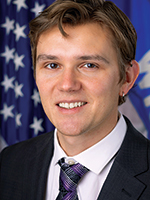
Photo of Christian Phelps
D Wisconsin House · District 93 On the 2026 ballot

Rep. Christian Phelps

Compare
Total votes
244
all sessions
Attendance
100%
1 missed
Near the chamber average
With party
84%
of cast votes
Near the chamber average
Bipartisan score
8%
crosses aisle rarely
Near the chamber average
Sponsored
241
bills & resolutions
Near the chamber average
Committees
2
assignments
241 bills and resolutions

Sponsored bills

Total
241
Primary
241
Co-sponsor
0
This page
241
matching current filters
Primary AB 500
Failed · Wisconsin House · Lead sponsor
Relating to: prohibiting corporal punishment in public and private schools.

Maddy summaryAB 500 bans corporal punishment in all public and private schools, defining it as intentional physical pain used for discipline (e.g., paddling or slapping). The bill prohibits school staff from using such punishment on students but allows reasonable force for safety under new school policies. Schools must adopt policies clarifying when force is permitted, excluding individualized education programs and athletic training. This directly affects all public and private schools and their staff in the state.

Failed Jul 2, 2026 0 co-sponsors
Primary AB 1012
Failed · Wisconsin House · Lead sponsor
Relating to: the establishment of a family and medical leave insurance program; family leave to care for a family member and for the active duty of a family member; the employers that must allow an employee to take family or medical leave; allowing a local government to adopt ordinances requiring employers to provide leave benefits; providing an exemption from emergency rule procedures; providing an exemption from rule-making procedures; granting rule-making authority; making an appropriation; and providing a penalty. (FE)

Maddy summaryAB 1012 establishes a family and medical leave insurance program that would allow eligible workers to take up to 14 weeks of leave per year to care for a newborn, newly adopted child, or family member with a serious health condition, or to address certain family military needs. The bill would require employers with 50 or more employees to provide this leave, funded through a new family and medical leave insurance trust fund. It defines "family member" broadly to include spouses, domestic partners, parents, children, siblings, and other close relatives or people in close association with the employee. The legislation also sets specific limits on leave availability, including a maximum of 6 weeks for certain family situations and 8-14 weeks for combined reasons within a 12-month period.

Failed Jun 16, 2026 0 co-sponsors
Primary AB 80
Signed into law · Wisconsin House · Lead sponsor
Relating to: ratification of the Social Work Licensure Compact. (FE)

Maddy summaryAB 80 would allow social workers, marriage and family therapists, and professional counselors licensed in this state to practice in other states that join the Social Work Licensure Compact without needing separate state licenses. The bill amends existing statutes to align state definitions and requirements with the compact framework, ensuring professionals certified under Chapter 457 can work across participating states. It directly affects licensed social work professionals seeking to practice in multiple states and changes how their credentials are recognized in statutes related to child welfare, mental health, and professional practice. The compact aims to streamline licensure for these professionals while maintaining state-specific standards.

Signed into law May 21, 2026 0 co-sponsors
Primary AB 1232
Failed · Wisconsin House · Lead sponsor
Relating to: a University of Wisconsin System nonresident tuition exemption. (FE)

Maddy summaryThis bill would create a tuition exemption for nonresident students attending University of Wisconsin System schools if they meet specific residency and immigration status requirements. To qualify, a student must have lived in Wisconsin for 12 consecutive months before registering for classes and must have approved deferred action status under the federal Deferred Action for Childhood Arrivals program. The exemption applies to students enrolling in the semester or session following the bill's effective date. This legislation is designed to provide financial relief to certain immigrant students by allowing them to pay in-state tuition rates despite not being Wisconsin residents. The bill was introduced in March 2026 and referred to the Committee on Colleges and Universities for review.

Failed Apr 17, 2026 0 co-sponsors
Primary AB 1209
Failed · Wisconsin House · Lead sponsor
Relating to: modifying the income and franchise tax rate structure for individuals and corporations, creating a school aid fund, supplemental school aid, school district revenue limits, and making an appropriation. (FE)

Maddy summaryThis bill modifies Wisconsin's income and franchise tax rates for both individuals and corporations while establishing a new School Aid Fund to support education. It creates a separate trust fund that receives annual transfers from the general fund, with specific provisions for supplemental school aid and revenue limits for school districts. The tax structure introduces graduated rates for higher income levels, with individual and corporate brackets adjusted to increase percentages on income exceeding certain thresholds, and includes provisions for partnerships to elect entity-level taxation. Changes take effect for taxable years beginning after December 31, 2025, with some rates already set for 2026.

Failed Apr 16, 2026 0 co-sponsors
Primary AB 790
Failed · Wisconsin House · Lead sponsor
Relating to: creating the water fund for our future, granting rule-making authority, and making an appropriation. (FE)

Maddy summaryAB 790 creates a dedicated "Water Fund for Our Future" with an initial $250 million transfer from the general fund. The fund establishes a rapid response account to cover clean water-related costs during natural disasters or public health emergencies, including remediation and assistance for affected individuals. A new joint committee oversees fund spending, reviewing requests for funding (excluding non-clean-water uses) and recommending approvals to the finance committee. All funds must be used exclusively for clean water activities, with specific rules for disbursement and oversight.

Failed Apr 13, 2026 0 co-sponsors
Primary AB 1203
Failed · Wisconsin House · Lead sponsor
Relating to: net zero emissions, carbon-free and renewable energy standards, and creating an office of sustainability and clean energy, granting rule-making authority, making an appropriation, and providing a penalty. (FE)

Maddy summaryThis bill establishes a comprehensive clean energy framework requiring Wisconsin to achieve 100 percent clean electricity production and net-zero carbon emissions by 2050. It creates a new Office of Sustainability and Clean Energy within the Department of Administration to develop and update an economy-wide decarbonization roadmap using sector-based modeling. The legislation sets specific interim targets for carbon-free electricity, including 50 percent by 2030, 65 percent by 2035, 80 percent by 2040, 90 percent by 2045, and full carbon-free status by 2050. State agencies must consider purchasing renewable energy from providers with long-term contracts, though the requirements do not apply if generation is not technically feasible or cost-effective. The bill also provides funding for technology implementation and defines carbon-free resources to include hydroelectric power alongside other renewable sources.

Failed Apr 9, 2026 0 co-sponsors
Primary AB 854
Failed · Wisconsin House · Lead sponsor
Relating to: violence prevention grants and making an appropriation. (FE)

Maddy summaryAB 854 creates a grant program funded by taxes on vapor products to support violence prevention efforts. It directs $30,000 for fiscal year 2025-26 and $120,000 for 2026-27 toward local health departments or tribal health centers. These entities can use the funds to run violence prevention programs or award grants to community organizations, but they cannot distribute money to law enforcement agencies or any groups working with them. The bill specifies that applications for these grants must be submitted by June 30 each year.

Failed Apr 9, 2026 0 co-sponsors
Primary AB 1168
Failed · Wisconsin House · Lead sponsor
Relating to: medical debt abolition and making an appropriation. (FE)

Maddy summaryThis bill establishes a program to eliminate medical debt for eligible Wisconsin residents by creating a $10 million annual appropriation for the Department of Health Services to purchase and cancel outstanding medical bills. To qualify, residents must either have household income at or below 400 percent of the federal poverty line or owe medical debt equal to at least 5 percent of their annual household income. The department will identify eligible individuals, negotiate with healthcare providers and debt collectors to buy their outstanding balances, and then formally abolish the debt while minimizing tax consequences for recipients. The program prioritizes purchasing debt from providers serving low-income populations and those in areas disproportionately affected by medical debt, with annual reporting required to track the number of debts eliminated and demographic information of affected residents.

Failed Apr 8, 2026 0 co-sponsors
Primary AB 916
Failed · Wisconsin House · Lead sponsor
Relating to: a home repair program and making an appropriation. (FE)

Maddy summaryAB 916 creates a state-funded home repair program to address habitability issues and improve energy efficiency in affordable housing. It provides grants of up to $25,000 per unit to eligible homeowners (income ≤100% of area median income who own or occupy their homes) and interest-free loans of up to $25,000 to eligible landlords (owning ≤5 properties/15 units of affordable housing). The program prioritizes repairs for homes with health/safety hazards, energy efficiency upgrades, and accessibility improvements for individuals with disabilities or young children. Properties must be between 10 and 40 years old to qualify, and funds are administered by the state authority or contracted counties/nonprofits with strict reporting requirements.

Failed Apr 7, 2026 0 co-sponsors
Showing 1 to 10 of 241 bills
1 2 3 25 Next