

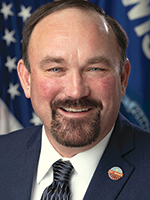
Photo of Clint Moses
R Wisconsin House · District 92 On the 2026 ballot

Rep. Clint Moses

Compare
Total votes
583
all sessions
Attendance
100%
of floor votes
Near the chamber average
With party
100%
of cast votes
Near the chamber average
Bipartisan score
0%
crosses aisle rarely
Near the chamber average
Sponsored
695
bills & resolutions
Near the chamber average
Committees
5
assignments
695 bills and resolutions

Sponsored bills

Total
695
Primary
695
Co-sponsor
0
This page
695
matching current filters
Primary AB 597
Signed into law · Wisconsin House · Lead sponsor
Relating to: a state matching grant program for recipients of federal per diem payments. (FE)

Maddy summaryAB 597 creates a state matching grant program that provides $25 per day per veteran to eligible housing providers who receive federal per diem payments under 38 USC 2012. It directly affects organizations housing veterans who qualify for federal per diem payments, such as veteran service nonprofits or shelters. The program funds up to 365 days per year per veteran, with quarterly payments based on the previous quarter's housing. Grants are limited to $25/day and require annual applications through the state department.

Signed into law Apr 2, 2026 0 co-sponsors
Primary AB 737
Signed into law · Wisconsin House · Lead sponsor
Relating to: financing certain infrastructure by special charge approved by a neighborhood improvement district.

Maddy summaryAB 737 allows municipalities to establish neighborhood improvement districts that can impose special property charges to fund infrastructure directly related to residential development within those neighborhoods. Property owners in designated districts would pay these charges, which can be collected in installments over time and included in regular tax bills, rather than requiring delinquency. The bill requires districts to specify exactly which infrastructure projects the funds will support and how charges are calculated per parcel, while allowing exemptions from notice requirements if a single owner holds all properties in the district. This legislation affects local property owners and municipalities by creating a new mechanism for financing neighborhood-specific infrastructure improvements through targeted assessments.

Signed into law Mar 27, 2026 0 co-sponsors
Primary AB 180
Signed into law · Wisconsin House · Lead sponsor
Relating to: requiring the Department of Health Services to seek any necessary waiver to prohibit the purchase of candy or soft drinks with FoodShare benefits. (FE)

Maddy summaryAB 180 requires the state Department of Health Services to request a federal waiver from the USDA to prohibit the use of FoodShare benefits (the state's name for SNAP) for purchasing candy or sugary drinks. The bill mandates that if the waiver is granted, candy and sugary drinks would be excluded from eligible items; if denied, the state must reapply annually. This applies directly to FoodShare recipients who currently can use benefits for these items. The bill creates a procedural requirement for the state to seek this change but does not immediately ban the purchases.

Signed into law Mar 24, 2026 0 co-sponsors
Primary AR 12
Failed · Wisconsin House · Lead sponsor
Relating to: observing February 28, 2026, as Rare Disease Day in Wisconsin.

Maddy summaryAssembly Resolution 12 designates February 28, 2026, as Rare Disease Day in Wisconsin to raise awareness about rare diseases, which affect millions of Americans including Wisconsin residents. The resolution acknowledges challenges like delayed diagnosis and limited treatment access for conditions impacting fewer than 200,000 people. It aligns with a national observance organized by the National Organization for Rare Disorders (NORD) and serves as a symbolic gesture without creating new laws or funding.

Failed Mar 23, 2026 0 co-sponsors
Primary AB 1024
Failed · Wisconsin House · Lead sponsor
Relating to: the sale, service, and labeling of food products containing lab-grown milk and providing a penalty. (FE)

Maddy summaryAB 1024 requires food products containing lab-grown milk (defined as milk replicated without mammal harvesting) to be prominently labeled with the phrase "lab-grown milk" in large, contrasting text on packaging. It mandates full ingredient lists and specific labeling for multi-component products. The bill prohibits using lab-grown milk as a milk substitute in restaurants without customer order and restricts its use in state institutions like schools or hospitals without medical authorization. Violations carry fines of $100-$500 for first offenses and up to $1,000 for repeat violations. The law takes effect January 1, 2027.

Failed Mar 23, 2026 0 co-sponsors
Primary AB 1036
Failed · Wisconsin House · Lead sponsor
Relating to: prohibiting nondisclosure agreements intended to conceal information about a data center from the public.

Maddy summaryAB 1036 prohibits local governments and data centers from using nondisclosure agreements (NDAs) to hide details about data center development or prevent public review of such facilities. It defines a "data center" as a facility primarily for storing, managing, or processing digital data, including associated infrastructure like servers and security systems. The law specifically bans agreements intended to conceal development details or block public oversight, with an exception for NDAs protecting trade secrets. This directly affects local governments approving data center projects and data center operators themselves.

Failed Mar 23, 2026 0 co-sponsors
Primary AB 996
Passed · Wisconsin House · Lead sponsor
Relating to: contributions by the Department of Financial Institutions to Trump accounts.

Maddy summaryThis bill creates a new state program requiring the Department of Financial Institutions to contribute to "Trump accounts" for eligible children who reside in the state and have prior payments made to such accounts. The contribution amount would match prior payments made under a specific IRS code (26 USC 6434), subject to available funds and only for accounts without prior state contributions. It defines key terms like "Trump account" and "eligible child" using IRS code references, though the bill's use of these codes appears inconsistent with actual tax law. The program would apply to children born and residing in the state, with contributions made as "qualified general contributions" under the referenced IRS section. The bill passed the Assembly in February 2026 with 62-35 support.

Passed Mar 23, 2026 0 co-sponsors
Primary AB 997
Passed · Wisconsin House · Lead sponsor
Relating to: funding for the Department of Financial Institutions for contributions to Trump accounts and making an appropriation. (FE)

Maddy summaryAB 997 increases funding by $60 million for the Department of Financial Institutions for payments to "Trump accounts" in fiscal years 2025-26 and 2026-27, contingent on statutory authorization. The bill directly affects the department’s budget and its ability to make these specific payments. It modifies existing appropriations under Section 20.144 (1) (g) without changing the department’s core responsibilities. This is a procedural budget adjustment, not a substantive policy change. The bill is currently pending in the Financial Institutions committee.

Passed Mar 23, 2026 0 co-sponsors
Primary AB 1071
Failed · Wisconsin House · Lead sponsor
Relating to: testing and labeling related to toxic heavy metals in baby food and providing a penalty. (FE)

Maddy summaryAB 1071 requires baby food manufacturers selling in the state to test for arsenic, cadmium, lead, and mercury (toxic heavy metals) and publicly disclose results. If tested, manufacturers must post metal levels, testing dates, and product details on their website with a QR code on the product label linking to this information. If not tested, they must clearly state this on the label and website with a QR code. The law applies to all baby food (including infant formula) sold in the state, with violations subject to a $100 daily penalty per product. It aims to provide consumers with transparent safety information about heavy metals in products for children under age 2.

Failed Mar 23, 2026 0 co-sponsors
Primary AB 1081
Failed · Wisconsin House · Lead sponsor
Relating to: modifying administrative rules relating to regulation of opioid treatment programs and requiring adjustments to the rates for substance use disorder treatment services with medications for opioid use disorder. (FE)

Maddy summaryAB 1081 adjusts payment rates for opioid treatment programs using medication-based care to match Medicare rates for comparable services starting in 2027. It also sets new staffing requirements, including a medical director with addiction medicine experience who must be present 40% of dosing time (reduced to 20% for the first 60 days of operation), and mandates one counselor for every 55 enrolled patients. The bill changes admission rules for minors, requiring documented failed detox attempts and written parental consent, while adding requirements for initial physical exams and Hepatitis/HIV testing with patient consent. These provisions directly affect all Wisconsin opioid treatment programs providing medication-assisted therapy.

Failed Mar 23, 2026 0 co-sponsors
Showing 31 to 40 of 695 bills
Previous 1 3 4 5 70 Next