

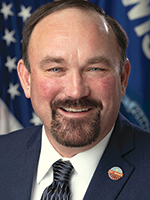
Photo of Clint Moses
R Wisconsin House · District 92 On the 2026 ballot

Rep. Clint Moses

Compare
Total votes
583
all sessions
Attendance
100%
of floor votes
Near the chamber average
With party
100%
of cast votes
Near the chamber average
Bipartisan score
0%
crosses aisle rarely
Near the chamber average
Sponsored
695
bills & resolutions
Near the chamber average
Committees
5
assignments
695 bills and resolutions

Sponsored bills

Total
695
Primary
695
Co-sponsor
0
This page
695
matching current filters
Primary AB 674
Vetoed · Wisconsin House · Lead sponsor
Relating to: prohibiting knowingly covering organ transplantation and related care under health insurance policies and the Medical Assistance program if the organ is transplanted in or originates from a country known to have participated in forced organ harvesting. (FE)

Maddy summaryAB 674 prohibits health insurance plans and the Medical Assistance program from covering organ transplants or related care if the organ was transplanted in or originated from a country designated by the department as participating in forced organ harvesting. The bill applies to disability insurance, self-insured health plans, and Medical Assistance. It defines "forced organ harvesting" as removal via coercion, deception, or abuse of power, and requires the department to designate affected countries. Life-saving post-transplant care remains covered even if the transplant itself is prohibited under the bill.

Vetoed May 13, 2026 0 co-sponsors
Primary AB 923
Signed into law · Wisconsin House · Lead sponsor
Relating to: creating a civil cause of action for sexual extortion.

Maddy summaryAB 923 creates a civil legal pathway for victims of sexual extortion (defined under statute 942.095) to sue for physical injury, emotional distress, or property loss. It allows victims, their parents/guardians (if minors), or estate representatives (in cases involving suicide linked to the extortion) to file lawsuits regardless of any criminal case outcome. The bill includes strong privacy protections, permitting plaintiffs to use initials instead of full names in court documents and allowing courts to issue orders shielding victims from public disclosure or unnecessary examinations. If successful, plaintiffs can recover damages for emotional distress, punitive damages, attorney fees, and other litigation costs.

Signed into law Apr 9, 2026 0 co-sponsors
Primary AB 454
Signed into law · Wisconsin House · Lead sponsor
Relating to: a workforce home loan program. (FE)

Maddy summaryAB 454 establishes a statewide "workforce home loan" revolving loan program to help low-to-moderate income workers purchase homes. It creates a new fund that will provide loans to first-time homebuyers whose household income is at or below 100% of the local area median income, with requirements including no prior residential property ownership in the past three years and meeting specific debt-to-income and credit score standards (minimum 580 FICO score for deferred payment options). The program uses repayments from existing loans to replenish the fund, allowing it to serve more borrowers over time. This directly affects eligible workforce households in housing markets across the state who qualify under the defined income and underwriting criteria.

Signed into law Apr 9, 2026 0 co-sponsors
Primary AB 374
Signed into law · Wisconsin House · Lead sponsor
Relating to: compliance with the federal Electoral Count Reform Act. (FE)

Maddy summaryAB 374 updates election procedures to align with the federal Electoral Count Reform Act. It modifies deadlines for handling ballots and canvassing results, requiring municipal clerks to deliver presidential election ballots to county clerks by 9 a.m. on the Saturday after the election (instead of Monday). The bill also clarifies processes for reconciling absentee and in-person ballots to prevent double-voting and mandates public canvassing of election results by specific deadlines, including a 5 p.m. Friday deadline for presidential elections. These changes directly affect local election officials managing municipal and presidential elections.

Signed into law Apr 9, 2026 0 co-sponsors
Primary AB 375
Signed into law · Wisconsin House · Lead sponsor
Relating to: modifications to the historic rehabilitation tax credit. (FE)

Maddy summaryAB 375 modifies Wisconsin's historic rehabilitation tax credit program. It extends the credit to cover rehabilitation work completed after 2025, maintaining a 20% credit on qualified rehabilitation costs (minimum $50,000) for certified historic structures and qualified rehabilitated buildings. The bill adds new certification requirements through the Wisconsin Economic Development Corporation and allows taxpayers to transfer unused credits to other entities subject to state taxes. This directly affects property owners and developers who rehabilitate historic buildings in Wisconsin, providing them with a tax incentive for such projects. The changes align Wisconsin's credit with federal rules while updating eligibility and claim procedures.

Signed into law Apr 9, 2026 0 co-sponsors
Primary AB 604
Signed into law · Wisconsin House · Lead sponsor
Relating to: coverage under the Medical Assistance program for incarcerated individuals. (FE)

Maddy summaryAB 604 would require Wisconsin's Department of Health Services to request a federal Medicaid waiver to provide pre-release medical coverage for incarcerated individuals eligible for Medicaid. It specifically covers case management, medication-assisted treatment for substance use disorders, and a 30-day supply of prescription medications for up to 90 days before release. This bill directly affects incarcerated people who qualify for Medicaid, aiming to improve continuity of care upon reentry. The waiver request must be submitted by January 1, 2027, to allow state and federal reimbursement for these services. The bill focuses on concrete policy changes to expand healthcare access during a critical transition period.

Signed into law Apr 9, 2026 0 co-sponsors
Primary AB 992
Failed · Wisconsin House · Lead sponsor
Relating to: requirements for proposed administrative rules that impose costs. (FE)

Maddy summaryAB 992 revises cost thresholds for administrative rule reviews, lowering the trigger point from $10 million to $4 million in projected costs for businesses, local governments, and individuals over two years. It prohibits agencies from splitting a single rule into multiple rules to avoid this cost analysis requirement. Agencies must halt rulemaking if costs exceed the threshold unless they modify the rule to reduce costs, then re-evaluate. This directly affects state agencies creating regulations and entities bearing compliance costs.

Failed Apr 6, 2026 0 co-sponsors
Primary AB 1167
Failed · Wisconsin House · Lead sponsor
Relating to: prohibiting recovery of a rate of return on retired electric generating facilities; an exemption from certificate requirements for constructing a large electric generating facility; and a permit dashboard for applications for certificates of public convenience and necessity. (FE)

Maddy summaryThis bill addresses three main areas of electric utility regulation. First, it prevents electric companies from charging customers for the profits they made on power plants that have already been retired. Second, it creates a public online dashboard to track the status of applications for permits needed to build large electric generating facilities. Third, it adds requirements for new large power facilities to show they will use at least 70% of their electricity for manufacturing or mining at the same location, and to agree to pay for connecting to the public power grid. These changes directly affect electric utilities, customers who pay utility rates, and developers seeking to build new power generation projects.

Failed Apr 2, 2026 0 co-sponsors
Primary AB 192
Signed into law · Wisconsin House · Lead sponsor
Relating to: fatality review teams and granting rule-making authority. (FE)

Maddy summaryAB 192 establishes a formal framework for fatality review teams in Wisconsin to examine specific types of deaths, including homicides, overdoses, child abuse, maternal deaths, and other unexpected deaths. It creates definitions for local and state teams, requires the Department of Children and Families to coordinate these teams, and allows confidential sharing of health records with teams for review purposes. The bill specifies that healthcare providers and agencies sharing records must maintain strict confidentiality under new provisions, and clarifies which death types qualify for review (e.g., suicide, domestic violence-related deaths, stillbirths, or infant deaths). This directly affects healthcare providers, fatality review teams, and state/local agencies responsible for child welfare and public health. The legislation focuses on improving death review processes while protecting privacy through updated confidentiality rules.

Signed into law Apr 2, 2026 0 co-sponsors
Primary AB 596
Signed into law · Wisconsin House · Lead sponsor
Relating to: a state matching grant program for recipients of federal per diem payments and making an appropriation. (FE)

Maddy summaryAB 596 creates a state matching grant program that allocates $950,000 to provide state funds matching federal per diem payments received by eligible non-state entities. It directly affects organizations or programs receiving federal per diem payments (such as those supporting veterans) by allowing them to access additional state funding. The bill establishes this program under the Veterans Affairs department budget, requiring the state to match federal payments without changing eligibility criteria or adding new requirements for recipients.

Signed into law Apr 2, 2026 0 co-sponsors
Showing 21 to 30 of 695 bills
Previous 1 2 3 4 70 Next