

Maddy summaryAB 280 amends Wisconsin tax credit rules to allow businesses to claim up to 15% of qualifying investments in workforce housing (for employees) and childcare programs as tax credits. It directly affects businesses that build, rehab, or establish housing/childcare for their employees, including contributions made to third parties like local revolving loan funds. The bill defines "investments" to include both direct capital expenditures and third-party contributions toward these projects. The tax credit applies to taxable years beginning January 1, 2026, and is administered by the Wisconsin Economic Development Corporation.
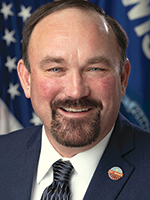
Rep. Clint Moses
Sponsored bills
Maddy summaryAB 201 modifies Wisconsin law to require sex offender registration for individuals convicted of sexual extortion or certain related offenses. It directs courts to mandate registration under Wisconsin Statute 301.45 if the underlying conduct was "sexually motivated" (as defined in Statute 980.01(5)), including violations of statutes related to sexual extortion (e.g., 942.09, 942.095). The bill affects offenders convicted of sexual extortion or sexually motivated crimes under Chapters 940, 942, 943, 944, or 948. Courts may later release individuals from registration if they meet conditions set by the court. This is a policy change to expand registration requirements for specific sexual offenses, not a new criminal penalty.
Maddy summaryAB 75 (now Wisconsin Act 45) requires the Wisconsin Department of Justice to collect and report criminal case data using an interactive dashboard that excludes personally identifiable information about defendants. The bill amends existing requirements by replacing terms like "charging recommendation" with "arrest charge" and mandates the dashboard be available by January 1, 2026. It directly affects the Department of Justice’s data collection processes and ensures transparency while protecting defendant privacy. The law was enacted after Governor approval on October 31, 2025.
Maddy summaryAJR 59 is a ceremonial resolution proclaiming June as Dairy Month in Wisconsin. It recognizes the state's long-standing dairy heritage, including its role as a national leader in dairy production since the 1800s, the $45.6 billion annual economic contribution of the industry, and the work of over 6,000 dairy farms. The resolution does not create new laws or regulations but formally honors Wisconsin's dairy farmers and industry as a key part of the state's identity. It directly affects Wisconsin residents by highlighting the industry's historical and economic significance during June. This resolution was passed by the legislature in June 2025.
Maddy summaryThis symbolic resolution designates May 2025 and May 2026 as Mental Health Awareness Months in Wisconsin. It recognizes the importance of mental well-being and aims to raise public awareness about mental health challenges across all age groups and communities. The resolution does not create new policies or funding but serves as a formal acknowledgment by the legislature to support ongoing efforts addressing mental health needs.
Maddy summaryAJR 50 is a ceremonial resolution recognizing the U.S. Army's 250th anniversary on June 14, 2025. It formally celebrates the Army's history of service and sacrifice since its founding in 1775, highlighting its role in defending the nation. The resolution specifically acknowledges Wisconsin's connection to the Army, including over 10,000 soldiers and civilians stationed in the state and Fort McCoy's economic impact. As a symbolic gesture with no policy changes, it does not affect any laws or groups beyond expressing legislative appreciation.
Maddy summaryAJR 48 is a ceremonial resolution designating May 14 annually as Hmong-Lao Veterans Day in Wisconsin. It honors Hmong-Lao veterans who served alongside U.S. forces during the Vietnam War, particularly those recruited by the CIA and U.S. military, and recognizes their post-war displacement and resettlement in Wisconsin. The resolution builds on 2021 Wisconsin Act 31, which already established May 14 as a day to thank these veterans, and encourages schools to include their service in Vietnam War education. As a commemorative resolution, it has no binding policy changes and serves solely to recognize their contributions.
Maddy summaryAB 232 transfers worker's compensation dispute resolution from the Division of Hearings and Appeals (Department of Administration) to the Department of Workforce Development. This change affects workers filing claims, employers, and insurers by shifting who handles appeals and decisions about compensation eligibility. The bill amends over 50 statutes to update references from the old division to the new department, ensuring all related procedures now fall under the Department of Workforce Development. The law was enacted as 2025 Wisconsin Act 33 after receiving gubernatorial approval on August 11, 2025.
Maddy summaryAB 242 amends Wisconsin law to strengthen penalties for tampering with utility infrastructure. It makes it illegal to intentionally remove, damage, or interfere with telecommunication, broadband, electric power, or related wires or equipment without first giving the utility company 24 hours' notice. Violations are punishable as Class B misdemeanors (for removing structures) or Class A misdemeanors/felony (for breaking lines or making unauthorized connections). The law directly affects individuals and contractors working near utility lines, including construction crews, landscapers, and anyone modifying property where wires are attached. It includes an exception allowing work with explicit permission from the utility company.
Maddy summaryAssembly Joint Resolution 29 celebrates May 7, 2025, as Skilled Trades Day in Wisconsin. This resolution acknowledges the importance of skilled trades workers and the state's apprenticeship programs within the construction industry.