

Maddy summaryAB 176 repeals the financial eligibility requirement (section 46.87(5m)) for Wisconsin's Alzheimer's family and caregiver support program. It updates two sections of the law to remove references to this repealed requirement, clarifying that eligibility now depends on meeting the financial criteria previously defined under the repealed section. The bill directly affects Alzheimer's patients and their caregivers in residential facilities who previously needed to satisfy these financial standards to receive program services. The key change is eliminating the specific financial threshold that determined program access, streamlining eligibility without creating new benefits or funding. This is a technical adjustment to existing statutes, not a substantive policy change.
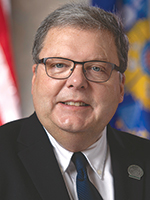
Rep. Pat Snyder
Sponsored bills
Maddy summaryAJR 6 is a symbolic resolution passed by the Wisconsin State Legislature declaring support for nuclear and fusion energy as critical clean energy sources. It states the legislature's commitment to advancing nuclear power, fusion technology, and related innovations to meet energy demands, reduce carbon emissions, and create high-paying jobs - citing current nuclear plants powering 1.2 million homes and avoiding 6.4 million tons of carbon emissions annually. The resolution does not create new laws or allocate funding but formally endorses expanding nuclear energy development. The bill was introduced in February 2025, referred to committees, and ultimately laid on the table in June 2025 without further action.
Maddy summaryAB 233 amends Wisconsin law to expand funding for child advocacy centers by adding two new recipients: the Lakeshore Regional Child Advocacy Center in Sheboygan County and a statewide "Child Advocacy Centers of Wisconsin" entity. It authorizes $17,000 annually per center for education, training, and quality assurance activities related to child maltreatment response. The bill directly affects existing centers (like those in Milwaukee, Kenosha, and Racine Counties) and the newly added entities by securing their grant funding from the Department of Justice’s existing appropriation. The policy change specifies concrete funding recipients and mechanisms without altering eligibility criteria for current centers.
Maddy summaryAB 108 requires the Public Service Commission to conduct a study identifying potential sites for nuclear power and fusion energy facilities, including advanced reactors, by a specific deadline. It also mandates that the Commission must make a final decision on applications for large nuclear facilities within 150 days of the application being deemed complete, or automatically approve the project. This directly affects applicants seeking permits for advanced nuclear power plants and the Commission's approval process. The bill aims to streamline approvals for new nuclear energy projects while establishing a formal study to identify suitable locations.
Maddy summaryAB 83 prohibits state and local governments from restricting the sale or use of motor vehicles based on their energy source (e.g., gasoline, electric, or hydrogen). It also extends this rule to other energy-powered devices, such as power tools or generators, if their significant functions rely on that energy source. The law explicitly allows government agencies to prioritize electric vehicles for their own fleets when purchasing. This ensures public policies do not discriminate against specific vehicle or device types based on energy use.
Maddy summaryAB 364 establishes a three-year pilot program to test virtual reality (VR) learning technology in three public school districts (one rural, one suburban, and one urban). The program requires a VR platform aligned with state math and science standards for grades 6-12, proven through third-party research to improve Algebra 1 outcomes and use 3D models to teach abstract concepts. The state education department will select districts via competitive bidding, fund at least 16,000 students to use the technology, and provide 3,200 VR headsets, along with teacher training and monthly progress reports to legislators. The pilot aims to evaluate if this VR approach enhances student engagement and learning in STEM fields.
Maddy summaryAB 258 modifies Wisconsin's license restrictions for drivers required to use ignition interlock devices after DUI convictions. It extends license revocation periods by 180 days for specific violations detected by the device, including three or more violations within 60 days, tampering, or unauthorized removal. The bill also creates a process for drivers to dispute violations using documentation (e.g., device malfunctions) and requires electronic reporting from interlock providers to the department. This directly affects individuals subject to ignition interlock orders under existing DUI-related license restrictions.
Maddy summaryAB 141 creates a temporary "provisional" pathway for social work licensure in Wisconsin, directly affecting individuals who have taken but not passed the required national social work exam. It allows these applicants to obtain a provisional certificate or license (valid for 36 months) while completing supervised practice, requiring 37.5 hours of supervision (including 25 hours of in-person one-on-one) over their first 2,000 hours of practice. The bill specifies that provisional credentials cannot be renewed and transition to full certification only after verified completion of supervised practice and meeting other requirements under Section 457.08(6). This change streamlines the process for entry-level social workers to gain practical experience while working toward full licensure.
Maddy summaryAB 164 standardizes terminology across Wisconsin's unemployment insurance system, replacing "unemployment insurance" with "reemployment assistance" in state laws to align with federal programs. It creates a new Division of Reemployment Assistance within the Department of Workforce Development and clarifies responsibilities for home care workers, requiring placement agencies to inform consumers about who pays federal social security taxes, state reemployment assistance contributions, and worker compensation insurance. The bill ensures home care consumers aren't unexpectedly liable for these costs if agencies fail to provide required notices, and establishes mechanisms for recovering costs from agencies when they do. These changes primarily affect home care workers, placement agencies, and state agencies administering unemployment benefits.
Maddy summaryAB 392 creates a state Task Force focused on addressing the crisis of missing and murdered African American women and girls in Wisconsin. The task force will develop recommendations to improve responses, prevention efforts, and support services for this community. The bill includes a funding appropriation to cover the task force’s operational costs. It was introduced by multiple legislators and referred to the Committee on Criminal Justice and Public Safety for further review.