

Maddy summaryAB 823 creates a program to provide electronic benefit transfer (EBT) and credit/debit card processing equipment and services to farmers' markets and farmers who sell directly to consumers. It allocates $367,500 biennially for this payment processing program and increases funding by $1 million annually for the healthy food incentive program. The bill requires participating vendors to process local purchasing incentives (even if funded by third parties) and adds 0.625 FTE positions to administer the program. This directly affects farmers' markets and farmers selling directly to consumers who participate in EBT or incentive programs.
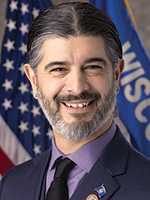
Rep. Vinnie Miresse
Sponsored bills
Maddy summaryAB 835 establishes $10 million annually in grants for students enrolled in approved teacher education programs, requiring recipients to work as teachers in Wisconsin public or tribal schools for at least four years after graduation. It adjusts the reimbursement rate for special education costs to 90% of eligible expenses for school districts. The bill also modifies school district revenue limits by adding specific dollar amounts ($325 for 2023-24, $146 for 2023-24-2025-26) to calculate annual funding caps. These changes directly affect education students, school districts, and special education programs through concrete funding adjustments.
Maddy summaryAB 816 creates the Office of the Public Affairs Network within Wisconsin's Department of Administration to provide live, unedited video and audio coverage of state government proceedings - including legislative sessions, committee meetings, court proceedings, and related public events - through a permanent online network. The bill establishes a Public Affairs Network Board (with members including the governor, legislative leaders, and public appointees) to oversee the office, which must operate strictly nonpartisanly and maintain a free, unrestricted digital archive of all covered proceedings. The legislation appropriates $2 million annually for the office's operations and includes provisions to acquire WisconsinEye's existing digital archives and equipment to transition the network to state management. This directly affects state government operations and provides the public with free, real-time access to unedited coverage of official proceedings without registration requirements.
Maddy summaryAB 859 adjusts the state reimbursement rate for special education and school-age parent program costs. It sets the reimbursement rate at 42% of eligible costs for the 2025-26 school year, increasing to 45% for the 2026-27 school year and all subsequent years. The bill applies to costs covered under sections 115.88(1m)-(3), (6), (8), 115.93, and 118.255(4), which include services for students in hospitals, convalescent homes, and school programs. This change directly affects school districts and programs providing these services by altering the state's financial contribution toward their expenses. The bill amends statutes to ensure state funds are distributed according to these revised percentages.
Maddy summaryAB 872 creates a new Energy Innovation Grant Program to fund projects advancing clean energy technologies. It allocates $10 million annually for the 2025-26 and 2026-27 fiscal years, directly supporting the Office of Energy Innovation within the Public Service Commission. The program allows the agency to distribute grants for innovative energy solutions, with no specific project types or recipient criteria detailed in the bill. This is a funding measure with no voting record yet, as the bill was introduced on January 16, 2026.
Maddy summaryAB 844 allows cities, counties, villages, and towns to adopt stricter energy efficiency standards for new buildings than the state's baseline code, provided they follow a state-developed "stretch energy code." Local governments can choose to implement either residential or commercial components of this code, which must exceed current state minimums. The state must create the stretch energy code by December 2026 through a working group including energy experts, climate nonprofits, and municipalities with climate plans. This directly affects local building regulations without changing the state's baseline requirements.
Maddy summaryAB 867 creates a new program allowing public utilities to finance energy improvements (like solar panels or insulation) at residential properties. Utilities would cover the upfront costs and recover them over time by adding a small, regular charge to the homeowner's utility bill. The Public Service Commission must develop rules to govern this program. This directly affects homeowners seeking energy upgrades and the utilities offering this financing option.
Maddy summaryAB 858 requires Wisconsin's Public Service Commission to consider a minimum "social cost of carbon" of $185 per metric ton of CO2 emissions when reviewing energy certificates. It mandates that costs for expanding fossil fuel infrastructure can only be recovered from customers who directly benefit from that infrastructure, and prohibits passing transition costs to renewable energy onto ratepayers. The bill directly affects utilities seeking infrastructure investments and residential/commercial electricity customers paying rates. Key provisions ensure fossil fuel expansion costs are tied to specific beneficiaries while shielding customers from transition expenses during the shift to renewables.
Maddy summaryAB 853 allocates $200,000 annually for the 2025-26 and 2026-27 fiscal years to fund two full-time research positions at the University of Wisconsin-Madison focused on agriculture and climate change. The positions must be filled using existing vacant research roles (not creating new ones), assigned to the university's extension division, and contribute to increasing the total number of research positions at UW-Madison. The bill modifies the state budget to add this funding under existing appropriations for the University of Wisconsin System. It does not create new positions but directs existing resources toward climate science research in agriculture through UW-Madison's extension program.
Maddy summaryAB 855 prohibits creating and sharing synthetic digital representations (like AI-generated images, videos, or audio) that use someone's recognizable personal characteristic (face, voice, etc.) without their consent, appear authentic to a reasonable person, and are intended to coerce, harass, intimidate, or defraud for monetary gain. It classifies unauthorized use for coercion/harassment as a Class A misdemeanor and for financial gain as a Class I felony. Key exceptions include tech providers (protected under Section 230), newsworthy content, and clear disclaimers like "This content generated by AI" in the media itself. The law directly affects individuals whose likenesses are misused without consent and aims to prevent non-consensual deepfakes used for harm.