

Maddy summaryAB 1031 exempts menstrual discharge collection devices from sales tax. The bill defines these products to include tampons, pads, menstrual cups, period underwear, and other similar items designed for menstrual cycle use (such as period swimwear or sleep shorts), while explicitly excluding regular grooming products like soap or toothpaste. It adds these items to the list of tax-exempt goods under state law, meaning retailers won’t charge sales tax on them. This change directly affects consumers who purchase these products, making them more affordable by removing the tax burden.
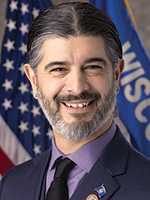
Rep. Vinnie Miresse
Sponsored bills
Maddy summaryAB 1015 adjusts Wisconsin Shares child care assistance copayment rules and increases funding. It limits copayments to no more than 7% of a family’s gross income (49.155 (5) (ag)) and waives copayments entirely for families earning below 150% of the federal poverty line (49.155 (5) (ar)). The bill also increases annual funding for child care subsidies by $22.93 million for fiscal years 2025-26 and 2026-27. These changes directly affect low-income families using Wisconsin Shares child care assistance.
Maddy summaryAB 1041 requires all Wisconsin public, private, and charter schools to integrate age-appropriate instruction about African American history into K-12 social studies curricula. It mandates the development of a state model curriculum covering African American contributions to U.S. and state history, with collaboration from organizations like the Wisconsin Black Historical Society. The bill funds three full-time education consultants ($384,900 annually) to support schools in implementing this curriculum. This policy directly affects all K-12 schools and educators, requiring concrete changes to social studies teaching standards starting with the 2026-27 school year.
Maddy summaryAB 1040 requires all public and private school boards, including charter schools, to maintain an easily accessible on-site supply of opioid antagonists (medication used to reverse opioid overdoses) at every school they oversee. It creates a grant program funded by a $100,000 appropriation increase for fiscal year 2026-27, allowing schools to purchase these antidotes to comply with the new requirement. The law takes effect on September 1, 2026, directly affecting school administrators and staff responsible for implementing this safety measure. This bill focuses on making life-saving medication readily available in schools without specifying outcomes or advocating for policy positions.
Maddy summaryAJR 142 is a Wisconsin legislative resolution celebrating Scouting America's 115th anniversary. It expresses the legislature's support for Scouting America's values and community contributions, including its emphasis on character development and volunteerism, but does not create new laws or funding. The resolution encourages Wisconsin citizens and organizations to recognize Scouting America's role in youth development and community service. It is purely symbolic, with no policy changes or direct effects on individuals or programs.
Maddy summaryAB 1063 requires state legislators to prove they live in the district they represent by filing sworn statements with proof of residency (like utility bills) at the start of each session and annually. If a legislator moves, they must update this within 10 days. Failure to comply triggers an investigation and potential legal action to remove them from office if residency is disputed. The bill also protects submitted residency records as confidential information. It directly affects all elected state legislators and aims to enforce existing residency requirements for legislative officeholders.
Maddy summaryAB 1055 creates a grant program to fund crime victim protective services, including temporary housing, for law enforcement agencies and prosecutors' offices. It allocates $2,572,900 for the 2025-26 fiscal year (with $2,574,100 for 2026-27) from the Justice Department's budget. The Department of Justice will administer the program, developing grant criteria without needing formal rulemaking, and will add one full-time staff position to manage it. This bill directly affects agencies providing support to individuals who have been victims of crime.
Maddy summaryAB 1056 is a comprehensive rewrite of Wisconsin's criminal justice laws that creates new funding streams for community policing ($10 million), officer recruitment/retention ($5 million), and violence prevention ($5 million). The bill reorganizes legal provisions related to firearm transfers, domestic violence, sexual assault, hate crimes reporting, and victim services, while establishing specific funding amounts for the address confidentiality program ($180,200). It modifies reimbursement processes for counties providing victim-witness services and creates new alternatives to prosecution for individuals with substance use disorders. The legislation directly affects law enforcement agencies, victims' services providers, and individuals seeking substance use treatment instead of traditional criminal prosecution.
Maddy summaryAB 1077 updates Wisconsin's firearms laws by requiring courts to notify the Department of Justice when ordering firearm restrictions, ensuring accurate background checks for buyers. It creates new funding for firearm dealer permits and mandates law enforcement agencies to submit recovered firearms for tracing via the eTrace system within 48 hours. The bill directly affects firearms dealers (through permit fees), courts (in handling firearm restriction orders), and law enforcement (in firearm tracing procedures). Key provisions include standardized court notifications to the DOJ for firearm restrictions and new requirements for law enforcement to trace recovered weapons.
Maddy summaryAB 1074 creates an Office of the Student Loan Ombudsman within the Department of Financial Institutions to assist borrowers with student loan issues. The office will handle complaints, analyze borrower data, and provide guidance on loan terms, working directly with student loan servicers and educational institutions. It establishes specific duties including resolving disputes, monitoring laws affecting borrowers, and requiring servicers to cooperate with the ombudsman. This bill directly affects student loan borrowers in the state and the student loan servicers who must now engage with this new oversight office.