

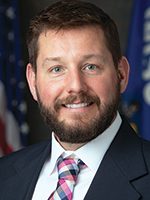
Photo of Elijah Behnke
R Wisconsin House · District 6 On the 2026 ballot

Rep. Elijah Behnke

Compare
Total votes
569
all sessions
Attendance
98%
14 missed
Near the chamber average
With party
98%
of cast votes
Near the chamber average
Bipartisan score
1%
crosses aisle rarely
Near the chamber average
Sponsored
861
bills & resolutions
Near the chamber average
Committees
6
assignments
861 bills and resolutions

Sponsored bills

Total
861
Primary
861
Co-sponsor
0
This page
861
matching current filters
Primary AB 385
Vetoed · Wisconsin House · Lead sponsor
Relating to: online credit card contributions and providing a penalty.

Maddy summaryAB 385 requires political committees and parties to collect a credit card's verification code and a U.S. billing address when accepting online credit card donations. It allows exceptions for U.S. citizens living abroad, who must instead provide their U.S. voter registration address. Financial institutions processing such payments without these verifications face fines equal to the total amount of the unverified contributions. The bill directly affects political groups and payment processors handling campaign donations.

Vetoed May 13, 2026 0 co-sponsors
Primary AB 923
Signed into law · Wisconsin House · Lead sponsor
Relating to: creating a civil cause of action for sexual extortion.

Maddy summaryAB 923 creates a civil legal pathway for victims of sexual extortion (defined under statute 942.095) to sue for physical injury, emotional distress, or property loss. It allows victims, their parents/guardians (if minors), or estate representatives (in cases involving suicide linked to the extortion) to file lawsuits regardless of any criminal case outcome. The bill includes strong privacy protections, permitting plaintiffs to use initials instead of full names in court documents and allowing courts to issue orders shielding victims from public disclosure or unnecessary examinations. If successful, plaintiffs can recover damages for emotional distress, punitive damages, attorney fees, and other litigation costs.

Signed into law Apr 9, 2026 0 co-sponsors
Primary AB 966
Signed into law · Wisconsin House · Lead sponsor
Relating to: requiring the Department of Justice to conduct a public awareness campaign. (FE)

Maddy summaryAB 966 requires the Department of Justice to create and run a public awareness campaign focused on children's online safety. The campaign must use digital platforms (like the department’s website and social media) and print materials to educate families about internet risks and prevention steps for children. It specifically mandates that the Department provide free educational materials to schools (as defined in statute 118.257(1)(d)) upon request. The bill directly affects children and schools by promoting accessible resources to help prevent exposure to harmful online content.

Signed into law Apr 9, 2026 0 co-sponsors
Primary AB 957
Signed into law · Wisconsin House · Lead sponsor
Relating to: Internet crimes against children law enforcement and making an appropriation. (FE)

Maddy summaryAB 957 increases funding by $400,000 for each of the 2025-26 and 2026-27 fiscal years to support internet crimes against children law enforcement within the Department of Justice. This is a budget adjustment that directly affects the Department of Justice's resources for investigating and prosecuting online crimes targeting minors. The bill does not create new laws or change existing legal standards - it solely allocates additional state funds for enforcement efforts.

Signed into law Apr 9, 2026 0 co-sponsors
Primary AB 958
Signed into law · Wisconsin House · Lead sponsor
Relating to: position authorizations for Internet crimes against children law enforcement. (FE)

Maddy summaryAB 958 authorizes the Department of Justice to add three new positions specifically for its Internet Crimes Against Children (ICAC) unit: two criminal analyst roles, one outreach specialist, and one digital evidence examiner. These positions are funded through existing appropriations under section 20.455(2)(a). The bill directly affects the ICAC unit’s staffing capacity to investigate and respond to online crimes involving children. It does not create new laws or policies but adjusts personnel authorizations to support existing law enforcement efforts. The bill was introduced in the 2026 Legislature and referred to the Criminal Justice and Public Safety Committee.

Signed into law Apr 9, 2026 0 co-sponsors
Primary AB 964
Signed into law · Wisconsin House · Lead sponsor
Relating to: Internet crimes against children administrative subpoenas for the crime of sexual extortion when the crime victim is a child. (FE)

Maddy summaryAB 964 clarifies that online sexual extortion targeting children falls under existing law by specifying it as a violation of Section 942.095 when the victim is a child (as defined in Section 948.01). This bill directly affects law enforcement agencies investigating internet crimes against children, enabling them to issue administrative subpoenas to internet companies for relevant data without a court order. The key provision streamlines the process for obtaining evidence from online platforms in cases where children are victims of sexual extortion. It does not create new penalties but ensures these cases are explicitly covered under current statutes for investigative efficiency.

Signed into law Apr 9, 2026 0 co-sponsors
Primary AB 969
Signed into law · Wisconsin House · Lead sponsor
Relating to: the drug repository program.

Maddy summaryAB 969 creates a formal drug donation program to redistribute unused medications to eligible patients. It defines key terms like "donor" (including pharmacies, hospitals, and individuals), "eligible patient" (indigent, uninsured, or underinsured individuals), and "recipient" (medical facilities or pharmacies that can receive donations). The bill allows donors to contribute drugs to participating facilities, with recipients permitted to charge a handling fee covering actual costs (e.g., storage, shipping), while prohibiting donations of certain FDA-regulated drugs requiring patient enrollment. This program aims to provide access to medications for underserved patients through a structured, safe, and cost-transparent system.

Signed into law Apr 9, 2026 0 co-sponsors
Primary AB 253
Signed into law · Wisconsin House · Lead sponsor
Relating to: independence accounts. (FE)

Maddy summaryThis bill creates "independence accounts" allowing individuals to save up to $15,000 annually from their gross earnings without that money counting toward Medicaid asset limits. It specifically excludes assets acquired through inheritance when determining eligibility for benefits. The department must seek federal approval to implement this change, though the program would take effect if federal authorities approve. The bill directly affects people applying for or receiving Medicaid benefits in the state.

Signed into law Apr 9, 2026 0 co-sponsors
Primary AB 445
Signed into law · Wisconsin House · Lead sponsor
Relating to: registers of deeds, transportation project plats, and providing a penalty. (FE)

Maddy summaryAB 445 updates procedures for county registers of deeds regarding property records and transportation project maps (plats). It revises how documents are numbered, indexed, and recorded - requiring unique sequential numbers for each document and clarifying "legal description" definitions for property records. These changes directly affect county offices handling property deeds, mortgages, and transportation project plats, streamlining administrative processes without altering fees or substantive rights. The bill focuses on procedural consistency in record-keeping across statutes.

Signed into law Apr 9, 2026 0 co-sponsors
Primary AB 373
Signed into law · Wisconsin House · Lead sponsor
Relating to: creating a refundable individual income tax credit for the parent of a stillbirth and making an appropriation. (FE)

Maddy summaryAB 373 creates a refundable $2,000 individual income tax credit for parents who experience a stillbirth in the state, as documented by a fetal death report. The credit is refundable, meaning parents who owe less in income tax than the credit amount will receive the difference as a cash payment from state funds. Eligibility requires the stillbirth to meet state reporting criteria (per §69.18), and rules specify $2,000 for joint filers per stillbirth or $1,000 each for unmarried parents or separate filers. The credit must be claimed within the standard tax filing deadline and cannot be used by nonresidents or for partial tax years.

Signed into law Apr 9, 2026 0 co-sponsors
Showing 41 to 50 of 861 bills
Previous 1 4 5 6 87 Next