

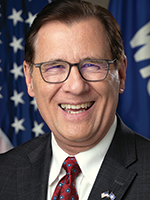
Photo of Dave Murphy
R Wisconsin House · District 56

Rep. Dave Murphy

Compare
Total votes
583
all sessions
Attendance
100%
of floor votes
Near the chamber average
With party
99%
of cast votes
Near the chamber average
Bipartisan score
0%
crosses aisle rarely
Near the chamber average
Sponsored
1,508
bills & resolutions
Near the chamber average
Committees
5
assignments
1,508 bills and resolutions

Sponsored bills

Total
1,508
Primary
1,508
Co-sponsor
0
This page
1,508
matching current filters
Primary AB 86
Signed into law · Wisconsin House · Lead sponsor
Relating to: imposing the penalty of life imprisonment for the crime of child trafficking and providing a penalty. (FE)

Maddy summaryAB 86 amends Wisconsin law to impose a life sentence without parole for individuals convicted of child trafficking involving three or more child victims. It specifically upgrades penalties under statutes 948.051(1)(b) and 948.051(2)(b), defining child trafficking as recruiting, transporting, or exploiting children for commercial sex acts. The bill requires courts to sentence offenders to life imprisonment without parole eligibility when three or more child victims are involved, affecting both traffickers and those who benefit from such crimes. This change applies to offenses committed on or after the bill’s effective date.

Signed into law Apr 3, 2026 0 co-sponsors
Primary AB 676
Signed into law · Wisconsin House · Lead sponsor
Relating to: creating a tax credit for insurers for certain investments in community development entities. (FE)

Maddy summaryAB 676 creates a tax credit for Wisconsin insurers who invest in community development entities (CDEs) that fund qualifying low-income community businesses. Insurers can claim a 10% credit (after an initial 0% period) against certain insurance regulatory fees for investments in CDEs that deploy capital to businesses with principal operations in Wisconsin - $125 million allocated for rural counties and $125 million for metro counties. The credit applies to investments meeting specific criteria, such as funding businesses with at least 60% of operations in Wisconsin and excluding those deriving significant income from real estate. This policy directly affects insurers and CDEs by incentivizing capital deployment to underserved communities through a structured, state-funded tax credit mechanism.

Signed into law Apr 3, 2026 0 co-sponsors
Primary AB 530
Signed into law · Wisconsin House · Lead sponsor
Relating to: the operation of drones over school property and providing a penalty.

Maddy summaryAB 530 restricts drone operations over school properties, directly affecting anyone flying drones near public, private, or tribal schools. The bill prohibits drones over school grounds without authorization, except for specific law enforcement or emergency purposes like search/rescue, locating escaped prisoners, or preventing imminent danger. Violations carry a maximum $5,000 penalty, and evidence from drone recordings related to violations must be handled by law enforcement or correctional authorities. The law clarifies definitions for "school" and "public protective services agency" to ensure consistent application.

Signed into law Apr 3, 2026 0 co-sponsors
Primary AB 453
Signed into law · Wisconsin House · Lead sponsor
Relating to: required approvals of rezoning requests related to residential development, contents of and consistency of local ordinances with local comprehensive plans, certain tax incremental district project costs related to residential development, and tax incremental district lifespan extension. (FE)

Maddy summaryAB 453 requires counties and cities to include specific elements in their comprehensive land-use plans, such as 20-year projections of residential development (in 5-year increments) and maps showing current/future land uses, including environmentally sensitive areas. It mandates that local ordinances related to residential development must align with these plans, though density requirements (specifying minimum/maximum residential units per acre) apply only to cities, not towns or counties. The bill affects local governments by standardizing planning processes for residential growth and ensuring consistency between zoning rules and long-term land-use goals. It does not create new taxes or funding but updates existing planning statute requirements.

Signed into law Apr 2, 2026 0 co-sponsors
Primary AB 19
Signed into law · Wisconsin House · Lead sponsor
Relating to: increased penalties for crimes against adults at risk; restraining orders for adults at risk; freezing assets of a defendant charged with financial exploitation of an adult at risk; sexual assault of an adult at risk; and providing a penalty.

Maddy summaryAB 19 increases penalties for crimes against elders (60+ years) and adults at risk (a defined term under state law) by raising felony classifications for physical abuse and sexual assault. It requires courts to allow these victims to participate in hearings via phone or video, and allows asset freezes for defendants charged with financial exploitation of such victims. Crucially, the bill states that defendants cannot claim ignorance of the victim’s age or status as a defense. The bill directly affects vulnerable adults, courts handling related cases, and defendants facing charges under these provisions. It amends multiple statutes to implement these changes without creating new offenses.

Signed into law Apr 2, 2026 0 co-sponsors
Primary AB 657
Signed into law · Wisconsin House · Lead sponsor
Relating to: a sales and use tax exemption for nuclear fusion technology projects. (FE)

Maddy summaryAB 657 exempts sales and use taxes for specific equipment and materials used exclusively in qualified nuclear fusion technology projects. It covers over 70 listed items, including plasma heating systems, superconductors, diagnostic tools, specialized materials like lithium and tungsten, and safety equipment. The exemption applies to businesses conducting fusion projects focused on energy generation, medical isotope production, research, or other fusion-related applications as defined in the bill. This policy directly reduces costs for companies developing nuclear fusion technology by eliminating taxes on qualifying purchases.

Signed into law Apr 2, 2026 0 co-sponsors
Primary AB 659
Signed into law · Wisconsin House · Lead sponsor
Relating to: tuition and fee remission or grants for certain veterans and their dependents enrolled in the University of Wisconsin System, a technical college, or a private nonprofit institution of higher education; and the University of Wisconsin System nonresident tuition exemption for certain veterans. (FE)

Maddy summaryAB 659 modifies Wisconsin's tuition benefit policies for veterans and their families. It reduces the required residency period from 5 to 3 consecutive years in the state before enrollment for veterans themselves and their dependents (spouses or children) to qualify for tuition exemptions or grants at University of Wisconsin System schools, technical colleges, or private nonprofit institutions. The bill applies to veterans who served honorably, died on duty or from service-connected disabilities, or have a 30% service-connected disability rating, and to dependents who meet the revised residency requirement. It does not change eligibility for veterans who were Wisconsin residents at the time of military entry. The policy change takes effect for the first semester or session beginning after the bill's effective date.

Signed into law Apr 2, 2026 0 co-sponsors
Primary AB 679
Signed into law · Wisconsin House · Lead sponsor
Relating to: weight limits for vehicles transporting grain, feed, or commercial fertilizer. (FE)

Maddy summaryAB 679 creates a new permit system for trucks carrying grain, feed, or commercial fertilizer that exceed standard weight limits. It allows vehicles with 6 or more axles to operate at up to 91,000 pounds gross weight on state highways, provided they meet axle weight distribution rules and follow department-specified routes. The bill directly affects agricultural haulers and trucking companies transporting these materials, requiring a $325 permit for such operations. Permits are invalid on interstate highways (except as permitted by federal law) and may be suspended during spring thaw conditions. This bill does not change base weight limits but establishes a regulated pathway for heavier agricultural transport.

Signed into law Apr 2, 2026 0 co-sponsors
Primary AB 223
Signed into law · Wisconsin House · Lead sponsor
Relating to: residency requirements for persons circulating nomination papers or recall petitions.

Maddy summaryThis bill amends residency requirements for people circulating nomination papers or recall petitions. It requires circulators to certify their residence (with street address if applicable) and confirms they are either a qualified elector of the state or a U.S. citizen aged 18+ who would not be disqualified from voting if they lived in the state. For recall petitions specifically, the certification must state the circulator is a qualified elector. These changes directly affect individuals collecting signatures for candidate nominations or recall efforts, ensuring circulators meet clear residency and eligibility standards before submitting petitions.

Signed into law Mar 27, 2026 0 co-sponsors
Primary AB 446
Signed into law · Wisconsin House · Lead sponsor
Relating to: consideration of a certain definition of antisemitism for purposes of laws, ordinances, policies, or criminal penalty enhancers concerning discrimination based on race, religion, color, or national origin.

Maddy summaryAB 446 requires all state agencies and local governments (including cities, counties, and school districts) to use the International Holocaust Remembrance Alliance's 2016 definition of antisemitism when evaluating evidence in discrimination cases based on race, religion, color, or national origin. This applies to both civil policies prohibiting discrimination and criminal cases where bias against a victim's identity is a factor for enhanced penalties. The bill explicitly states it does not affect First Amendment rights or conflict with existing federal or state antidiscrimination laws.

Signed into law Mar 27, 2026 0 co-sponsors
Showing 71 to 80 of 1,508 bills
Previous 1 7 8 9 151 Next