

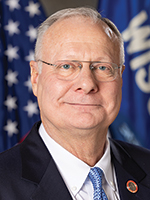
Photo of Randy Udell
D Wisconsin Assembly · District 47 On the 2026 ballot

Rep. Randy Udell

Compare
Total votes
245
all sessions
Attendance
100%
of floor votes
Near the chamber average
With party
97%
of cast votes
Near the chamber average
Bipartisan score
1%
crosses aisle rarely
Near the chamber average
Sponsored
396
bills & resolutions
Near the chamber average
Committees
3
assignments
396 bills and resolutions

Sponsored bills

Total
396
Primary
396
Co-sponsor
0
This page
396
matching current filters
Primary AB 968
Signed into law · Wisconsin Assembly · Lead sponsor
Relating to: virtual currency kiosks.

Maddy summaryAB 968 would require virtual currency kiosks (machines exchanging cash for digital currency or vice versa) to obtain state licenses, display mandatory fraud warnings, and verify customer identities using government ID and photos. It sets a $500 daily transaction limit, caps fees at 3% or $5 per transaction, and mandates detailed receipts showing all transaction details. The bill directly affects kiosk operators and customers, aiming to prevent fraud through identity checks and clear transaction records. Currently under review in the Financial Institutions committee.

Signed into law Apr 9, 2026 0 co-sponsors
Primary AB 964
Signed into law · Wisconsin Assembly · Lead sponsor
Relating to: Internet crimes against children administrative subpoenas for the crime of sexual extortion when the crime victim is a child. (FE)

Maddy summaryAB 964 clarifies that online sexual extortion targeting children falls under existing law by specifying it as a violation of Section 942.095 when the victim is a child (as defined in Section 948.01). This bill directly affects law enforcement agencies investigating internet crimes against children, enabling them to issue administrative subpoenas to internet companies for relevant data without a court order. The key provision streamlines the process for obtaining evidence from online platforms in cases where children are victims of sexual extortion. It does not create new penalties but ensures these cases are explicitly covered under current statutes for investigative efficiency.

Signed into law Apr 9, 2026 0 co-sponsors
Primary AB 194
Signed into law · Wisconsin Assembly · Lead sponsor
Relating to: modifications to housing programs under the Wisconsin Housing and Economic Development Authority. (FE)

Maddy summaryAB 194 modifies Wisconsin's housing programs under the Wisconsin Housing and Economic Development Authority. It redefines "developer" to include tribal housing authorities (Section 3) and clarifies "residential housing" to include tax-exempt reservation or trust lands (Section 4). The bill reduces maximum loan limits for housing projects from 33% to 20% of development costs (Section 10) and from 25% to 10% (Section 11). It also requires local governments to submit cost-reduction analyses showing how zoning or fee changes lowered housing costs (Section 7), directly affecting developers, tribal entities, and local governments administering housing programs.

Signed into law Apr 9, 2026 0 co-sponsors
Primary AB 373
Signed into law · Wisconsin Assembly · Lead sponsor
Relating to: creating a refundable individual income tax credit for the parent of a stillbirth and making an appropriation. (FE)

Maddy summaryAB 373 creates a refundable $2,000 individual income tax credit for parents who experience a stillbirth in the state, as documented by a fetal death report. The credit is refundable, meaning parents who owe less in income tax than the credit amount will receive the difference as a cash payment from state funds. Eligibility requires the stillbirth to meet state reporting criteria (per §69.18), and rules specify $2,000 for joint filers per stillbirth or $1,000 each for unmarried parents or separate filers. The credit must be claimed within the standard tax filing deadline and cannot be used by nonresidents or for partial tax years.

Signed into law Apr 9, 2026 0 co-sponsors
Primary AB 375
Signed into law · Wisconsin Assembly · Lead sponsor
Relating to: modifications to the historic rehabilitation tax credit. (FE)

Maddy summaryAB 375 modifies Wisconsin's historic rehabilitation tax credit program. It extends the credit to cover rehabilitation work completed after 2025, maintaining a 20% credit on qualified rehabilitation costs (minimum $50,000) for certified historic structures and qualified rehabilitated buildings. The bill adds new certification requirements through the Wisconsin Economic Development Corporation and allows taxpayers to transfer unused credits to other entities subject to state taxes. This directly affects property owners and developers who rehabilitate historic buildings in Wisconsin, providing them with a tax incentive for such projects. The changes align Wisconsin's credit with federal rules while updating eligibility and claim procedures.

Signed into law Apr 9, 2026 0 co-sponsors
Primary AB 604
Signed into law · Wisconsin Assembly · Lead sponsor
Relating to: coverage under the Medical Assistance program for incarcerated individuals. (FE)

Maddy summaryAB 604 would require Wisconsin's Department of Health Services to request a federal Medicaid waiver to provide pre-release medical coverage for incarcerated individuals eligible for Medicaid. It specifically covers case management, medication-assisted treatment for substance use disorders, and a 30-day supply of prescription medications for up to 90 days before release. This bill directly affects incarcerated people who qualify for Medicaid, aiming to improve continuity of care upon reentry. The waiver request must be submitted by January 1, 2027, to allow state and federal reimbursement for these services. The bill focuses on concrete policy changes to expand healthcare access during a critical transition period.

Signed into law Apr 9, 2026 0 co-sponsors
Primary AB 1204
Failed · Wisconsin Assembly · Lead sponsor
Relating to: residency requirements for certain employees of a local governmental unit. (FE)

Maddy summaryThis bill allows local governments to require that certain top administrative employees live within their jurisdiction. It specifically permits police and fire departments to set residency rules for their chiefs, cities and villages to apply them to administrators, counties without elected executives to apply them to county administrators, and school boards to apply them to school district administrators. Additionally, cities and villages that have or are electing a city manager may require that manager to live locally. The changes take effect only for individuals hired after the bill becomes law, meaning existing employees are not affected.

Failed Apr 8, 2026 0 co-sponsors
Primary AB 1179
Failed · Wisconsin Assembly · Lead sponsor
Relating to: creating WisEARNS, granting rule-making authority, and making an appropriation. (FE)

Maddy summaryThis bill creates a new state program called WisEARNS designed to help workers in Wisconsin who do not have access to employer-sponsored retirement plans save for their future. The legislation establishes a WisEARNS board with members representing investors, small business owners, employees, employers, and financial experts to oversee the program's implementation. The program would automatically enroll eligible employees who work in Wisconsin and lack retirement savings options into a state-managed retirement savings account, with the board responsible for selecting a vendor to administer the plan. The bill also authorizes the state treasurer to make rules for the program and includes an appropriation to fund its initial operations.

Failed Apr 7, 2026 0 co-sponsors
Primary AB 916
Failed · Wisconsin Assembly · Lead sponsor
Relating to: a home repair program and making an appropriation. (FE)

Maddy summaryAB 916 creates a state-funded home repair program to address habitability issues and improve energy efficiency in affordable housing. It provides grants of up to $25,000 per unit to eligible homeowners (income ≤100% of area median income who own or occupy their homes) and interest-free loans of up to $25,000 to eligible landlords (owning ≤5 properties/15 units of affordable housing). The program prioritizes repairs for homes with health/safety hazards, energy efficiency upgrades, and accessibility improvements for individuals with disabilities or young children. Properties must be between 10 and 40 years old to qualify, and funds are administered by the state authority or contracted counties/nonprofits with strict reporting requirements.

Failed Apr 7, 2026 0 co-sponsors
Primary AB 1044
Failed · Wisconsin Assembly · Lead sponsor
Relating to: grants for patient lift devices and making an appropriation. (FE)

Maddy summaryAB 1044 creates a state grant program allocating $300,000 for the 2025-26 fiscal year to help adult family homes, community-based residential facilities, nursing homes, and residential care apartment complexes purchase patient lift devices. These devices must be state-approved, allow independent or staff-assisted operation, and mechanically lift a person. Facilities receiving grants must report usage data, with up to $100,000 of the appropriation reserved for collecting and analyzing this information.

Failed Apr 6, 2026 0 co-sponsors
Showing 21 to 30 of 396 bills
Previous 1 … 2 3 4 … 40 Next