

Maddy summaryAB 228 creates specific provisions for tax incremental financing (TIF) districts that contain qualified data centers, affecting local legislative bodies and data center developers. It exempts these "data center districts" from a 12 percent limit findings requirement when being created or having their project plans amended, provided all project costs are related to the data center. However, a project plan for such an excepted data center district cannot later be amended to include costs unrelated to the data center. Additionally, the value increment from these excepted data center districts cannot be included when calculating the 12 percent limit for other TIF districts.
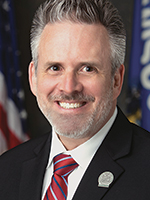
Rep. David Steffen
Sponsored bills
Maddy summaryAB 159 creates a grant program to support rural creative economy development in Wisconsin. It provides competitive grants of up to $50,000 to eligible applicants - including rural cities, tribes, nonprofits, and economic development organizations - for projects like renovating public spaces, supporting public arts, and promoting local creative businesses. Applicants must secure matching funds from nonstate sources (with no more than 25% in-kind), and grants must directly benefit rural areas defined as populations under 10,000 or non-urbanized regions. The Wisconsin Economic Development Corporation must report on the program's effectiveness by May 2027.
Maddy summaryAB 124 prohibits individuals convicted of a violent crime from changing their name, with violations punishable as a Class H felony. The bill amends existing state laws to explicitly block all name change requests - whether through court orders or vital records updates - for people with such convictions. This applies to all name change processes, including those for birth records, marriage records, or court-ordered changes. The law does not affect name changes for individuals without violent crime convictions.
Maddy summaryAB 40 establishes a competitive grant program to fund school safety improvements and security training for school personnel. It allocates $30 million for the 2025-26 fiscal year to public, private, and tribal schools, with a maximum grant of $20,000 per school. The program prioritizes schools that have not previously received similar grants under Section 165.88 and requires annual reports to the Joint Committee on Finance. Grants must be awarded by June 30, 2027, after which no new funding will be issued.
Maddy summaryAB 231 creates a 25% tax credit for film production companies in Wisconsin covering eligible expenses (like wages, equipment, and location costs) and capital investments for accredited productions. It directly affects film production companies operating in Wisconsin that meet minimum spending thresholds ($50,000 or $100,000 depending on production length) and excludes news, sports, or corporate content. The bill establishes a State Film Office to administer the program, requiring accredited productions to include a state acknowledgment in the final film and mandating annual reports on credit allocations. It caps annual tax credits at $10 million statewide and $1 million per company, with strict eligibility rules and third-party audit requirements to ensure compliance.
Maddy summaryAB 172 creates a new consumer data protection law by defining key terms like "personal data," "biometric data," "sale of personal data," and "consumer" in section 100.80 of the statutes. This bill directly affects businesses that collect or process personal data of state residents, requiring them to follow standardized handling practices for such data. The law includes penalty provisions for violations, though specific penalty amounts and enforcement details are not provided in the available bill text.
Maddy summaryAB 132 creates a "nuclear power summit board" to organize, promote, and host a Wisconsin nuclear power summit in Madison, requiring the event to occur within one month after a specific university academic term begins. The board includes appointed legislators (two senators, two assembly members), the Wisconsin Economic Development Corporation CEO, a governor-appointed member, and nonvoting industry/faculty representatives. It is funded through a dedicated appropriation from the Wisconsin Economic Development Corporation, with the summit allowing free attendance for Wisconsin residents and varying registration fees for others. The board must disband 180 days after the summit concludes, returning remaining assets to the University of Wisconsin-Madison's nuclear engineering program.
Maddy summaryAJR 6 is a symbolic resolution passed by the Wisconsin State Legislature declaring support for nuclear and fusion energy as critical clean energy sources. It states the legislature's commitment to advancing nuclear power, fusion technology, and related innovations to meet energy demands, reduce carbon emissions, and create high-paying jobs - citing current nuclear plants powering 1.2 million homes and avoiding 6.4 million tons of carbon emissions annually. The resolution does not create new laws or allocate funding but formally endorses expanding nuclear energy development. The bill was introduced in February 2025, referred to committees, and ultimately laid on the table in June 2025 without further action.
Maddy summaryAB 233 amends Wisconsin law to expand funding for child advocacy centers by adding two new recipients: the Lakeshore Regional Child Advocacy Center in Sheboygan County and a statewide "Child Advocacy Centers of Wisconsin" entity. It authorizes $17,000 annually per center for education, training, and quality assurance activities related to child maltreatment response. The bill directly affects existing centers (like those in Milwaukee, Kenosha, and Racine Counties) and the newly added entities by securing their grant funding from the Department of Justice’s existing appropriation. The policy change specifies concrete funding recipients and mechanisms without altering eligibility criteria for current centers.
Maddy summaryAB 108 requires the Public Service Commission to conduct a study identifying potential sites for nuclear power and fusion energy facilities, including advanced reactors, by a specific deadline. It also mandates that the Commission must make a final decision on applications for large nuclear facilities within 150 days of the application being deemed complete, or automatically approve the project. This directly affects applicants seeking permits for advanced nuclear power plants and the Commission's approval process. The bill aims to streamline approvals for new nuclear energy projects while establishing a formal study to identify suitable locations.