

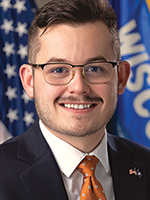
Photo of Calvin Callahan
R Wisconsin Assembly · District 35 On the 2026 ballot

Rep. Calvin Callahan

Compare
Total votes
579
all sessions
Attendance
99%
4 missed
Near the chamber average
With party
99%
of cast votes
Near the chamber average
Bipartisan score
0%
crosses aisle rarely
Near the chamber average
Sponsored
428
bills & resolutions
Near the chamber average
Committees
4
assignments
428 bills and resolutions

Sponsored bills

Total
428
Primary
428
Co-sponsor
0
This page
428
matching current filters
Primary AJR 1
Failed · Wisconsin Assembly · Lead sponsor
Relating to: requiring photographic identification to vote in any election (second consideration).

Maddy summaryAJR 1 is a constitutional amendment requiring voters to present valid photo identification to cast a ballot in any election. It directly affects all voters in state elections, specifying that acceptable ID must be issued by the state, federal government, a federally recognized tribal entity, or a college/university in the state. The bill mandates the legislature to define acceptable ID types and establish exceptions, while allowing voters without ID on election day to cast a provisional ballot and submit ID later. This proposal, on second consideration after a 2023 rejection, would be submitted to voters in April 2025 if approved.

Failed Mar 23, 2026 0 co-sponsors
Primary AJR 3
Failed · Wisconsin Assembly · Lead sponsor
Relating to: proclaiming January 2025 as Human Trafficking Awareness and Prevention Month in the state of Wisconsin.

Maddy summaryAJR 3 is a symbolic resolution that officially recognizes January 2025 as "Human Trafficking Awareness and Prevention Month" in Wisconsin. It does not create new laws or allocate funding but aims to raise public awareness about human trafficking, highlighting its prevalence across all 72 Wisconsin counties and its impact on vulnerable groups like youth and individuals with disabilities. The resolution aligns with broader state and national efforts to combat trafficking through education and community engagement. As a procedural resolution, it focuses solely on designation and awareness, with no direct policy changes or obligations for state agencies.

Failed Mar 23, 2026 0 co-sponsors
Primary AB 144
Failed · Wisconsin Assembly · Lead sponsor
Relating to: eliminating a judgeship from district IV of the court of appeals and establishing an additional judgeship for district III of the court of appeals.

Maddy summaryAB 144 reassigns judicial positions within the state's court of appeals system. It eliminates one judgeship in District IV (reducing its total from 4 to 3 judges) and adds one judgeship to District III (increasing its total from 4 to 5 judges). The change takes effect on August 1, 2026, with the District IV position ending on July 31, 2026, and a new District III judge elected in the spring 2026 election for a 2026-2032 term. This directly affects the court structures in Districts III and IV of the court of appeals.

Failed Mar 23, 2026 0 co-sponsors
Primary AB 21
Failed · Wisconsin Assembly · Lead sponsor
Relating to: technical colleges’ lease of their facilities to others. (FE)

Maddy summaryAB 21 amends a statute to prohibit technical college districts from leasing their facilities to others for non-school purposes, with one exception: leases for child care centers remain permitted. This bill directly affects public technical college districts by restricting their ability to generate revenue through facility rentals, limiting such leases to only those supporting child care operations. The key provision clarifies that districts cannot enter new leases after the bill's effective date, except for child care centers, which would continue to be allowed under the existing exception. The bill focuses on defining permissible lease arrangements without creating new programs or funding mechanisms.

Failed Mar 23, 2026 0 co-sponsors
Primary AB 46
Failed · Wisconsin Assembly · Lead sponsor
Relating to: flags flown at state and local government buildings and eliminating a related administrative rule.

Maddy summaryAB 46 restricts flag displays on state and local government properties to only the U.S. flag, state flag, POW/MIA flag (recognized by Congress), and military branch flags. It applies to all state agencies and political subdivisions (cities, towns, counties) that own or occupy government buildings. The bill allows exceptions only if the legislature passes a joint resolution with a three-fourths majority vote for state facilities or a local governing body votes with a three-fourths majority for municipal properties. It repeals an existing administrative rule and takes effect January 1, 2027.

Failed Mar 23, 2026 0 co-sponsors
Primary AJR 25
Failed · Wisconsin Assembly · Lead sponsor
Relating to: proclaiming April 24, 2025, to be Holocaust Remembrance Day and April 27, 2025, to May 4, 2025, as Holocaust Days of Remembrance in Wisconsin.

Maddy summaryAJR 25 is a joint resolution that formally proclaims April 24, 2025, as Holocaust Remembrance Day and April 27, 2025, to May 4, 2025, as Holocaust Days of Remembrance in Wisconsin. This resolution aims to raise public awareness throughout Wisconsin about the Holocaust and its impact on world history and shared humanity.

Failed Mar 23, 2026 0 co-sponsors
Primary AB 12
Failed · Wisconsin Assembly · Lead sponsor
Relating to: state agency status for certain physician assistants and advanced practice nurses who provide services without compensation for local health departments or school districts. (FE)

Maddy summaryAssembly Bill 12 grants "state agency status" to physician assistants and advanced practice nurse prescribers who volunteer their services. This status applies when they provide uncompensated healthcare services for local health departments or school districts. For local health departments, this covers services requiring medical oversight, and for schools, it includes immunization programs. By gaining state agency status, these providers would be considered agents of the Department of Health Services for specific legal protections, such as representation by the attorney general, provided they adhere to state protocols.

Failed Mar 23, 2026 0 co-sponsors
Primary AB 300
Failed · Wisconsin Assembly · Lead sponsor
Relating to: a grant program for the purchase of automated registration plate reader systems. (FE)

Maddy summaryAB 300 creates a state grant program to help local law enforcement agencies purchase automated license plate reader systems (high-speed cameras that scan plates and convert data for law enforcement use). The program requires at least half of the grant funds to go to agencies in rural areas (defined as cities/towns under 20,000 population, at least 15 miles from larger cities). Agencies must submit a spending plan to the Department of Justice for review before receiving grants, which are limited to public safety and crime prevention purposes. The bill does not apply to state-level agencies or require specific outcomes, focusing solely on funding access for local rural and urban law enforcement.

Failed Mar 23, 2026 0 co-sponsors
Primary AB 40
Failed · Wisconsin Assembly · Lead sponsor
Relating to: school safety grants and making an appropriation. (FE)

Maddy summaryAB 40 establishes a competitive grant program to fund school safety improvements and security training for school personnel. It allocates $30 million for the 2025-26 fiscal year to public, private, and tribal schools, with a maximum grant of $20,000 per school. The program prioritizes schools that have not previously received similar grants under Section 165.88 and requires annual reports to the Joint Committee on Finance. Grants must be awarded by June 30, 2027, after which no new funding will be issued.

Failed Mar 23, 2026 0 co-sponsors
Primary AB 231
Failed · Wisconsin Assembly · Lead sponsor
Relating to: creating a tax credit for expenses related to film production services and for capital investments made by a film production company, granting rule-making authority, and making an appropriation. (FE)

Maddy summaryAB 231 creates a 25% tax credit for film production companies in Wisconsin covering eligible expenses (like wages, equipment, and location costs) and capital investments for accredited productions. It directly affects film production companies operating in Wisconsin that meet minimum spending thresholds ($50,000 or $100,000 depending on production length) and excludes news, sports, or corporate content. The bill establishes a State Film Office to administer the program, requiring accredited productions to include a state acknowledgment in the final film and mandating annual reports on credit allocations. It caps annual tax credits at $10 million statewide and $1 million per company, with strict eligibility rules and third-party audit requirements to ensure compliance.

Failed Mar 23, 2026 0 co-sponsors
Showing 31 to 40 of 428 bills
Previous 1 … 3 4 5 … 43 Next