

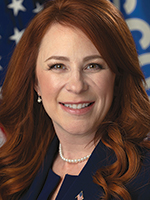
Photo of Amanda Nedweski
R Wisconsin Assembly · District 32 On the 2026 ballot

Rep. Amanda Nedweski

Compare
Total votes
425
all sessions
Attendance
100%
1 missed
Near the chamber average
With party
99%
of cast votes
Near the chamber average
Bipartisan score
0%
crosses aisle rarely
Near the chamber average
Sponsored
241
bills & resolutions
Near the chamber average
Committees
3
assignments
241 bills and resolutions

Sponsored bills

Total
241
Primary
241
Co-sponsor
0
This page
241
matching current filters
Primary AB 39
Vetoed · Wisconsin Assembly · Lead sponsor
Relating to: requiring state employees to perform their work at the offices of their employer.

Maddy summaryAB 39 requires most Wisconsin state employees to work at their agency's office for at least 80% of their regularly scheduled work hours each month. This applies to all state agencies, including departments and boards, but excludes employees whose duties were performed off-site before March 1, 2020, and staff from the investment board. The law mandates in-office work during standard hours, with exceptions for pre-pandemic remote work patterns. It takes effect on December 31, 2025, and does not apply to legislative or judicial staff.

Vetoed May 13, 2026 0 co-sponsors
Primary AB 457
Vetoed · Wisconsin Assembly · Lead sponsor
Relating to: the conditions under which a school district may adopt a resolution to exceed its revenue limit. (FE)

Maddy summaryAB 457 would allow California school districts to adopt resolutions exceeding their legally set revenue limits under specific, defined conditions. It directly affects school districts seeking flexibility to spend more than their allocated budget for certain needs, such as addressing unexpected costs or funding critical projects. The bill establishes clear criteria and procedures districts must follow to request and receive approval for exceeding revenue limits. Currently, the bill has passed the Education Committee and is pending further review by the Rules Committee, but it has not yet become law.

Vetoed May 13, 2026 0 co-sponsors
Primary AB 308
Vetoed · Wisconsin Assembly · Lead sponsor
Relating to: prohibiting funding for health services for unlawfully present individuals. (FE)

Maddy summaryAB 308 prohibits Wisconsin state and local government funds from being used to pay for health services for individuals without legal immigration status. The bill directly affects undocumented residents by blocking state/local funding for their healthcare. Key provisions ban state/local funds for such services (except where federal law requires payment or where applying the ban would cause loss of federal funds). The law does not restrict federal healthcare programs or funding. This is a policy change affecting state budget allocations, not a procedural measure.

Vetoed May 13, 2026 0 co-sponsors
Primary AB 602
Vetoed · Wisconsin Assembly · Lead sponsor
Relating to: participating in the federal tax credit program for contributions to scholarship granting organizations.

Maddy summaryAB 602 requires the state department to annually submit a list of qualifying scholarship granting organizations (SGOs) to the U.S. Treasury and certify the state's authority to participate in the federal tax credit program for donations to these organizations. It mandates that the governor must decide by July 1, 2026, whether to join this federal program, which would allow residents to claim tax credits for contributions to SGOs starting in 2027. The bill directly affects state administrative processes, scholarship organizations, and donors who may qualify for federal tax benefits. It does not create new tax credits but establishes the state's procedural framework for eligibility under existing federal law (26 USC 25F).

Vetoed May 13, 2026 0 co-sponsors
Primary AB 168
Vetoed · Wisconsin Assembly · Lead sponsor
Relating to: various changes to the unemployment insurance law. (FE)

Maddy summaryAB 168 would have updated Wisconsin's unemployment insurance law with several key changes. It required stronger identity verification for claimants filing benefits and operating a dedicated call center with extended hours during emergencies or high call volumes. The bill also mandated training materials for employers and required the unemployment department to notify lawmakers and the governor before changing fraud detection methods. This bill was vetoed by the governor on October 31, 2025, so these provisions did not become law.

Vetoed May 13, 2026 0 co-sponsors
Primary AB 595
Vetoed · Wisconsin Assembly · Lead sponsor
Relating to: compliance with the federal Help America Vote Act, voter registration data sharing agreements, removing ineligible voters from the official voter registration list, and fees for obtaining the official voter registration list. (FE)

Maddy summaryAB 595 updates Wisconsin's voter registration system to better comply with federal voting laws. It requires the Elections Commission to verify U.S. citizenship for all voters by matching registration data with state databases from the Department of Transportation, State Registrar, and Department of Corrections. Municipal clerks must report monthly on voter status changes, including removals due to citizenship issues, and share audit results with election officials. The bill directly affects election administrators, state agencies handling voter data, and voters whose eligibility is verified through these new processes.

Vetoed May 13, 2026 0 co-sponsors
Primary AB 918
Signed into law · Wisconsin Assembly · Lead sponsor
Relating to: required subjects in a human growth and development instructional program. (FE)

Maddy summaryAB 918 amends Wisconsin statute 118.019(2m)(e) to require public schools to include specific topics in human growth and development curriculum. The bill mandates instruction on adoption, parental responsibility, and the socioeconomic benefits of marriage for adults and children. This directly affects K-12 schools developing or updating their human growth curriculum. The change adds these three subjects to the existing required content without altering other curriculum elements. The bill was introduced in January 2026 and referred to the Children and Families committee.

Signed into law Apr 9, 2026 0 co-sponsors
Primary AB 964
Signed into law · Wisconsin Assembly · Lead sponsor
Relating to: Internet crimes against children administrative subpoenas for the crime of sexual extortion when the crime victim is a child. (FE)

Maddy summaryAB 964 clarifies that online sexual extortion targeting children falls under existing law by specifying it as a violation of Section 942.095 when the victim is a child (as defined in Section 948.01). This bill directly affects law enforcement agencies investigating internet crimes against children, enabling them to issue administrative subpoenas to internet companies for relevant data without a court order. The key provision streamlines the process for obtaining evidence from online platforms in cases where children are victims of sexual extortion. It does not create new penalties but ensures these cases are explicitly covered under current statutes for investigative efficiency.

Signed into law Apr 9, 2026 0 co-sponsors
Primary AB 984
Failed · Wisconsin Assembly · Lead sponsor
Relating to: requirements for the use of a memory care designation by community-based residential facilities. (FE)

Maddy summaryAB 984 sets new standards for community-based residential facilities that use the "memory care" designation in their name, advertising, or communications. It requires these facilities to serve only individuals with irreversible dementia (like Alzheimer’s) and to provide mandatory staff training on dementia care. The training must cover dementia basics, person-centered care, communication techniques, non-drug behavioral interventions, and supporting residents’ independence - both for initial hiring and annually thereafter. These requirements take effect July 1, 2027, with existing facilities needing compliance by that date to continue using the designation.

Failed Apr 7, 2026 0 co-sponsors
Primary AB 910
Passed · Wisconsin Assembly · Lead sponsor
Relating to: the amounts of fines and fees state agencies are authorized or required to impose by law. (FE)

Maddy summaryAB 910 requires state agencies to adjust fines and fees for inflation every three years. Agencies must report current amounts, calculate inflation-adjusted values using the consumer price index, and recommend whether to increase, decrease, or maintain fees based on inflation. This applies to all state agencies collecting fees for services or penalties (like driver’s license fees or permit charges), affecting individuals who pay these fees. Agencies can spread increases over up to four years and must consider their service costs when recommending changes. The bill establishes a regular process to keep fee levels aligned with inflation, rather than allowing them to become outdated.

Passed Apr 6, 2026 0 co-sponsors
Showing 11 to 20 of 241 bills