

Maddy summaryAB 578 ensures Wisconsin continues providing WIC (Women, Infants, and Children) food benefits during federal government shutdowns. It requires the state to fund these benefits at pre-shutdown levels until federal funding is restored under federal law. The bill directly affects WIC participants - mothers, infants, and young children - who rely on these nutrition services. It creates a state funding mechanism to prevent benefit disruptions during federal funding lapses, such as the October 2025 shutdown referenced in the bill. The policy change takes effect immediately but includes a repeal provision for October 2026.
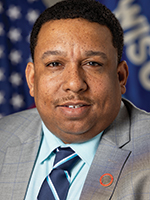
Rep. Russell Goodwin
Sponsored bills
Maddy summaryAB 571 creates a statewide Parkinson’s disease registry to collect and track health data on Parkinson’s disease and related conditions (like multiple system atrophy). Health care providers must report anonymized patient data - including diagnosis, treatment, outcomes, and demographics - to the University of Wisconsin-Madison for storage and analysis. The registry will generate annual public reports on disease incidence, prevalence, and trends via a dedicated website, with strict privacy safeguards (e.g., coded data, IRB-approved research access). This affects health care facilities, providers, and patients, but does not impose new costs or treatment requirements.
Maddy summaryAB 598 allows patient representatives to consent to health care facility admissions for incapacitated individuals without requiring a court-appointed guardian or protective placement petition. The bill creates a defined "patient representative" role, requiring two medical professionals (e.g., two physicians or one physician plus an advanced practice clinician) to certify incapacity based on medical need - not age, disability, or eccentricity. Patient representatives gain authority to make health care decisions, enroll individuals in Medical Assistance, and authorize health care expenses similar to a guardian, but only for non-developmental disability and non-mental illness cases. This change streamlines admissions for incapacitated patients while mandating 72-hour notifications to county agencies about the certification.
Maddy summaryAB 78 modifies Wisconsin law regarding vehicle impoundment for reckless driving offenses. It gives law enforcement officers discretion to impound vehicles used in certain reckless driving cases, rather than requiring mandatory impoundment. The bill directly affects drivers convicted of qualifying reckless driving offenses and law enforcement officers who decide whether to impound a vehicle. This change, now part of 2025 Wisconsin Act 46, alters the standard procedure for handling such vehicles.
Maddy summaryAJR 91 is a ceremonial joint resolution recognizing the U.S. Navy's 250th birthday on October 13, 2025, marking the anniversary of the Continental Congress vote to establish the Navy on October 13, 1775. It expresses the Wisconsin Legislature's appreciation for the Navy's historical service and its legacy of defending U.S. freedoms, values, and interests over 250 years. The resolution has no binding effect or policy changes; it solely serves to honor the Navy's history and its connections to Wisconsin through shipbuilding, named vessels, and military contributions.
Maddy summaryAJR 99 is a symbolic resolution recognizing October 14, 2025, as "First Responders Appreciation Day" in Wisconsin. It does not create new laws or policies but formally honors all professional and volunteer first responders, including police, firefighters, and emergency medical personnel. The resolution acknowledges their daily risks and service to the public, specifically noting Wisconsin's over 4,800 career firefighters, 20,600 volunteer firefighters, 14,700 law enforcement officers, and 17,426 EMS personnel. This is a non-binding gesture of appreciation with no direct impact on legislation or funding.
Maddy summaryAJR 59 is a ceremonial resolution proclaiming June as Dairy Month in Wisconsin. It recognizes the state's long-standing dairy heritage, including its role as a national leader in dairy production since the 1800s, the $45.6 billion annual economic contribution of the industry, and the work of over 6,000 dairy farms. The resolution does not create new laws or regulations but formally honors Wisconsin's dairy farmers and industry as a key part of the state's identity. It directly affects Wisconsin residents by highlighting the industry's historical and economic significance during June. This resolution was passed by the legislature in June 2025.
Maddy summaryAJR 47 is a symbolic resolution declaring May as Eye Health Awareness Month in Wisconsin. It does not create new laws or programs but formally recognizes the importance of eye health and encourages proactive measures. The resolution urges Wisconsin residents to prioritize eye exams, use protective measures like sunglasses, and learn about eye conditions, while calling on organizations to support related education and resources. This is a non-binding observance aimed at raising public awareness, not a policy with enforcement mechanisms.
Maddy summaryAJR 66 is a symbolic resolution congratulating Southwest Wisconsin Technical College (SWTC) for winning the 2025 Aspen Prize for Community College Excellence. The resolution recognizes SWTC’s national recognition as the top two-year college in the U.S., highlighting its success in student outcomes - especially for underserved groups - and its strong employer partnerships and teaching practices. It does not create new laws, provide funding, or alter policies; it solely expresses the Wisconsin legislature’s commendation to SWTC, its staff, students, and community partners. The resolution directly affects SWTC by formally honoring its achievement, with no broader impact on state law or other institutions.
Maddy summaryAssembly Joint Resolution 29 celebrates May 7, 2025, as Skilled Trades Day in Wisconsin. This resolution acknowledges the importance of skilled trades workers and the state's apprenticeship programs within the construction industry.