

Maddy summaryAB 633 grants Devil’s Lake State Park in Baraboo, Wisconsin, specific legal rights, including the right to clean water, natural ecosystems, and freedom from harmful activities. The bill prohibits state agencies, businesses, and government entities from infringing these rights, requiring agencies to review and adjust policies within one year and complete full park restoration within five years. Violations carry $1,000 fines per offense, and damages must fund park restoration via the conservation fund. It also allows individuals to sue to enforce these rights, with courts prioritizing ecological restoration over scientific uncertainty.
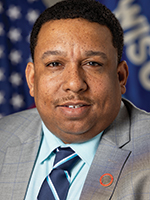
Rep. Russell Goodwin
Sponsored bills
Maddy summaryAJR 114 is a non-binding resolution recognizing nature's inherent rights - including the right to exist, flourish, and regenerate - and affirming Wisconsin's duty to protect these rights as part of its conservation legacy. It calls for exploring policies to implement "rights of nature" principles, engaging Indigenous communities and experts, and encourages local governments and agencies to adopt such approaches. The resolution does not create new laws but urges future legislative action and collaboration to address environmental challenges like climate change and biodiversity loss.
Maddy summaryAB 322 designates the monarch butterfly as Wisconsin's official state butterfly. The bill adds a specific statutory provision (1.10(3)(w)) stating "The monarch butterfly is the state butterfly" and amends another section to include "butterfly" in the list of symbols featured in the Wisconsin Blue Book. This symbolic designation directly affects all Wisconsin residents by formally recognizing the monarch butterfly as a state emblem. The bill does not create new regulations or impact any policies - its sole purpose is to establish a ceremonial state symbol.
Maddy summaryAB 410 provides state funding through grants to community organizations for falls prevention awareness programs and initiatives. It directly affects local health agencies, senior service providers, and community groups working with at-risk populations, particularly older adults. The bill establishes a specific appropriation from the state budget to support these prevention efforts. This is a funding measure, not a regulatory change, and focuses on allocating resources for education and outreach programs.
Maddy summaryAB 600 establishes new rules for faculty tenure and probationary appointments at University of Wisconsin System institutions. It defines "probationary appointments" as temporary positions (capped at 7 consecutive academic years, excluding approved leaves) and "tenure appointments" as permanent roles. The bill requires tenure decisions to follow a multi-step process: a chancellor's recommendation, a committee review if the academic department rejects tenure, and adherence to board-defined rules prohibiting discriminatory or irrelevant factors in decisions. It also clarifies that tenure is institution-specific and mandates procedural safeguards, including due process for dismissals, for both tenured and probationary faculty.
Maddy summaryAB 591 modifies Wisconsin's fee remission program for veterans and their dependents enrolled in the University of Wisconsin System or technical colleges. It removes outdated provisions (like sections 36.27 (3n) (bm) 2. and 39.50 (3m)) and clarifies that the state will reimburse institutions for waived tuition and fees, with proration if funds are insufficient. This directly affects veterans and dependents who qualify for fee waivers, ensuring they receive proportional reimbursement when state funds fall short. The changes take effect for students enrolled in Fall 2026.
Maddy summaryAB 608 allocates $10 million annually for two years (2025-26 and 2026-27) to support student success and retention programs at University of Wisconsin System institutions and Wisconsin technical colleges. The funding, designated as a continuing appropriation, directly supports institutions in enhancing academic advising and other retention-focused initiatives. It creates new statutory provisions to channel these funds through the University of Wisconsin System and technical college district boards. The bill does not establish new programs but provides dedicated annual funding for existing student support efforts at these public institutions.
Maddy summaryAB 513 modifies Wisconsin law to clarify procedures for employment discrimination cases involving unfair honesty testing or genetic testing. It allows individuals or the department to file civil lawsuits in circuit court within 300 days of an alleged violation, with courts able to award compensatory damages and punitive damages up to specific caps based on employer size (e.g., $50,000 for businesses with ≤100 employees). The bill also establishes a process for automatic annual adjustments to these damage caps using the consumer price index. It ensures complainants receive clear notices about their right to pursue legal action after administrative decisions.
Maddy summaryAB 583 helps people wrongfully imprisoned in Wisconsin by providing them with tax-exempt compensation, health coverage, and transition support. It exempts state compensation payments for wrongful imprisonment from state income tax, covers health insurance premiums (with shared costs), and requires a 5-day transition plan for released individuals to access housing, job help, and healthcare. The bill creates new funding mechanisms (like appropriations under 20.515) to pay for these benefits and mandates state agencies to coordinate with counties on post-release support. It directly affects individuals who receive state compensation under wrongful imprisonment claims (s. 775.05) and the state budget.
Maddy summaryAB 593 amends Wisconsin statutes to clarify and strengthen collective bargaining processes for University of Wisconsin System employees covered by union contracts. It requires pay increases to align with existing compensation plans or collective bargaining agreements, prohibits closed-session negotiations for finalizing agreements, and updates funding mechanisms for grievance arbitrations and training. The bill directly affects UW System employees in unionized positions and their bargaining representatives. Key provisions include revised rules for pay adjustments, transparency in negotiation procedures, and specific appropriations for dispute resolution services under existing labor laws.