

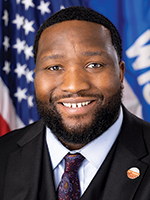
Photo of Darrin Madison
D Wisconsin House · District 10 On the 2026 ballot

Rep. Darrin Madison

Compare
Total votes
423
all sessions
Attendance
99%
3 missed
Near the chamber average
With party
86%
of cast votes
Near the chamber average
Bipartisan score
7%
crosses aisle rarely
Near the chamber average
Sponsored
709
bills & resolutions
Near the chamber average
Committees
4
assignments
709 bills and resolutions

Sponsored bills

Total
709
Primary
709
Co-sponsor
0
This page
709
matching current filters
Primary AB 854
Failed · Wisconsin House · Lead sponsor
Relating to: violence prevention grants and making an appropriation. (FE)

Maddy summaryAB 854 creates a grant program funded by taxes on vapor products to support violence prevention efforts. It directs $30,000 for fiscal year 2025-26 and $120,000 for 2026-27 toward local health departments or tribal health centers. These entities can use the funds to run violence prevention programs or award grants to community organizations, but they cannot distribute money to law enforcement agencies or any groups working with them. The bill specifies that applications for these grants must be submitted by June 30 each year.

Failed Apr 9, 2026 0 co-sponsors
Primary AB 1168
Failed · Wisconsin House · Lead sponsor
Relating to: medical debt abolition and making an appropriation. (FE)

Maddy summaryThis bill establishes a program to eliminate medical debt for eligible Wisconsin residents by creating a $10 million annual appropriation for the Department of Health Services to purchase and cancel outstanding medical bills. To qualify, residents must either have household income at or below 400 percent of the federal poverty line or owe medical debt equal to at least 5 percent of their annual household income. The department will identify eligible individuals, negotiate with healthcare providers and debt collectors to buy their outstanding balances, and then formally abolish the debt while minimizing tax consequences for recipients. The program prioritizes purchasing debt from providers serving low-income populations and those in areas disproportionately affected by medical debt, with annual reporting required to track the number of debts eliminated and demographic information of affected residents.

Failed Apr 8, 2026 0 co-sponsors
Primary AB 916
Failed · Wisconsin House · Lead sponsor
Relating to: a home repair program and making an appropriation. (FE)

Maddy summaryAB 916 creates a state-funded home repair program to address habitability issues and improve energy efficiency in affordable housing. It provides grants of up to $25,000 per unit to eligible homeowners (income ≤100% of area median income who own or occupy their homes) and interest-free loans of up to $25,000 to eligible landlords (owning ≤5 properties/15 units of affordable housing). The program prioritizes repairs for homes with health/safety hazards, energy efficiency upgrades, and accessibility improvements for individuals with disabilities or young children. Properties must be between 10 and 40 years old to qualify, and funds are administered by the state authority or contracted counties/nonprofits with strict reporting requirements.

Failed Apr 7, 2026 0 co-sponsors
Primary AB 1044
Failed · Wisconsin House · Lead sponsor
Relating to: grants for patient lift devices and making an appropriation. (FE)

Maddy summaryAB 1044 creates a state grant program allocating $300,000 for the 2025-26 fiscal year to help adult family homes, community-based residential facilities, nursing homes, and residential care apartment complexes purchase patient lift devices. These devices must be state-approved, allow independent or staff-assisted operation, and mechanically lift a person. Facilities receiving grants must report usage data, with up to $100,000 of the appropriation reserved for collecting and analyzing this information.

Failed Apr 6, 2026 0 co-sponsors
Primary AB 722
Failed · Wisconsin House · Lead sponsor
Relating to: large energy customer fees; electric utility very large customer class; a renewable resource tariff; building requirements for data centers; water usage by large customers; required pay rate on large-scale data center projects; and granting rule-making authority. (FE)

Maddy summaryAB 722 imposes annual fees on large energy customers in Wisconsin based on their peak electricity demand, starting at $2 million for those using 100-250 megawatts and increasing by $1 million for each additional 250-megawatt increment. Fifty percent of these fees will fund the Green Innovation Fund, managed by the Wisconsin Economic Development Corporation. The bill also requires data centers to report annual water usage to local governments, certify adherence to sustainable building standards (like LEED or BREEAM) within three years of operation, and pay workers the prevailing wage rate for large-scale construction projects exceeding $250 million in cost. These provisions directly affect large energy users, data center operators, and local governments managing water reporting.

Failed Apr 6, 2026 0 co-sponsors
Primary AB 785
Failed · Wisconsin House · Lead sponsor
Relating to: a percentage of income payment program for electricity and gas service, electricity and gas service disconnections, granting rule-making authority, and making an appropriation. (FE)

Maddy summaryAB 785 establishes a program to cap electricity and gas costs at 2% of a household's annual income for energy burdened households (spending 2-4% of income on utilities) and severely energy burdened households (spending 4% or more, or having no income with utility bills). It prohibits utility disconnections for residential customers with income up to 300% of the federal poverty level due to nonpayment and creates an "energy burden relief fund" to finance the program. The bill requires automatic enrollment for eligible households, an online application portal, and annual reporting by the Public Service Commission on program administration and barriers to participation.

Failed Apr 6, 2026 0 co-sponsors
Primary AB 1218
Failed · Wisconsin House · Lead sponsor
Relating to: preventing surprise bills for emergency medical services and other items and services under health insurance policies and plans. (FE)

Maddy summaryThis bill aims to protect health insurance enrollees from unexpected medical bills by establishing rules for how insurance plans must handle emergency care and services provided by out-of-network providers. It requires insurance plans to cover emergency medical services without requiring prior authorization and ensures that cost-sharing amounts for out-of-network emergency care are no higher than what would apply for in-network care. Additionally, the bill mandates that plans pay out-of-network providers directly for emergency services and certain non-emergency services provided at in-network facilities, preventing patients from being billed for the difference between the out-of-network rate and the recognized amount. These provisions apply to defined network plans, preferred provider plans, and self-insured governmental plans that have networks of participating providers.

Failed Mar 30, 2026 0 co-sponsors
Primary AB 1109
Failed · Wisconsin House · Lead sponsor
Relating to: use of artificial intelligence to deny prior authorization for medical necessity or experimental status.

Maddy summaryThis bill prohibits disability insurance policies and self-insured health plans from using artificial intelligence to deny prior authorization requests for medical necessity or experimental treatments. Instead, it requires that a licensed human healthcare provider must review these specific requests before any denial can occur. The law applies to limited service health organizations, preferred provider plans, and defined network plans, with exceptions for plans covered by collective bargaining agreements. If passed, the restrictions would take effect at the start of the fourth month following the bill's publication.

Failed Mar 30, 2026 0 co-sponsors
Primary AB 1217
Failed · Wisconsin House · Lead sponsor
Relating to: prior authorization transparency, exemptions from prior authorization requirements, and granting rule-making authority. (FE)

Maddy summaryThis bill requires health care plans to publicly disclose their prior authorization requirements on their websites in plain language, making it easier for patients and providers to understand which services need approval before being covered. It mandates that plans maintain complete lists of required authorizations, including when rules began and ended, and ensures clinical review criteria are based on nationally recognized, evidence-based standards. The legislation also grants the state insurance commissioner authority to create rules regarding prior authorization exemptions and establishes protections against claim denials when prior authorization rules change after services are already provided.

Failed Mar 30, 2026 0 co-sponsors
Primary AB 1155
Failed · Wisconsin House · Lead sponsor
Relating to: protection of pregnant individuals’ information, authorization for disclosure, data breach, and providing a penalty.

Maddy summaryThis bill requires unregulated pregnancy centers to obtain written authorization from individuals before disclosing their personal health information, with specific requirements for what the authorization must include and how long it remains valid. The law defines unregulated pregnancy centers as facilities that do not provide abortions or emergency contraception and are not covered by existing medical privacy laws, while also establishing rules for when information can be shared without consent, such as for legal compliance or law enforcement cooperation. Centers must notify individuals if their health data is breached and face penalties for violating these privacy protections, while also being prohibited from discriminating against people who refuse to authorize information sharing. The bill creates a new section in the state statutes to establish these requirements and specifies that the law takes effect three months after publication.

Failed Mar 30, 2026 0 co-sponsors
Showing 11 to 20 of 709 bills