

Maddy summaryAB 974 establishes a permanent "public affairs network fund" to provide annual grants to WisconsinEye, the public affairs network broadcasting state government proceedings. The bill creates a new trust fund using state appropriations, donations, and interest earnings, which will fund WisconsinEye’s operating costs for live broadcasts, civic events, and free online archives of unedited government proceedings. WisconsinEye must meet specific requirements, including appointing legislative designees to its board, focusing coverage on official government business, and providing continuous free public access to broadcasts and archives. If WisconsinEye ceases operations, it must repay all grant funds to the state and transfer its archives to the state historical society.
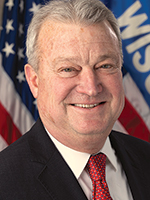
Rep. Joel Kitchens
Sponsored bills
Maddy summaryAB 817 increases the state reimbursement for certified veteran organizations providing military funeral honors from $50 to $100 per funeral. It directly affects local veteran groups certified by the department to perform these honors. The bill amends statute 45.60(2) to allow this higher reimbursement amount from a specific state fund, covering costs incurred by these organizations. The change applies to all military funerals in the state where honors are provided.
Maddy summaryAB 701 adopts the Uniform Public Expression Protection Act to shield individuals and organizations from lawsuits targeting their speech on matters of public concern. It creates a "special motion" allowing defendants to quickly dismiss such cases within 60 days of being sued, with the court requiring the plaintiff to prove their claim has merit. The law specifically protects speech in government proceedings, political expression, or press freedoms, but excludes lawsuits by/against government entities or commercial speech related to sales. This applies to civil suits where the core issue involves public discourse, not private business disputes.
Maddy summaryAB 752 makes it a Class H felony to use an absentee ballot drop box, U.S. mail, or commercial carrier while committing election fraud under existing law (s. 12.13). The bill directly affects individuals who attempt to fraudulently submit absentee ballots through these specific methods. Its key provision increases penalties for this type of fraud by classifying it as a felony rather than a lesser offense. The law focuses solely on the method of submission during fraudulent activity, not on the act of voting itself.
Maddy summaryAB 720 requires health insurance plans - including defined network plans, preferred provider plans, and government self-insured plans - to cover emergency ambulance services provided by non-participating ambulance providers. It mandates payment at the lowest of three rates: a mutually agreed rate, a local governmental rate, or 350% of the Medicare rate for the same area. Plans must pay ambulance providers directly within 30 days for clean claims, cannot impose additional costs on enrollees beyond standard cost-sharing, and must provide clear explanations for denied claims. The bill excludes air ambulance services and applies to all health insurance plans covering emergency medical services.
Maddy summaryAB 704 increases fees for snowmobile registration and trail use stickers in Wisconsin. It raises the public-use registration fee from $30 to $45 (with a $5 fee for political subdivisions), keeps private-use registration fee-free, and increases trail sticker fees: from $49.25 to $69.25 for exempt snowmobiles, $9.25 to $19.25 for club members meeting specific criteria, and $29.25 to $49.25 for others. The bill directly affects snowmobile owners who register their vehicles or use public trails. Key provisions include standardized fee increases and a reduced rate for members of qualifying snowmobile clubs.
Maddy summaryAB 702 creates a new income tax credit for individuals incurring unreimbursed medical expenses related to in vitro fertilization (IVF), directly affecting those who pay for IVF consultations, procedures, or prescribed drugs out-of-pocket. The credit allows a maximum $5,000 annual reduction against state income tax for eligible individuals with adjusted gross income under $100,000 (single) or $200,000 (joint filers). It excludes expenses covered by insurance, travel, lodging, or health savings accounts, and prohibits claiming the same expenses under other tax provisions. The credit must be claimed using forms provided by the state tax department when filing annual returns.
Maddy summaryAB 709 amends Wisconsin state law to clarify rules for school transportation services, primarily affecting schools, school bus contractors, and emergency transportation providers. It allows school boards to request temporary emergency transportation for 15+ students when regular service isn't available, requiring written approval from the state transportation secretary. The bill also updates insurance requirements: vehicles carrying 9-14 students (not owned/leased by schools) must carry $10,000 property damage and $25,000 per person bodily injury coverage. These changes standardize emergency procedures and ensure minimum insurance coverage for non-school-operated transportation.
Maddy summaryAJR 1 is a constitutional amendment requiring voters to present valid photo identification to cast a ballot in any election. It directly affects all voters in state elections, specifying that acceptable ID must be issued by the state, federal government, a federally recognized tribal entity, or a college/university in the state. The bill mandates the legislature to define acceptable ID types and establish exceptions, while allowing voters without ID on election day to cast a provisional ballot and submit ID later. This proposal, on second consideration after a 2023 rejection, would be submitted to voters in April 2025 if approved.
Maddy summaryAJR 3 is a symbolic resolution that officially recognizes January 2025 as "Human Trafficking Awareness and Prevention Month" in Wisconsin. It does not create new laws or allocate funding but aims to raise public awareness about human trafficking, highlighting its prevalence across all 72 Wisconsin counties and its impact on vulnerable groups like youth and individuals with disabilities. The resolution aligns with broader state and national efforts to combat trafficking through education and community engagement. As a procedural resolution, it focuses solely on designation and awareness, with no direct policy changes or obligations for state agencies.