

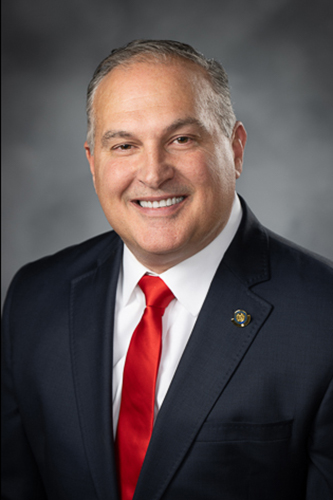
Photo of Brian Helton
R West Virginia Senate · District 9

Sen. Brian Helton

Compare
Total votes
799
all sessions
Attendance
97%
27 missed
Lower than 87% of chamber peers
With party
99%
of cast votes
Higher than 79% of chamber peers
Bipartisan score
0%
crosses aisle rarely
Lower than 89% of chamber peers
Sponsored
232
bills & resolutions
Near the chamber average
Committees
15
assignments
232 bills and resolutions

Sponsored bills

Total
232
Primary
79
Co-sponsor
153
This page
232
matching current filters
Co-sponsor SB 531
Vetoed · West Virginia Senate · Co-sponsor
Relating to offenses of assault and battery on athletic officials

Maddy summaryThis bill increases penalties for assaulting or battering athletic officials or participants in West Virginia. It classifies such acts as misdemeanors with specific fines ($250-$500 for assault, $500-$1,000 for battery) and jail terms (5-6 months for assault, 10-12 months for battery). School boards can ban convicted offenders from all school sports events for at least one year, requiring written notice of the ban. Violating this ban is treated as trespassing under existing law.

Vetoed Apr 30, 2025 1 co-sponsor
Co-sponsor SB 722
Vetoed · West Virginia Senate · Co-sponsor
Creating WV Short Line Railroad Modernization Act

Maddy summarySB 722 creates a tax credit program for West Virginia short line railroads (Class II or III railroads or rail siding owners) to fund infrastructure improvements. Eligible companies can claim a 50% tax credit for qualified maintenance costs (capped at $5,000 per mile of track) or new infrastructure projects (capped at $2 million per project or $5 million annually). Credits can be used against state taxes, carried forward for up to five years, or transferred to other taxpayers. The bill directly affects rail operators in West Virginia seeking to modernize tracks, sidings, or safety infrastructure.

Vetoed Apr 30, 2025 1 co-sponsor
Primary SB 748
Failed · West Virginia Senate · Lead sponsor
Creating Safer Communities Act

Maddy summarySB 748, the Creating Safer Communities Act, allows West Virginia counties to levy a public safety sales or amusement tax (capped at 1% of the purchase price) to fund public safety, school safety, and emergency response services. Counties must first hold a voter referendum at the next general election, requiring a simple majority vote for approval, and any rate change requires a new referendum. The bill mandates specific ballot language, advance notice of the referendum, and requires funds to be dedicated exclusively to designated services like school resource officers and emergency medical services. This legislation directly affects counties seeking to address public safety funding gaps through voter-approved local taxes.

Failed Apr 13, 2025 0 co-sponsors
Primary SCR 18
Passed · West Virginia Senate · Lead sponsor
Recognizing intent to create WV Coal Renaissance Act

Maddy summaryThis concurrent resolution (SCR 18) recognizes the West Virginia Legislature's intent to create the "West Virginia Coal Renaissance Act" but does not enact new law. It directs state agencies (like the Department of Commerce and Public Service Commission) to develop strategies for increasing coal usage in state power plants, including optimizing plant operations, preventing premature closures, and supporting coal production. The resolution specifically targets coal-fired electric utilities and plants, aiming to reverse years of declining coal use by aligning state policy with federal energy priorities under the Trump administration. It focuses on planning and coordination (e.g., quarterly progress reports) rather than mandating immediate policy changes.

Passed Apr 12, 2025 0 co-sponsors
Primary SB 503
Failed · West Virginia Senate · Lead sponsor
Allowing sheriffs to appoint more than one chief deputy with consent of county commission

Maddy summarySB 503 allows West Virginia sheriffs to appoint more than one chief deputy, provided the county commission consents. This change directly affects sheriffs and county commissions, who must now approve such appointments. The bill removes previous restrictions that limited sheriffs to a single chief deputy, addressing staffing needs in larger counties. It does not alter political restrictions for chief deputies or firearm rules for conservators, which are separate provisions in the bill.

Failed Apr 12, 2025 0 co-sponsors
Co-sponsor SR 50
Passed · West Virginia Senate · Co-sponsor
Requesting federal government study waterway restoration to mitigate existing and future flooding

Maddy summarySenate Resolution 50 is a non-binding request to the federal government to study and implement waterway restoration projects in West Virginia. The resolution specifically asks federal agencies to evaluate and act on debris removal, river bed stabilization, and restoration of natural water flow patterns to address existing flooding damage and prevent future flooding. It was prompted by historic flooding in West Virginia during winter and spring 2025, which left streams and rivers filled with debris that continues to damage property and infrastructure. The resolution requests federal action to mitigate these issues and reduce future recovery costs. This resolution is addressed to President Donald J. Trump and Elon Musk, in his alleged capacity as a special government employee.

Passed Apr 12, 2025 1 co-sponsor
Co-sponsor SCR 27
Passed · West Virginia Senate · Co-sponsor
Requesting Joint Committee on Government and Finance study sale of alcohol

Maddy summarySCR 27 is a request for the Joint Committee on Government and Finance to study West Virginia's alcohol sales regulations. The bill asks the committee to examine current rules (many dating to the 1930s) that govern alcohol sales, distribution, and consumption. The study will assess whether these regulations are efficient, modern, and effective, considering input from businesses, consumers, health professionals, and law enforcement. The committee must report its findings and recommendations to the 2026 legislative session.

Passed Apr 12, 2025 1 co-sponsor
Co-sponsor SCR 26
Passed · West Virginia Senate · Co-sponsor
Requesting Joint Committee on Government and Finance study smoke shops

Maddy summarySenate Concurrent Resolution 26 directs the Joint Committee on Government and Finance to study smoke shops in West Virginia, focusing on products they sell, health risks, and sales to minors. The resolution specifically asks the committee to examine both legal and illegal tobacco, nicotine, CBD, kratom, and cannabis products, including their compliance with federal safety guidelines. The committee will assess how illegal products enter the state and their sources, with a report due to the 2026 legislative session. This study aims to inform potential regulatory changes regarding these products without proposing new laws. The resolution does not make policy changes but requests a comprehensive examination to address safety concerns.

Passed Apr 12, 2025 1 co-sponsor
Co-sponsor SB 592
Passed · West Virginia Senate · Co-sponsor
Relating generally to aboveground storage tanks

Maddy summaryThis bill exempts small oil and gas-related tanks (210 barrels or less capacity) not located in high-risk "zones of critical concern" from most regulatory requirements, including third-party inspections. It requires owners of tanks in high-risk zones to perform monthly secondary containment inspections and self-certify annually instead of using third-party inspectors. The bill also prevents regulators from mandating physical tank modifications for leak detection without confirmed leaks. These changes primarily affect oil/gas operators and coal mining sites using such tanks.

Passed Apr 11, 2025 1 co-sponsor
Primary SB 939
Passed · West Virginia Senate · Lead sponsor
Relating to testing for substance use disorder

Maddy summarySB 939 requires medication-assisted treatment (MAT) facilities in West Virginia to implement a specific drug testing schedule for patients with substance use disorder. Upon admission, patients must undergo a comprehensive drug test, followed by direct observation tests every two weeks for six weeks, then every 45 days for one year, and every six months after that. Facilities must also allow providers to request tests at any time to assess treatment compliance. This bill directly affects patients in MAT programs and the facilities providing these services, establishing clear, time-based testing protocols to monitor treatment adherence.

Passed Apr 11, 2025 0 co-sponsors
Showing 121 to 130 of 232 bills
Previous 1 … 12 13 14 … 24 Next