

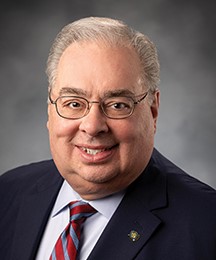
Photo of Kevan Bartlett
R West Virginia Senate · District 8

Sen. Kevan Bartlett

Compare
Total votes
799
all sessions
Attendance
95%
36 missed
Lower than 76% of chamber peers
With party
97%
of cast votes
Near the chamber average
Bipartisan score
1%
crosses aisle rarely
Near the chamber average
Sponsored
118
bills & resolutions
Lower than 76% of chamber peers
Committees
12
assignments
118 bills and resolutions

Sponsored bills

Total
118
Primary
7
Co-sponsor
111
This page
118
matching current filters
Co-sponsor SB 602
In committee · West Virginia Senate · Co-sponsor
Requiring repeat DUI offenders to carry ID indicating they may not purchase alcohol

Maddy summarySB 602 requires repeat DUI offenders in West Virginia to carry a special identification card indicating they are prohibited from purchasing alcohol. The card must feature a prominent red stripe and the words "No Alcohol Sale" on its front. This applies to individuals identified as "interdicted persons" under the law, meaning those legally barred from alcohol sales due to DUI convictions. The bill establishes the card's design, application process, and enforcement mechanisms for businesses to verify compliance. It does not change DUI penalties but creates a new identification requirement for affected individuals.

In committee Jan 27, 2026 1 co-sponsor
Co-sponsor SB 522
In committee · West Virginia Senate · Co-sponsor
Creating WV Jobs Protection Act

Maddy summarySB 522, the West Virginia Jobs Protection Act, requires all employers in West Virginia - including businesses, government agencies, and contractors - to use the federal E-Verify system to confirm the work authorization of every new hire within three business days of their start date. This applies to all employers regardless of size, with violations subject to fines of $5,000-$15,000 per unauthorized worker, license suspension, or loss of state contracts. Employers must enroll in E-Verify and begin compliance by July 1, 2026, and retain verification records for at least three years. The law aims to ensure all employees have legal work authorization under federal law, with the West Virginia Division of Labor overseeing enforcement and reporting compliance data annually.

In committee Jan 20, 2026 1 co-sponsor
Co-sponsor SCR 2
In committee · West Virginia Senate · Co-sponsor
Supporting practices of freedom of religion in public spaces

Maddy summarySCR 2 is a symbolic Senate Concurrent Resolution (not a law) introduced in West Virginia on January 19, 2026. It expresses legislative support for religious freedom in public spaces, specifically endorsing practices like public school students and teachers openly expressing their faith, accommodating religious observances in government settings, protecting religious symbols in public areas, and fostering respectful dialogue among faiths. The resolution cites historical documents and recent Supreme Court decisions (like *Kennedy v. Bremerton*) to frame its support for religious expression in public life. It does not create new legal requirements or change existing laws, as it is a non-binding statement of principle.

In committee Jan 20, 2026 1 co-sponsor
Co-sponsor SB 76
In committee · West Virginia Senate · Co-sponsor
Providing exemption from state severance tax for coal sold to coal-fired power plants located in WV

Maddy summarySB 76 would exempt coal sold to coal-fired power plants located within West Virginia from the state's 5% severance tax. This directly affects coal producers who sell thermal coal (used for electricity generation) to in-state power plants, reducing their tax burden on these specific sales. The bill amends existing law to create this exemption, removing the tax that would otherwise apply to coal sold for electricity generation at facilities operating in West Virginia. The change would provide immediate tax savings for coal producers supplying local power plants, without altering other severance tax rates or provisions.

In committee Jan 20, 2026 1 co-sponsor
Co-sponsor SB 503
In committee · West Virginia Senate · Co-sponsor
Displaying official US motto in state buildings

Maddy summarySB 503 requires all West Virginia state office buildings and individual agency offices to display the national motto "In God We Trust" in a visible, conspicuous location. The display must be durable, at least 8.5x11 inches, and may include the U.S. flag but no other text or imagery. State funds cannot be used for this display; agencies may only accept private donations. The law, effective July 1, 2026, applies to all state buildings used for official business. It does not change the motto itself but mandates its physical display in specified locations.

In committee Jan 19, 2026 1 co-sponsor
Co-sponsor SB 498
In committee · West Virginia Senate · Co-sponsor
Relating to pornography access for minors

Maddy summaryWest Virginia's SB 498, titled the "Protecting Kids from Porn" Act, requires websites providing adult content (where over 25% of material is explicit) to implement strict age verification before allowing access. It mandates a four-step process: facial recognition, government ID verification, credit card authentication for adults, and third-party checks, with re-verification every 24 hours. The law prohibits bypassing these measures via VPNs or proxies and imposes significant penalties, including $1 million per violation, permanent blocking of non-compliant sites, and civil liability up to $10,000 per minor exposed. It directly affects commercial adult websites operating in West Virginia and aims to prevent minors from accessing pornographic material online.

In committee Jan 19, 2026 1 co-sponsor
Co-sponsor SB 431
In committee · West Virginia Senate · Co-sponsor
Prohibiting sale of certain Kratom products

Maddy summarySB 431 prohibits the sale, distribution, and advertising of Kratom products designed to resemble or function like electronic cigarettes or vapor devices, directly affecting retailers, manufacturers, and distributors of such products. The bill bans Kratom products marketed for inhalation or packaged to mimic vaping devices (e.g., vape pens), while allowing non-inhaled forms like powders, capsules, or teas. Violations carry fines up to $5,000 for repeat offenses and may lead to business license suspension, with prohibited products subject to immediate seizure. The law takes effect on July 1, 2026.

In committee Jan 16, 2026 1 co-sponsor
Co-sponsor SB 447
Introduced · West Virginia Senate · Co-sponsor
Relating to Industrial Access Road Grant Program

Maddy summarySB 447 amends West Virginia's Industrial Access Road Fund to clarify spending rules and raise monetary limits. It increases the annual county allocation cap for unmatched funds from $400,000 to $800,000 and sets a $300,000 cap for matched funds. The fund can only finance roads to existing or planned industrial sites (e.g., manufacturing, distribution, or West Virginia Business Ready Sites Program locations), not schools, shopping centers, or private property. Counties must provide surety bonds if sites aren't built on time, and projects require Division of Highways approval within 90 days.

Introduced Jan 16, 2026 1 co-sponsor
Primary SJR 10
In committee · West Virginia Senate · Lead sponsor
Constitutional Officer Term Limit Amendment

Maddy summaryThis Senate Joint Resolution (SJR 10) proposes a constitutional amendment to limit certain state executive officers to three consecutive terms. It would apply to the Secretary of State, Auditor, Treasurer, Attorney General, and Commissioner of Agriculture, preventing any person from serving more than three consecutive terms in these offices for terms beginning after January 1, 2029. Terms served before 2029 are not counted toward this limit, and partial terms after that date would count. The amendment must be approved by voters at the 2026 general election to take effect.

In committee Jan 14, 2026 0 co-sponsors
Co-sponsor SB 171
In committee · West Virginia Senate · Co-sponsor
Creating WV Released Time Education Act

Maddy summarySB 171 creates the West Virginia Released Time Education Act, allowing students to be excused from school for religious instruction courses. School districts must adopt policies permitting excusal for up to five hours weekly (with parental written consent), requiring sponsoring religious entities to handle transportation, liability, and attendance records without using school funds. Schools must award academic credit for these courses based solely on secular criteria like class hours, syllabus content, and instructor qualifications - excluding religious content. The bill specifies that excused time counts toward school attendance for funding and attendance requirements, and it provides legal remedies for violations.

In committee Jan 14, 2026 1 co-sponsor
Showing 41 to 50 of 118 bills
Previous 1 4 5 6 12 Next