

Maddy summarySB 920 establishes West Virginia's Off-Highway Motor Vehicle Recreation Act, creating a nine-member Commission within the Department of Natural Resources to manage OHV recreation. The Commission, with members representing OHV users, environmental groups, tourism, and local government, will designate public lands as OHV recreation areas, review trail projects, conduct environmental assessments, and set safety regulations. The bill creates a dedicated fund financed by OHV registration fees, fines, state appropriations, and private donations to support trail maintenance, grant programs for landowners, and environmental protection. The Commission must submit annual reports on program spending and impacts, with the law taking effect January 1, 2026. This directly affects OHV users, public land managers, and private landowners seeking to develop or maintain trails.
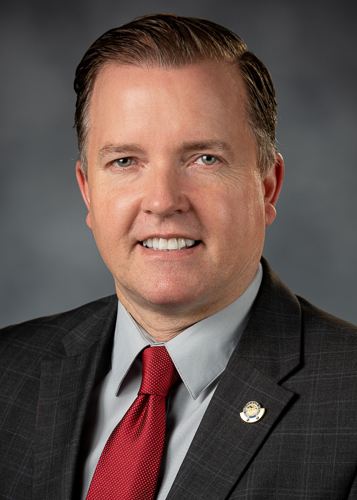
Sen. Mark Maynard
Sponsored bills
Maddy summarySB 919 requires Child Protective Services (CPS) workers in West Virginia to audio-record all investigatory interactions with individuals under investigation for child abuse or neglect allegations. This applies during home visits or interviews, using body cameras similar to law enforcement, but mandates obtaining informed consent or a court order when privacy expectations exist. The bill also requires CPS to document all communications (phone calls, texts, emails) and grants families the right to record their own interactions with equal evidentiary weight. These recordings must be submitted to court as evidence in related proceedings. The law directly affects CPS workers, families under investigation, and court proceedings involving child abuse/neglect cases.
Maddy summarySB 928 would remove restrictions on licensed concealed handgun carriers entering West Virginia's State Capitol Complex buildings. Currently, permit holders must show their license upon entry, and firearms are prohibited in specific areas like the Governor's office and Supreme Court chambers. The bill eliminates the license-showing requirement and expands permitted carry locations within the Capitol complex, while maintaining existing rules about pepper spray containers (max 1 ounce) and prohibited areas. This change directly affects individuals with valid concealed carry permits seeking to enter Capitol buildings for official business or public access.
Maddy summarySB 918 would create a non-denominational chapel inside the West Virginia State Capitol building for prayer, meditation, and religious reflection open to all faiths and visitors. The Department of Administration would manage the chapel and form an advisory committee with legislative members and public representatives to ensure inclusive use. The bill specifies that state funds cannot promote any specific religion, and the chapel must remain neutral, with all usage guided by non-discriminatory policies.
Maddy summarySB 733 amends the membership rules for West Virginia's Legislative Oversight Commission on Department of Transportation Accountability. It clarifies that if a legislative chamber (Senate or House) has fewer than three minority party members, vacancies on the commission may be filled with a majority party member from that chamber. The bill does not change the commission's duties but ensures it can maintain its required seven-member composition from each chamber under all party composition scenarios. This procedural change affects how the Senate President and House Speaker appoint members to the commission, which oversees Department of Transportation accountability.
Maddy summarySB 926 would require the West Virginia Department of Education to offer an optional 120-hour Firefighter One course as part of high school curriculum for grades 9-12. The course would cover national firefighter standards (including HazMat awareness, first aid, and CPR certification) and, upon completion, would meet the minimum requirements set by the West Virginia State Fire Commission for responding to fire calls. This bill directly affects high school students in West Virginia public schools who choose to enroll in the optional course. The legislation is currently in the early stages of the legislative process after being introduced on March 24, 2025.
Maddy summaryThis bill creates the "West Virginia Country Roads Mapping and Marketing Act," allowing counties to request the state Department of Highways (WVDOH) to map scenic and back roads for tourism promotion. Counties must apply for mapping, and the WVDOH will classify roads by surface type (paved, gravel, dirt) and identify 4x4 vehicle requirements. The WVDOH will develop an interactive public map and mobile app featuring user-submitted updates, points of interest, and road conditions, with funding sourced from the department's tourism and infrastructure budget. The program requires annual reporting to the Legislature on participation and tourism impact.
Maddy summaryThis bill requires the West Virginia Department of Health to propose rules that include alpha-gal syndrome on the list of diseases that must be reported to the Centers for Disease Control and Prevention. Alpha-gal syndrome is an allergic reaction to red meat that can occur after a person is bitten by a deer tick. The legislation directly affects the state Department of Health by mandating that they update their disease reporting requirements to include this specific condition. If passed, healthcare providers in West Virginia would need to report confirmed alpha-gal syndrome cases to the CDC as part of routine disease surveillance. The bill does not change how the disease is diagnosed or treated, but rather establishes a reporting mechanism to help track its spread.
Maddy summaryThis bill transfers management of Stevens Correctional Center in McDowell County from the county commission to West Virginia's Division of Corrections and Rehabilitation (DCR). It clarifies that the state now owns the facility's assets, confirms McDowell County's prior debts related to the center have been paid by the state, and requires county employees to transfer to DCR with retained seniority and leave balances. The bill explicitly states that Stevens Correctional Center is no longer contracted with the county and is now under full state control, alongside other state-operated correctional facilities listed in the law. These changes formalize the state's operational control over the facility without altering its function or capacity.
Maddy summaryThis Senate Resolution (SR 38) is a ceremonial designation, not a policy bill. It formally recognizes Mingo County, West Virginia, by designating March 20, 2025, as "Mingo County Day" at the West Virginia Legislature. The resolution highlights the county's history (founded 1895, Native American heritage, coal mining legacy, Mine Wars), recent flood resilience, and tourism assets like the Hatfield-McCoy Trail. It does not create new laws, allocate funds, or directly affect any residents or policies - it is purely a symbolic gesture of legislative recognition. The resolution was adopted by the Senate on March 20, 2025.