

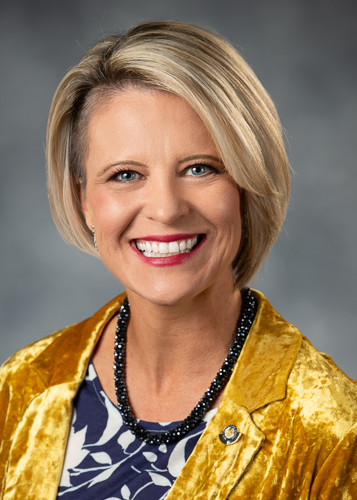
Photo of Amy Grady
R West Virginia Senate · District 4

Sen. Amy Grady

Compare
Total votes
2,270
all sessions
Attendance
98%
41 missed
Near the chamber average
With party
97%
of cast votes
Near the chamber average
Bipartisan score
1%
crosses aisle rarely
Near the chamber average
Sponsored
599
bills & resolutions
Near the chamber average
Committees
12
assignments
599 bills and resolutions

Sponsored bills

Total
599
Primary
158
Co-sponsor
441
This page
599
matching current filters
Co-sponsor SB 731
In committee · West Virginia Senate · Co-sponsor
Eliminating hepatitis-b and meningitis as required vaccines

Maddy summarySB 731 removes hepatitis-B and meningitis vaccines from West Virginia's mandatory school immunization requirements for students entering public, private, or parochial schools and state-regulated child care centers. The bill amends West Virginia Code §16-3-4 to delete these two vaccines from the list of required immunizations, which previously included chickenpox, measles, mumps, and others. This change aligns with updated Centers for Disease Control and Prevention recommendations that no longer include hepatitis-B and meningococcal meningitis vaccines in the standard childhood schedule. The policy directly affects all students seeking enrollment in schools or childcare centers across West Virginia.

In committee Feb 3, 2026 1 co-sponsor
Primary SB 388
Passed · West Virginia Senate · Lead sponsor
Requiring public elementary or secondary school make Aitken Bible available to certain classrooms

Maddy summarySB 388 requires all public elementary and secondary schools in West Virginia to make the Aitken Bible available in fourth, eighth, and 10th grade social studies classrooms. Schools may only use private donations to obtain the Bible - public funds cannot be used for this purpose. The bill explicitly applies to public charter schools authorized under West Virginia law. This legislation mandates the availability of the Aitken Bible in specified grades while restricting funding sources for its distribution.

Passed Feb 2, 2026 0 co-sponsors
Co-sponsor SB 673
In committee · West Virginia Senate · Co-sponsor
Increasing tax on vapes and e-cigarettes

Maddy summarySB 673 imposes a 3-cent tax per milligram of nicotine on all e-cigarette products sold in West Virginia, replacing a previous tax based on product type. This tax applies to both disposable (closed-system) and refillable (open-system) devices, with fallback rates (40mg per unit for disposables, 6mg/mL for refillables) if labeling is unclear. All revenue generated will be directed to the Public Employees Insurance Agency (PEIA) to reduce or stabilize state employees' health insurance premiums, without replacing existing employer contributions. The bill directly affects e-cigarette distributors and manufacturers in the state, effective July 1, 2026.

In committee Jan 30, 2026 1 co-sponsor
Co-sponsor SB 11
In committee · West Virginia Senate · Co-sponsor
Allowing certain Teachers Retirement System members to exchange unused leave for monetary compensation

Maddy summaryThis bill allows classroom teachers who joined the West Virginia Teachers Retirement System on or after July 1, 2015, to sell up to 10 unused personal leave days to their county school board for a cash payment. Teachers would receive 80% of the rate paid to a substitute teacher with a bachelor's degree and 10 years of experience for each day sold, with payment required by June 30. Once sold, the leave days are forfeited and cannot be used for future absences.

In committee Jan 30, 2026 1 co-sponsor
Co-sponsor SCR 1
Passed · West Virginia Senate · Co-sponsor
Requesting DOH name certain transportation infrastructure

Maddy summaryThis Senate Concurrent Resolution (SCR 1) requests the West Virginia Division of Highways to rename specific bridges and road segments after military veterans and community members. It directly affects the Division of Highways, which would implement the proposed names for 15+ existing infrastructure locations across 10 counties. The resolution specifies exact locations (e.g., a bridge in Wayne County to be called the "Hercie Maynard Memorial Bridge" or a section of WV Route 10 as the "Purple Heart Trail") without creating new laws or funding. It is purely a naming request, not a policy change, and honors individuals with military service or local significance. The resolution was quickly adopted by both legislative chambers in January 2026.

Passed Jan 30, 2026 1 co-sponsor
Co-sponsor SB 102
In committee · West Virginia Senate · Co-sponsor
Establishing Summer Feeding for All Program

Maddy summaryThis bill requires West Virginia county public school systems to conduct annual surveys of students to assess food access during non-school periods (like summers) and compile local resources for nutritious meals. It directs counties to share this information with students and community food providers, while enabling schools to develop local programs using existing resources (e.g., community partnerships or mentorship). The West Virginia Office of Child Nutrition will facilitate coordination and share successful approaches across counties. The law focuses on enabling local solutions to reduce student food insecurity during school breaks, rather than mandating specific statewide programs.

In committee Jan 28, 2026 1 co-sponsor
Co-sponsor SB 546
In committee · West Virginia Senate · Co-sponsor
Relating to clothing and necessity allowance

Maddy summarySB 546 establishes requirements for clothing and necessity allowances for children in foster care in West Virginia. It mandates that placement providers (foster parents, kinship caregivers, or residential providers) assess each child’s wardrobe and approved necessities (non-clothing items like hygiene products) at initial placement. If lacking, providers must obtain an initial allowance of at least $375 for immediate clothing and essentials, or supplementary allowances up to $175 for extraordinary needs like illness or damaged items. Payment options include a reloadable card (issued within 48 hours), a case worker’s purchasing card, or reimbursement (last resort), with requirements to maintain an inventory tracking the child’s items throughout all placements. The bill directly affects foster children, their caregivers, and the Department of Human Services.

In committee Jan 28, 2026 1 co-sponsor
Co-sponsor SR 18
Passed · West Virginia Senate · Co-sponsor
Designating January 27, 2026, as Sexual Violence Awareness Day at Legislature

Maddy summarySenate Resolution 18 (SR 18) designates January 27, 2026, as Sexual Violence Awareness Day at the West Virginia Legislature. The resolution formally recognizes the prevalence of sexual violence in the state (citing West Virginia women ranking fifth nationally in sexual coercion victimizations) and supports agencies like the West Virginia Foundation for Rape Information and Services. It does not create new laws or policies but serves as a ceremonial acknowledgment to honor survivors, support victim services, and renew commitment to addressing sexual violence.

Passed Jan 27, 2026 1 co-sponsor
Co-sponsor SR 12
Passed · West Virginia Senate · Co-sponsor
Recognizing January as Human Trafficking Awareness month

Maddy summarySenate Resolution 12 designates January as Human Trafficking Awareness Month in West Virginia. The resolution recognizes human trafficking as a global crime affecting people of all backgrounds and highlights the need for public awareness. It references West Virginia's existing "YOU CAN" initiative and encourages residents to learn about trafficking through resources like the See, Send app. This is a symbolic resolution focused on raising public awareness, not creating new laws or policies.

Passed Jan 23, 2026 1 co-sponsor
Co-sponsor SB 544
In committee · West Virginia Senate · Co-sponsor
Relating to temporary increase in payment to kinship parent

Maddy summarySB 544 provides a temporary increase in subsidy payments for kinship parents (relatives caring for children) to match foster parent rates, lasting up to six months. To qualify, kinship parents must complete a state and national criminal background check within five days of placement, pass the check, undergo a home safety screening, and receive a list of child-placing agencies from the Department of Human Services to assist with foster parent certification. The temporary payment begins within 30 days of placement and continues monthly until certification is achieved or the six-month period ends, whichever comes first. Kinship parents cover the cost of background checks and fingerprinting.

In committee Jan 23, 2026 1 co-sponsor
Showing 61 to 70 of 599 bills
Previous 1 6 7 8 60 Next