

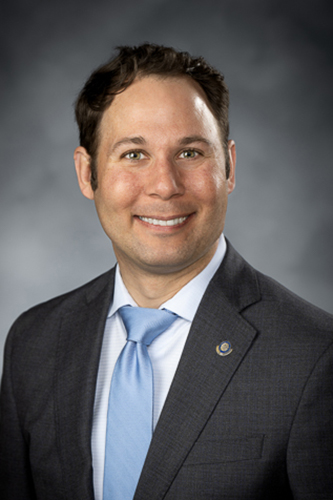
Maddy summaryThis bill (SB 576) requires the Secretary of the West Virginia Department of Health Facilities to continue operating all state-owned health facilities and prohibits the sale or transfer of operations or related property for three specific hospitals - Mildred Mitchell-Bateman Hospital, Welch Community Hospital, and William R. Sharpe Jr. Hospital - without prior legislative approval. It strengthens existing duties by mandating that the Secretary cannot divest these facilities to private buyers without an act of the Legislature. The bill directly affects the Secretary’s authority and ensures these hospitals remain under state control unless the Legislature explicitly approves a sale.
Sponsored bills
Maddy summarySB 551 amends West Virginia law to restore voting rights for faculty, student, and employee members currently serving as nonvoting advisors on boards of governors at 19 public universities and community colleges. The bill changes their status from "nonvoting, advisory" to full voting members, directly affecting institutions like West Virginia University, Marshall University, and West Virginia State University. Key provisions remove the nonvoting designation from statutes governing these positions, allowing faculty (rank of instructor or above), students (in good academic standing), and employees (classified or non-classified) to vote on board decisions. This policy change aims to increase institutional representation without altering board composition or appointment processes.
Maddy summarySB 436 requires West Virginia's Department of Human Services (DoHS) to create and implement a statewide prevention plan by February 2027. The plan must provide trauma-informed, evidence-based preventive services to children under 18 and their families - including foster youth, pregnant and parenting teens, youth aging out of foster care, post-adoption youth, and families with economic or safety needs - ensuring accessible services through a mix of physical locations and telehealth. DoHS must track service outcomes, report annually to the legislature starting in 2027 (including county-level data and costs), and work to secure federal funding under the Family First Prevention Services Act. The bill directly affects DoHS operations and the delivery of child welfare prevention services across the state.
Maddy summarySB 568, the Oral Health and Cancer Rights Act, requires health insurers in West Virginia to cover medically necessary dental procedures directly related to cancer treatment (such as surgery, chemotherapy, or radiation). This affects cancer patients needing dental care to eat, breathe, speak, or swallow after treatment, and all health benefit plans offered by insurers in the state. The bill mandates that covered services must be billed using the specific modifier "West Virginia Code §33-64-1" (or a unique prescription identifier for medications), ensuring insurers recognize these procedures as covered. The law takes effect July 1, 2027, applying to all nonexempt health insurance contracts.
Maddy summarySB 429 creates the Child Care Workforce Scholarship Act, providing full child care subsidies for the children of West Virginia child care workers regardless of household income. Eligible workers (those employed 20+ hours weekly at licensed child care centers or homes) automatically qualify for subsidies covering 100% of costs ($0 co-pay) through the existing subsidy program, with benefits renewable annually. The bill appropriates $5.2 million from the General Revenue Fund for Fiscal Year 2026 to cover these subsidies and supplement federal funds, directly aiming to stabilize the child care workforce and increase available child care capacity statewide.
Maddy summarySB 112 would change West Virginia law to automatically restore voting rights for people convicted of a felony upon their release from incarceration, regardless of whether they are on probation, parole, or supervised release. Currently, individuals serving felony sentences cannot vote, but this bill would end that disqualification immediately after release. The key provision amends Section 3-2-2 of the state code to state that eligibility is "automatically restored upon release from incarceration." This directly affects all West Virginians who were incarcerated for a felony conviction, allowing them to register and vote as soon as they leave prison.
Maddy summarySB 109 clarifies that racial discrimination under West Virginia law includes discrimination based on hair textures and protective hairstyles historically associated with specific races. The bill explicitly adds these protections to the state's human rights code, defining "protective hairstyles" to include braids, locks, and twists. It directly affects all individuals covered by West Virginia's anti-discrimination laws in workplaces, schools, and public accommodations. This amendment expands existing protections to address bias against hair styles commonly linked to Black culture, without changing other aspects of discrimination law.
Maddy summaryThis bill requires all health insurance providers in West Virginia to cover infertility diagnosis, treatment, and fertility preservation services. It mandates coverage for medically necessary fertility care - including evaluations, medications, and donor services - and specifically requires coverage for fertility preservation (like egg or sperm freezing) before medical treatments known to impair fertility, such as chemotherapy. The law applies to all group health insurance policies and prohibits insurers from imposing separate deductibles, copays, or limits on these covered services. This directly affects West Virginia residents with infertility diagnoses or those needing fertility preservation before medical procedures, ensuring access to these services through their insurance plans.
Maddy summarySJR 6 proposes a constitutional amendment to limit terms for five West Virginia constitutional offices: Secretary of State, Auditor, Treasurer, Commissioner of Agriculture, and Attorney General. It would prevent any person from serving more than two consecutive terms in any of these specific offices. The amendment requires voter approval at the 2026 general election and would take effect upon ratification, counting existing terms toward the two-term limit. This is a procedural constitutional change, not a direct law, and does not affect the Governor's term limits.
Maddy summarySB 115 would repeal West Virginia's 2016 "Workplace Freedom Act" (codified in sections §21-5G-1 through §21-5G-7 of the state code), which prohibits agreements requiring workers to join a union or pay dues as a condition of employment. The bill removes this legal restriction, allowing employers and unions to negotiate agreements that mandate union membership or dues in collective bargaining. This change would directly affect workers, labor unions, and employers across West Virginia by altering the state's labor law regarding union security. If enacted, it would eliminate the right-to-work policy that has governed the state's labor relations since 2016.