

Maddy summaryHB 3504 creates West Virginia's Critical Infrastructure Protection Act, defining "critical infrastructure" to include facilities like power plants, water treatment centers, pipelines, hospitals, and telecommunications equipment. It prohibits unauthorized entry (trespassing) on these sites, with misdemeanor penalties of up to $1,000 fines or one year in jail. For damaging critical infrastructure (including cyberattacks) causing over $2,500 in harm, it imposes felony charges with fines of $3,000-$10,000 or 1-5 years in prison, increasing for repeat offenses. The law directly affects property owners who can enforce these rules and anyone entering or damaging these designated facilities without permission.
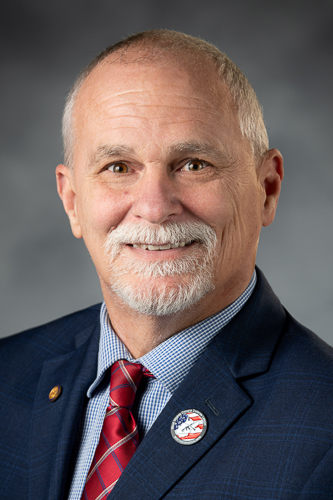
Del. Chuck Horst
Sponsored bills
Maddy summaryThis concurrent resolution (HCR 24) requests the West Virginia Division of Highways to rename bridge number 52-250/00-009.13 (currently known as Littleton Bridge) in Wetzel County as the "Postlethwait Brothers Memorial Bridge." It honors four brothers - Clarence, John Lloyd, Frank, and George Postlethwait - who served in multiple wars (World War II, Korea, Vietnam) with distinguished military careers. The resolution, which passed unanimously on April 12, 2025, directs the Division of Highways to install signage identifying the bridge with this new name.
Maddy summaryHouse Concurrent Resolution 18 proposes renaming Johnsontown Bridge (located on WV 009 over Tilhance Creek in Berkeley County, West Virginia) to the "Paul J. Hofe Memorial Bridge" to honor Paul J. Hofe, a local resident who served in the U.S. Army, worked for the IRS for 35 years, and operated a well-drilling business for 50 years that provided free wells to families and community organizations. The resolution directs the Division of Highways to update the bridge's official name and install new signage identifying it as the "Paul J. Hofe Memorial Bridge." This is a commemorative resolution with no substantive policy changes beyond the bridge name and signage.
Maddy summaryThis symbolic resolution designates November 7th annually as "Pastor Appreciation Day" in West Virginia. It honors clergy members for their community service, spiritual leadership, and roles in life events like weddings, funerals, and disaster response. The resolution does not create new laws, funding, or obligations - it serves solely as ceremonial recognition. It affects no specific individuals or policies, as it is a non-binding declaration of appreciation.
Maddy summaryHCR 99 is a legislative resolution requesting the Joint Standing Committee on the Judiciary to study policies preventing financial fraud and scams in West Virginia. It directs the committee to examine current state laws, review national approaches, and focus on four key areas: reducing robocalls and spoofing, addressing cryptocurrency-related scams (noting $1.4 million in losses in 2023), improving victim restitution, and protecting against property title fraud. The resolution cites data showing 8,000 West Virginians lost $27 million to fraud in 2024, with national losses exceeding $12.5 billion. The committee must report findings and recommendations to the legislature, governor, and attorney general by December 31, 2025. This is a study resolution, not a law, and does not create immediate policy changes.
Maddy summaryHB 2816 clarifies that secondary legal sources - such as textbooks, treatises, or scholarly articles - do not constitute binding law or public policy in West Virginia. It specifies these sources are only persuasive when addressing causes of action, rights, or remedies, and only if they align with existing state law. The bill also allows circuit courts to certify novel legal questions (issues of "first impression") to the Supreme Court of Appeals for resolution. This directly affects courts and legal practitioners by setting clear boundaries for when external legal commentary may influence judicial decisions.
Maddy summaryHCR 88 is a ceremonial resolution honoring two West Virginia first responders nominated for the Medal of Valor. It specifically recognizes Captain Donald Lawson (New Martinsville Police) for rescuing two people from carbon monoxide poisoning despite his own hospitalization, and Darrell Lambert (Lake Volunteer Firefighter) for entering a burning building without protective gear to save a trapped resident, sustaining burns in the process. The resolution formally confirms the Legislature's approval of their award and directs the House Clerk to send a copy to Governor Morrisey. This is a symbolic honor with no new policy or funding changes, directly affecting only these two nominees. It passed unanimously in both chambers on April 3, 2025.
Maddy summaryHB 2410 (Safeguard the Right-To-Try Cutting-Edge Medicine Act) allows terminally ill or severely debilitated patients in West Virginia to access investigational drugs, biological products, or devices not yet approved by the FDA. It defines eligibility for patients who have exhausted all FDA-approved treatments, cannot participate in nearby clinical trials, and receive physician recommendations. The bill requires detailed written informed consent explaining treatment risks, costs, insurance limitations, and potential liability for expenses. It directly affects patients with qualifying illnesses and their physicians, establishing a legal framework for accessing unapproved treatments while clarifying that insurers and hospice care may not cover such treatments.
Maddy summaryHB 3506 sets a new mandatory 7% employee contribution rate for judges of courts of record in West Virginia, effective July 1, 2025. This directly affects current and future judges who participate in the state's judges' retirement system, replacing previous rates that had fluctuated between 6% and 10.5% over time. The bill also establishes a key mechanism where employer contributions to the retirement fund may be suspended if the fund's funding level exceeds 125%, as determined by annual actuarial valuations. The changes aim to standardize contributions while providing a trigger for pausing employer payments during periods of strong fund solvency.
Maddy summaryHB 2409, titled the "Hospital Price Transparency Act," requires hospitals in West Virginia to publicly disclose pricing for medical services. It directly affects licensed hospitals by mandating they provide two types of price information: (1) a digital file of all standard charges in machine-readable format (like CSV or XML), and (2) a simplified list of prices for "shoppable services" (like scheduled procedures) in consumer-friendly format. The bill defines key terms like "standard charge" (including gross charges, negotiated rates, and cash prices) and requires hospitals to update these disclosures online for public access. Non-compliance may trigger administrative penalties. This bill does not address cooperative agreements, as described in the query.