

Maddy summaryHCR 21 is a commemorative resolution requesting the West Virginia Division of Highways rename a specific bridge in Wetzel County. It asks to name bridge number 52-250/12-000.02 (at coordinates 39.68344, -80.45906), currently known as Church Fork Bridge, as the "U.S. Army Private Terry F. Tustin Memorial Bridge." The resolution cites Private Tustin's military service in Vietnam, his long residence in Hundred, West Virginia, and his family ties as reasons for the memorial. The bill directs the Division of Highways to install signs identifying the bridge by its new name. This is a symbolic naming request with no policy changes or funding impact.
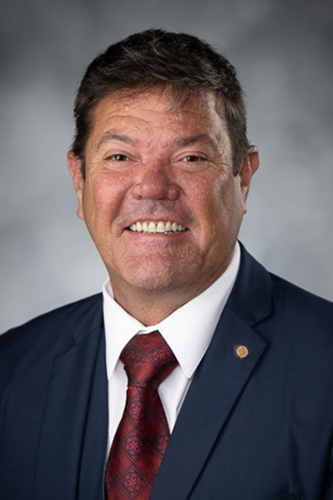
Del. Mike Hornby
Sponsored bills
Maddy summaryHCR 25 is a procedural resolution requesting the West Virginia Division of Highways rename a specific section of U.S. Route 250 (north of Moundsville city limits to just north of WV Route 891) to "Waynesburg Pike Road" and install a sign at the intersection of WV Route 88 and U.S. Route 250. It directly affects road signage and identification for drivers using this segment of road. The resolution follows a prior designation by the Marshall County 911 Infrastructure Renaming Committee and does not change traffic laws or regulations. It is a non-binding request for the Division of Highways to implement the name change and signage.
Maddy summaryHB 2618 would automatically restore firearm rights to West Virginia residents who complete sentences for nonviolent felonies, eliminating the need for separate court petitions. It specifically applies to individuals convicted of nonviolent crimes but excludes those convicted of violent felonies, certain drug offenses (like Schedule I-III controlled substances except marijuana), or domestic violence misdemeanors. The bill amends West Virginia law to remove automatic firearm prohibitions once sentences and court-ordered penalties like fines are fully served. This changes current practice where individuals must seek judicial restoration of rights after completing their sentence. The bill is currently pending in the House Judiciary Committee after being introduced on February 19, 2025.
Maddy summaryHCR 94 is a request for the Joint Committee on Government and Finance to study establishing an artificial intelligence (AI) elective course in West Virginia public high schools. The study would assess current AI education programs, identify gaps in student access, evaluate funding options, analyze AI’s impact on future industries, and recommend legislative or partnership actions. If implemented, the proposed course would teach foundational AI concepts (like machine learning), practical applications in fields like business and defense, and hands-on tool usage. This resolution does not create the course but asks for a study to inform future decisions. The committee must report findings by the 2026 legislative session.
Maddy summaryHB 2760 establishes a partnership between Workforce West Virginia and the State Board of Education to implement a STEM-focused online learning platform for high schools and technical schools in West Virginia, with an initial emphasis on chemistry education. Starting in the 2025-2026 school year, the program will begin with 10 selected schools, expanding to all participating schools after two years. Participating schools will receive instructional resources and teacher training using the platform, which complements existing digital literacy standards. The program requires an evaluation by January 2027 to assess student impact and recommend continuation, expansion, or termination.
Maddy summaryHB 3494 requires individuals convicted in West Virginia of specific crimes to formally acknowledge their firearm prohibition and transfer firearms at the time of sentencing. It directly affects people convicted of felonies (over one year imprisonment, under §61-7-7(a)(1)) or misdemeanor domestic violence assaults/batteries involving intimate partners, spouses, or household members (under §61-7-7(a)(8)). The bill mandates they sign a form confirming the prohibition and hand over firearms to someone legally allowed to possess them. This adds a new procedural step to existing firearm restrictions, focusing on immediate compliance at conviction. The bill is currently in the House Judiciary Committee for review.
Maddy summaryHB 2635 sets specific classroom size limits for West Virginia public schools in kindergarten through sixth grade, requiring counties to maintain ratios of no more than 20 students per teacher in kindergarten (with one aide for classes over 10 students) and 25 students per teacher in grades 1-6 (with aides for grades 1-3 starting 2023-2026). It mandates that if classrooms exceed these limits, they must be split into two equally sized classes by the 2025-2026 school year to preserve aide coverage and individualized teacher time. County boards must implement these changes or use full/part-time interventionists as alternatives, and teachers in oversized classrooms face additional pay based on the excess student count. The bill directly affects K-6 public schools, teachers, and aides across West Virginia, with compliance deadlines phased through 2026.
Maddy summaryHB 2378 makes syringe services programs unlawful in West Virginia, prohibiting operators from providing sterile syringes or needles without a prescription. It requires all such programs to cease operations immediately upon the bill's effective date, with a 120-day administrative transition period solely for care referrals (no syringe exchanges allowed during this time). The bill permits harm reduction services like overdose prevention education and referrals to treatment programs, as long as they do not involve syringe exchanges. Violators face civil penalties up to $2,500 per day, and the Office of Health Facilities Licensure and Certification may seek injunctive relief for noncompliance. This replaces all previous regulations on syringe services programs (repealing §16-64-1 through §16-64-10).
Maddy summaryHJR 40 proposes a constitutional amendment to change how members of the West Virginia State Board of Education are selected. It would replace the current system of nine appointed members with a hybrid model: five members elected on a partisan basis from five geographic regions (serving staggered four-year terms), and four members appointed by the Governor with Senate consent. The amendment would require the Board to submit any rules or policies they create to the Legislature for review, approval, amendment, or rejection. If approved by voters in the 2026 general election, these changes would take effect with the 2028 general election, modifying the current appointment system for the Board.
Maddy summaryHB 2493, the "Sound Science in Regulations Act," requires West Virginia state agencies to base new environmental and health regulations on "the best available science." This applies specifically to rules about drinking water, air quality, hazardous substances, and waste handling that are stricter than federal standards or created without federal counterparts. The bill defines "best available science" as reliable, unbiased research published in nonpartisan refereed journals, and mandates that such science must demonstrate a causal link between exposure to a substance and human harm. It does not affect existing regulations, federal requirements, or rules matching federal standards.