

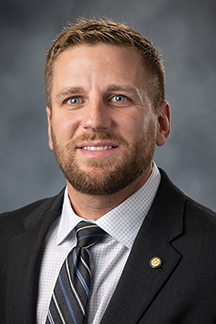
Maddy summaryHR 9 is a ceremonial resolution honoring the late West Virginia House Delegate Douglas John Skaff Jr. It expresses the House of Delegates' condolences to his family and commemorates his service, including his roles as a delegate representing multiple districts and as Minority Leader. The resolution has no policy impact - it is purely symbolic, acknowledging his career in public service, business, and community leadership. It was unanimously adopted by the House on February 5, 2026, the same day it was introduced.
Rep. David Cannon
Sponsored bills
Maddy summaryHB 5097 requires West Virginia hospitals to provide effective communication assistance for deaf and hard of hearing patients and their families. Specifically, hospitals without an on-staff American Sign Language (ASL) interpreter must offer technology solutions like hearing loops, captioning services, or video relay systems. The bill mandates that any ASL interpreters used must be approved by the West Virginia Commission for the Deaf and Hard of Hearing. Noncompliance can be reported to licensing authorities, and the law takes effect upon passage. This directly affects all hospitals operating under West Virginia's healthcare regulations serving patients with hearing or speech impairments.
Maddy summaryThis is a symbolic House Resolution (not a bill), introduced by multiple West Virginia delegates. It designates the month of June as "Fidelity Month" to promote the values of faith, family, and patriotism across the state. The resolution cites declining support for these values in polling and research, and calls for the state to "rededicate" itself to them during June. It has no binding policy requirements or direct impact on specific groups; it is purely a commemorative gesture.
Maddy summaryThis West Virginia House resolution states that the U.S. national debt (over $38 trillion in 2026) poses a national security threat, citing foreign debt ownership, projected Social Security/Medicare shortfalls, and warnings from military/intelligence leaders. It urges Congress to establish regular budgeting procedures but does not create new laws or alter federal spending. As a symbolic resolution, it has no direct legal effect on national debt policy or federal budgets. The resolution focuses on raising awareness rather than implementing concrete changes.
Maddy summaryHB 5069 requires new wind energy projects in West Virginia to maintain minimum distances from residences, property lines, and certain infrastructure. Specifically, wind turbines must be placed at least 1.5 times their total height (tower, turbine, blades) from residences and 1.1 times their height from property lines or paved public roads/transmission lines (115kV+). Property owners can opt out of these setbacks by signing a written waiver. The bill applies only to new siting certificate applications after its effective date, directly affecting wind developers and nearby landowners.
Maddy summaryHB 5027 amends West Virginia's eminent domain law to clarify that the state or its subdivisions cannot take private property primarily for private economic development where ownership or control transfers to a private entity (e.g., via purchase or lease). The bill prohibits such takings without the owner's consent, while preserving existing public uses like infrastructure, utilities, schools, and parks. It specifically targets cases where eminent domain would benefit private developers rather than serve a direct public purpose. This change applies to all property owners and government entities exercising eminent domain authority in West Virginia.
Maddy summaryHB 5035 requires medication-assisted treatment (MAT) programs - facilities providing medication for opioid addiction - to create written community relations policies. These policies must detail how the program will engage with local communities and avoid disrupting public functions. The bill mandates that MAT programs publish a public notice 60 days before opening or moving, notify county commissioners and mayors by certified mail, and obtain local government approval for new locations. It also restricts new MAT facilities from locating within half a mile of schools or daycares (with limited variances for existing facilities), aiming to address community concerns through transparency and local input.
Maddy summaryHB 5040 requires West Virginia's Commissioner of Highways to create and submit an annual plan for routine repaving of all state roads with asphalt surfaces. This bill amends existing law to mandate that the Commissioner present this comprehensive paving plan to the Legislature each year. The plan would establish a systematic approach to maintaining state highways by scheduling regular repaving, rather than responding only to urgent repairs. It directly affects the Commissioner's office and the state's road maintenance process, but does not create new funding or change current road standards. The bill focuses solely on requiring an annual planning mechanism for routine pavement maintenance.
Maddy summaryHB 4469 requires county surveyors first elected or appointed after January 1, 2027, to be West Virginia residents, defined as someone who lives in the state and has intent to stay (e.g., holds a driver's license, pays state taxes, or registers vehicles there). It does not affect current county surveyors but applies to future appointments. The bill also creates a process for county surveyors to request exemptions from the Ethics Commission if they wish to hold multiple public offices simultaneously. These exemptions require demonstrating the office is not widely available, requires personal prestige, and allows financial gain outside the role.
Maddy summaryThis bill allows West Virginia airport authorities to use federally approved project delivery methods - such as design-build or construction manager-at-risk - for airport capital improvement projects funded by the Federal Aviation Administration (FAA). It specifically authorizes these methods when they meet FAA safety and design standards, streamlining procurement for projects like terminal upgrades or runway construction. The bill affects airport authorities managing FAA-funded projects, ensuring compliance with federal requirements satisfies state procurement rules. It does not change funding levels but adjusts how projects can be delivered.