

Maddy summaryThis House Resolution urges the Capitol Building Commission and Department of Administration to assess and address hazardous trees along California Avenue and Kanawha Boulevard on the State Capitol Complex grounds. The resolution requests an immediate evaluation of trees that have caused property damage through falling limbs and broken trunks over the past two years. It specifically asks officials to trim trees back to the grass side of sidewalks or remove and replace hazardous trees to protect public safety and state property. This non-binding resolution directs state agencies to take preventative maintenance actions without mandating specific enforcement measures.
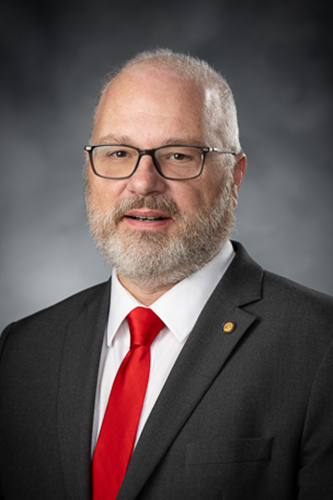
Rep. Gary Howell
Sponsored bills
Maddy summaryHB 4971 requires new high-voltage electric transmission lines (400kV or greater) needing West Virginia Public Service Commission approval to include a substation near industrial parks if the line runs within five miles of one. It limits this requirement to one substation per 40-mile segment of the line within the state, with the substation needing completion within two years after the line becomes operational. The law applies to transmission developers and the Public Service Commission, aiming to boost economic development by linking grid infrastructure directly to industrial areas. Key provisions include evaluating substation locations based on expected job creation and tax benefits, and prohibiting route choices designed to avoid industrial park proximity.
Maddy summaryHB 4537 requires West Virginia municipalities and public service districts to determine the cost of extending water or sewer service to new customers and apply for state infrastructure grants to cover these costs. If grants are approved, the municipality must extend service after customers pay required fees, and grant funds must reimburse customers for upfront costs like application fees and service extension contributions. This directly affects potential customers seeking new service connections and municipalities managing utility infrastructure. The bill streamlines access to state funding to reduce customer financial barriers for service extensions.
Maddy summaryHB 5492 allows West Virginia's Department of Economic Development to pre-purchase standardized electric substation transformers from regulated utilities to accelerate industrial and commercial development projects. The bill specifies technical requirements for transformers (e.g., 150-200 MVA capacity, specific voltage levels) and authorizes the state to pay for initial ordering costs while utilities retain ownership until assigned to qualifying projects like industrial parks. If transformers aren't assigned by delivery, the state covers remaining costs and utilities hold them for future projects or system use. The state can recover funds through utility rate adjustments, project agreements, or other approved methods, without requiring Public Service Commission approval for these purchases.
Maddy summaryHB 4989 establishes a state-funded pilot program offering free cancer screenings to West Virginia's active and retired firefighters. The program provides a comprehensive screening package including a multi-cancer blood test, abdominal/thyroid/liver ultrasound, lung CT if needed, and skin cancer screening, with a $1,300 cost limit per person. Firefighters may self-fund screenings before July 1, 2026, and seek reimbursement, while the state covers costs for the 24-month pilot starting July 1, 2026. A committee will develop the program plan, track participation and results, and report findings to state leaders after 12 and 24 months.
Maddy summaryHB 4485 allows public school and higher education employees in West Virginia to voluntarily donate accrued sick leave to coworkers taking maternity leave. The bill establishes a formal leave donation program where employees can transfer personal leave days to colleagues experiencing maternity leave or a catastrophic medical emergency, with specific rules: donors may transfer unlimited days to spouses but face limits for others, and unused donated days revert to the donor after the leave period ends. It prohibits using donated leave for retirement credit or insurance extensions and requires voluntary participation without coercion. This policy directly affects educators in K-12 schools and colleges who qualify for personal leave under state law.
Maddy summaryHCR 22 is a concurrent resolution requesting the Joint Committee on Government and Finance to study policy options that could accelerate the ordering and deployment of electric generation equipment in West Virginia. It specifically asks the committee to examine mechanisms like state-backed deposit guarantees, regulatory frameworks for cost recovery, and accelerated depreciation schedules to reduce delays in equipment procurement. The study aims to support grid reliability, economic growth, and West Virginia’s goal of reaching 50 gigawatts of generation capacity by 2050, while protecting ratepayers and taxpayers. It does not create new laws but seeks recommendations for potential legislative action based on the committee’s findings.
Maddy summaryHCR 21 is a study resolution requesting the Joint Committee on Government and Finance to examine whether West Virginia counties should direct a portion of new property tax revenue from large-scale investments (like manufacturing or energy projects) toward property tax relief for primary residence homeowners. The study would assess thresholds for "significant" revenue growth, prioritize relief for retirees, develop revenue allocation formulas, and analyze constitutional requirements for such a policy. It does not create new tax relief but evaluates feasibility and implementation details, including safeguards to maintain funding for schools and public safety. The committee must report findings by 2027, potentially leading to future legislation or constitutional amendments.
Maddy summaryHB 5675, the WV Reshoring Manufacturing Act, creates a tax credit for West Virginia businesses that replace imported goods with locally manufactured products. It directly affects businesses purchasing goods for resale or use in WV (eligible taxpayers) and manufacturers operating physical facilities in the state (qualified manufacturers). The bill provides tax credits equal to a percentage of the verified dollar value of imported goods replaced by WV-made goods, requiring independent CPA verification through "reshoring activity verification reports" for both initial and continued reshoring. Credits are time-limited, non-transferable, and expire after 10 years, with separate provisions for initial reshoring and repeat purchases of reshored goods. The program aims to reduce reliance on foreign imports by incentivizing local production, as documented in the Legislature's findings of $4.8 billion in imported goods purchased by WV businesses in 2024.
Maddy summaryHB 5668 establishes the Central West Virginia Economic Development and Rural Revitalization Program to address economic challenges in eight specific counties: Webster, Clay, Braxton, Roane, Calhoun, Wirt, Lewis, and Gilmer. The bill creates a state program within the Department of Commerce that provides grants, loans, and technical assistance for projects like business development, infrastructure improvements, broadband expansion, and tourism initiatives. It also introduces a 25% tax credit for businesses making qualified investments in the region that create or retain full-time jobs. Projects must be located in the designated counties and prioritize job creation, private funding leverage, and support for economically distressed communities.