

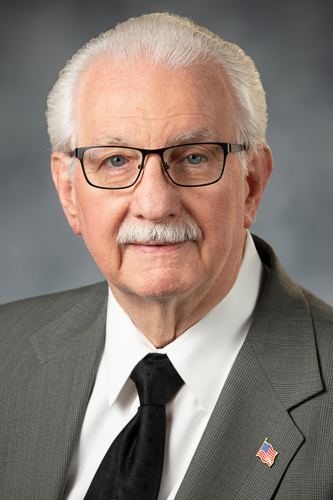
Photo of Keith Marple
R West Virginia House · District 69

Rep. Keith Marple

Compare
Total votes
2,380
all sessions
Attendance
96%
100 missed
Lower than 90% of chamber peers
With party
96%
of cast votes
Near the chamber average
Bipartisan score
2%
crosses aisle rarely
Near the chamber average
Sponsored
223
bills & resolutions
Near the chamber average
Committees
4
assignments
223 bills and resolutions

Sponsored bills

Total
223
Primary
8
Co-sponsor
215
This page
223
matching current filters
Co-sponsor HB 4399
In committee · West Virginia House · Co-sponsor
Relating to disabled veteran taxpayers

Maddy summaryHB 4399 clarifies the definition of a "disabled veteran taxpayer" in West Virginia law to ensure consistency for property tax benefits. The bill specifically adds that a disabled veteran must have a 90% or greater service-connected disability rating from the U.S. Department of Veterans Affairs (VA) or qualify for individual unemployability under VA disability ratings. This change directly affects disabled veterans who seek the property tax credit authorized under §11-13MM-4 of the code, as it defines eligibility more precisely. The bill does not alter tax rates or create new benefits, but ensures the existing credit applies only to veterans meeting the clarified VA disability standard.

In committee Jan 16, 2026 1 co-sponsor
Co-sponsor HB 4373
In committee · West Virginia House · Co-sponsor
To implement a Property Tax Poverty Exemption - School Excess Levy

Maddy summaryThis bill creates a property tax exemption for homeowners in West Virginia whose household income meets federal poverty guidelines. It directly affects low-income homeowners who occupy their property as their primary residence and pay school excess levies (the portion of property taxes funding schools beyond regular levies). To qualify, applicants must file an annual application between July 1 and December 1 with proof of income, residency, and property ownership, and meet residency requirements (two years in WV or specific return-from-out-of-state rules). The exemption applies only to school excess levy taxes - not regular property taxes - and must be renewed yearly.

In committee Jan 15, 2026 1 co-sponsor
Co-sponsor HB 4374
In committee · West Virginia House · Co-sponsor
Relating to Off Duty LEO and LEOSA Exemptions

Maddy summaryHB 4374 allows off-duty and retired law enforcement officers (LEOs) to carry concealed handguns in the West Virginia State Capitol Complex, including the Capitol building and grounds, under specific conditions. It directly affects current and retired LEOs who meet agency requirements and out-of-state officers covered by the federal Law Enforcement Officers Safety Act (LEOSA). Key provisions require officers to show agency-issued credentials when requested, prohibit carrying in the Governor’s office, Supreme Court chambers, and certain other areas, and specify that officers must comply with their agency’s firearm policies. The bill does not override federal restrictions or apply to officers denied concealed carry permits.

In committee Jan 15, 2026 1 co-sponsor
Co-sponsor HB 4365
In committee · West Virginia House · Co-sponsor
Relating to accessories to a crime

Maddy summaryHB 4365 modifies West Virginia's accessory-to-crime laws. It removes the legal protection previously granted to domestic partners of felony offenders, meaning they can now be charged as accessories after the fact (unlike spouses or family members). The bill also eliminates the prior restriction preventing servants from being considered accessories. Additionally, it specifies that close relatives (siblings, parents, children, or grandparents) who act as accessories to a felony commit a misdemeanor, not a felony, and clarifies that accessories to misdemeanors face misdemeanor penalties. These changes directly affect domestic partners, servants, and close family members who assist felony or misdemeanor offenders.

In committee Jan 15, 2026 1 co-sponsor
Co-sponsor HB 4369
In committee · West Virginia House · Co-sponsor
Sales Tax Exemption for Certain Hygiene and Infant Products

Maddy summaryHB 4369 exempts specific hygiene and infant products from West Virginia's sales tax. It directly affects consumers who purchase these items by removing the tax burden. The bill defines three exempt categories: disposable diapers (for infants/toddlers or incontinence), feminine hygiene products (like tampons and pads), and infant products (including baby bottles, formula, and car seats). These exemptions apply to sales under West Virginia's consumer sales tax code. The bill aims to reduce costs for households buying essential items, without altering tax rates for other goods.

In committee Jan 15, 2026 1 co-sponsor
Co-sponsor HB 4372
In committee · West Virginia House · Co-sponsor
Permit teachers in K-12 schools be authorized to carry concealed firearms as a designated school protection officer

Maddy summaryHB 4372 allows K-12 teachers, administrators, and support staff in West Virginia to carry concealed firearms if certified as School Protection Officers (SPOs). To qualify, applicants must complete state-developed training (including firearms instruction) through the Department of Homeland Security, meet specific qualifications, and receive county superintendent approval. The bill creates a new SPO designation with mandatory certification requirements, replacing the general prohibition on weapons in schools for these designated staff. This policy change directly affects school employees who pursue SPO certification, altering existing restrictions under §61-7-11a of the West Virginia Code.

In committee Jan 15, 2026 1 co-sponsor
Co-sponsor HB 4368
In committee · West Virginia House · Co-sponsor
Relating to military connected students

Maddy summaryHB 4368 defines "military-connected students" as children of active-duty, reserve, or deceased military members and establishes new enrollment and support rules for them in West Virginia schools. The bill allows remote school enrollment without physical registration using military orders (with options for temporary or permanent addresses), ensures equitable access to academic courses and extracurricular activities, and requires schools to provide counseling and support services when a parent is activated for duty. It also mandates prompt coordination for students with disabilities during transfers and permits military-connected students to remain at their school until completing the highest grade level offered there. These provisions directly affect military-connected students, their families, and local education agencies across West Virginia.

In committee Jan 15, 2026 1 co-sponsor
Co-sponsor HB 4376
In committee · West Virginia House · Co-sponsor
Say No to Good Old Boy Governance

Maddy summaryHB 4376, titled "Say No to Good Old Boy Governance," prohibits elected state officials from appointing family members to state or local government positions. The bill defines "family member" broadly to include spouses, parents, children, grandparents, grandchildren, siblings, and extended relatives like aunts, uncles, nieces, and nephews. This law applies specifically to elected officials holding state office (such as state legislators or governors) who have appointment authority for public roles. It aims to prevent nepotism by banning the practice of favoring relatives in government appointments.

In committee Jan 15, 2026 1 co-sponsor
Co-sponsor HB 4367
In committee · West Virginia House · Co-sponsor
Allowing for surplus money collected above voter approved excess levy requests to remain with specific county and placed in general fund

Maddy summaryHB 4367 allows counties that receive voter approval for a special excess levy to retain any surplus funds collected above the specific amount approved by voters. These surplus funds would remain with the county and be added to its general fund, rather than being redirected elsewhere. The bill amends West Virginia Code §11-8-16 to clarify that counties must retain such surplus money, which must be accounted for in the county's general fund and used like other general fund revenues. This directly affects counties that have approved special excess levies through voter elections. The change ensures counties can use unspent levy funds for general county purposes without needing additional voter approval.

In committee Jan 15, 2026 1 co-sponsor
Co-sponsor HJR 11
In committee · West Virginia House · Co-sponsor
Amending the Homestead Exemption of the Constitution

Maddy summaryHJR 11 proposes amending West Virginia's state constitution to increase the homestead exemption from $10,000 to $20,000. This change would directly affect homeowners aged 65 or older, or those permanently and totally disabled, who own their primary residence as their principal place of abode. The bill would exempt the first $20,000 of assessed value for qualifying residential property from ad valorem property taxes. This constitutional amendment requires voter approval at the 2026 general election to take effect. The current exemption amount is $10,000 under the existing constitutional provision.

In committee Jan 14, 2026 1 co-sponsor
Showing 41 to 50 of 223 bills
Previous 1 4 5 6 23 Next