

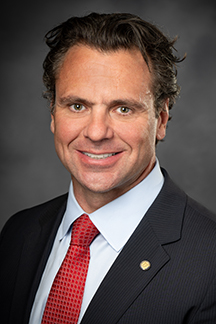
Maddy summaryThis is a commemorative House resolution honoring former West Virginia House Speaker and Chief Justice Timothy P. Armstead following his passing. It memorializes his service, names a conference room in the House as the "Speaker Tim Armstead Memorial Conference Room," and extends condolences to his family. The resolution does not create new laws or affect policy - it formally recognizes his legacy and contributions to West Virginia.
Del. J.B. Akers
Sponsored bills
Maddy summaryHB 4725 clarifies West Virginia's animal cruelty law by specifying that courts may return an animal to its owner after a dismissed case, provided conditions protect the animal, or order euthanasia if a vet recommends it. It also establishes clear duration for possession bans: 5 years to life for misdemeanor convictions and 15 years to life for felony convictions. These provisions directly affect courts handling cruelty cases, convicted individuals, and animal shelters managing seized animals. The bill ensures consistent guidelines for animal disposition and ownership restrictions without altering existing penalties for cruelty offenses.
Maddy summaryHB 4003 creates the WV First Small Business Growth Act, offering tax credits to investors who fund certified "growth funds" that invest in eligible West Virginia small businesses. The program, administered by the West Virginia Department of Commerce, provides a 15% annual tax credit (after the first two years) against insurance premium taxes for qualified investments. To qualify, growth funds must use 100% of investment proceeds within three years to make "qualified investments" in businesses with fewer than 250 employees operating primarily in West Virginia. This directly affects growth investors (who receive tax credits), growth funds (which must be certified), and eligible small businesses receiving capital.
Maddy summaryHB 4695 doubles criminal penalties for specific offenses against minors in West Virginia. It increases maximum prison terms and fines for sexual assault in the third degree (from 5 to 10 years/ $10,000 to $20,000), sexual abuse in the third degree (from 3 to 5 years/ $500 to $1,000), child neglect resulting in death (from 15 to 40 years/ $5,000 to $10,000), and sexual abuse by parents/guardians (from 20 to 40 years/ $5,000 to $10,000). The bill directly affects individuals convicted of these crimes against minors under 16 years old or in positions of trust over children. These changes amend sections §61-8B-5, §61-8B-9, §61-8D-4a, and §61-8D-5 of West Virginia law.
Maddy summaryHB 5455 directs all mandatory fees from special license plates in West Virginia to the State Road Fund for road maintenance. It adds a voluntary donation option at registration or renewal, allowing drivers to contribute to programs related to their plate's theme (e.g., military, education, or environmental causes). Donations must be clearly marked as optional, separate from fees, and distributed only to the designated program. The bill requires the DMV to disclose these details to applicants and report annual fee and donation totals to the legislature. This affects all drivers purchasing special license plates and ensures road funding remains primary while offering optional support for themed causes.
Maddy summaryHB 5450 would transfer responsibility for hearing appeals of certain law enforcement certification decisions from the Deputy Secretary of the Department of Military Affairs and Public Safety to the Office of Administrative Hearings. This applies to appeals concerning denials of entry into law enforcement certification programs, denials of continued training, denials of certification reactivation, and suspensions or decertifications of officers. The bill amends state law to clarify that the Office of Administrative Hearings will handle these appeals instead of the current office, centralizing the process. This is a procedural change affecting law enforcement applicants and officers challenging certification decisions.
Maddy summaryHB 5451 amends West Virginia law to update the payment process for funeral expenses of first responders killed in the line of duty. It ensures the state provides up to $8,000 for funeral costs (covering burial, services, etc.) for eligible law enforcement, firefighters, EMTs, correctional staff, and probation officers who die while performing official duties. The bill clarifies that this payment supplements other benefits but guarantees at least $8,000 total if other funds cover less. It makes technical updates to align the statute with current code language and adjusts the effective date.
Maddy summaryHB 5448 amends West Virginia law to allow members of the State Emergency Response Commission to delegate meeting attendance to an employee when they cannot personally attend. This change explicitly permits members to have an employee serve as their representative ("designee") at commission meetings, addressing practical challenges of scheduling and attendance. The bill does not alter the commission’s membership, responsibilities, or other substantive rules. It specifically updates the statute to clarify that delegation is permissible for all commission-related meetings.
Maddy summaryHB 5445 revises West Virginia's law requiring criminal history checks for individuals applying to be Statewide Interoperable Radio Network (SIRN) Radio Programmers or seeking approval to work in SIRN network facilities. The bill mandates that applicants submit fingerprints to the West Virginia State Police for state and national criminal history checks through the FBI. It specifies that these check results and related records are not public, may only be shared with the applicant, their written consent, or a court order, and that applicants must pay the associated costs. This update clarifies and formalizes the background check process for SIRN personnel to protect network security.
Maddy summaryHB 5446 updates West Virginia law to allow municipalities with certified fire code officials, inspectors, and plans examiners to perform fire safety inspections in specific occupancies - including business, mercantile, and public assembly spaces - that were previously under the State Fire Marshal’s direct jurisdiction. It clarifies certification requirements for fire code professionals, requiring municipalities to ensure staff meet training and examination standards for designated fire code disciplines. Uncertified municipal fire staff may work under a probationary period (up to 2 years) while completing certification. The bill directly affects local fire departments and municipal governments by expanding their authority to enforce fire codes in certain commercial and public spaces, while maintaining the State Fire Marshal’s oversight.