

Maddy summaryHR 9 is a ceremonial resolution honoring the late West Virginia House Delegate Douglas John Skaff Jr. It expresses the House of Delegates' condolences to his family and commemorates his service, including his roles as a delegate representing multiple districts and as Minority Leader. The resolution has no policy impact - it is purely symbolic, acknowledging his career in public service, business, and community leadership. It was unanimously adopted by the House on February 5, 2026, the same day it was introduced.
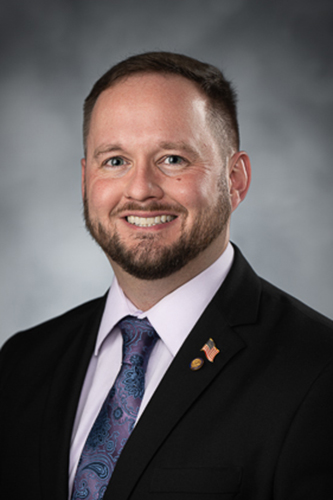
Del. Elliott Pritt
Sponsored bills
Maddy summaryHB 5189 establishes a two-county pilot program requiring child protective services (CPS) workers in West Virginia to use mobile devices (like tablets) for conducting child abuse and neglect investigations starting October 2027. The bill mandates that devices must create real-time digital records, automatically upload data daily to a central system, work with existing software, and be used in at least 70% of cases during the pilot. It directly affects CPS workers in the two participating counties and requires the Department of Human Services to report annually on program metrics to the legislature. The pilot will run for five years, ending in 2032, with data used for system-wide quality improvement analysis.
Maddy summaryThis bill requires West Virginia public schools hosting paid athletic events to sell tickets at the school gate, accept cash payments, and offer online ticket purchases. It directly affects all public secondary schools in the state that charge admission for athletic events. The law mandates these three specific ticketing methods to ensure accessibility for all attendees. This amendment updates existing education code without altering eligibility rules or other school activity requirements.
Maddy summaryHB 5192 clarifies that the School Access Safety Fund's per-pupil funding calculation must use the higher of either the last three-year average enrollment or the current year's enrollment. This change ensures funding levels remain stable during temporary enrollment declines, preventing reductions in allocated funds. County school boards receiving these safety-related funds will use this method to determine their per-pupil allocation. The bill specifically amends existing law for the School Access Safety Fund, which supports school safety projects.
Maddy summaryThis is a symbolic House Resolution (not a bill), introduced by multiple West Virginia delegates. It designates the month of June as "Fidelity Month" to promote the values of faith, family, and patriotism across the state. The resolution cites declining support for these values in polling and research, and calls for the state to "rededicate" itself to them during June. It has no binding policy requirements or direct impact on specific groups; it is purely a commemorative gesture.
Maddy summaryThis West Virginia House resolution states that the U.S. national debt (over $38 trillion in 2026) poses a national security threat, citing foreign debt ownership, projected Social Security/Medicare shortfalls, and warnings from military/intelligence leaders. It urges Congress to establish regular budgeting procedures but does not create new laws or alter federal spending. As a symbolic resolution, it has no direct legal effect on national debt policy or federal budgets. The resolution focuses on raising awareness rather than implementing concrete changes.
Maddy summaryHB 4775 requires the West Virginia Department of Education to analyze statewide school discipline data - including breakdowns by race, gender, and disability - and develop a statewide program to reduce disciplinary actions against K-12 students. It mandates county school boards to implement this program, aiming to improve disciplinary outcomes. The bill also requires the Department to submit biennial reports to the Legislative Oversight Commission on Education Accountability, provide annual updates, and publish discipline data on a public dashboard for transparency. This directly affects all public schools and county boards across West Virginia through new data collection, program implementation, and reporting obligations.
Maddy summaryHB 4467 amends West Virginia law to allow pregnant employees and new mothers working in public school systems to use their existing sick leave bank for maternity leave. It specifically prohibits county school boards from banning this use of sick leave for maternity purposes. The bill clarifies that school employees may contribute up to two days of personal leave annually to the sick leave bank, but cannot be forced to contribute. This policy change directly affects all full-time public school employees in West Virginia who are pregnant or have newborn children.
Maddy summaryHB 5038, the Affordable Electricity and Economic Growth Act of 2026, directs West Virginia's Department of Economic Development to identify suitable sites for coal-fired electricity generation and coke production facilities near coal deposits, transmission infrastructure, and steel manufacturing locations. It requires state agencies to streamline regulations and review existing rules to reduce delays for projects using locally mined coal. The bill aims to support economic development by making it easier to build facilities that produce electricity and coke (used in steelmaking) within the state. This directly affects coal producers, steel manufacturers, and state regulatory agencies responsible for permitting and oversight.
Maddy summaryHB 5024 removes specific DMV fees for volunteer firefighters in West Virginia, including license plate fees, vehicle registration costs, operator's license fees, and inspection fees. The bill directly affects volunteer firefighters who serve in their communities, waiving these recurring costs associated with vehicle ownership and operation. Key provisions amend existing law to exempt volunteer firefighters from these fees when registering vehicles or obtaining licenses. The bill does not create new fees or alter other existing exemptions, focusing solely on eliminating these costs for the specified group. This is a concrete policy change that reduces financial burdens for volunteer firefighters.