

Maddy summaryHB 4871 requires West Virginia public school districts to offer a vegetarian meal option that meets federal nutrition standards for students enrolled in schools. County school boards must make this option available but can require advance requests (with reasonable deadlines) and are not obligated to provide it if a request isn't submitted in time. The bill does not change existing rules for medical or religious dietary accommodations and allows school districts to set their own implementation procedures for requests and menu planning. It directly affects students seeking vegetarian meals and school nutrition programs operating under federal meal reimbursement programs.
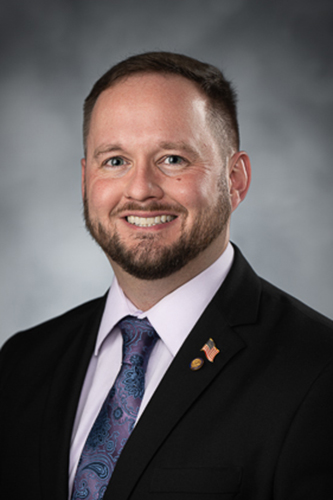
Del. Elliott Pritt
Sponsored bills
Maddy summaryHB 4834 amends West Virginia law to explicitly permit women’s wrestling as a sanctioned sport in public high schools and public charter schools. The bill directly affects school districts and athletic programs by allowing them to officially recognize and sponsor girls' wrestling teams under existing athletic regulations. It adds women’s wrestling to the list of permitted interscholastic athletic events without changing eligibility rules for students. The change requires the West Virginia Secondary School Activities Commission to approve wrestling as a sanctioned sport under its authority.
Maddy summaryHB 5623, the Youth Mental Health Protection Act, prohibits licensed mental health providers in West Virginia from performing conversion therapy on anyone under 18. The bill specifically bans both direct conversion therapy and referrals to providers offering such services, covering clinical psychologists, social workers, school counselors, and other licensed professionals. Violations would be treated as unprofessional conduct, with first offenses resulting in written warnings and mandatory training, and repeat offenses leading to disciplinary action by licensing boards. This law directly affects minors under 18 and all mental health providers licensed in West Virginia who interact with youth clients.
Maddy summaryHB 5583, the West Virginia Seal of Civic Literacy Act, creates a formal recognition for high school students who demonstrate exceptional civics knowledge. It directly affects public high school students in West Virginia who complete required civics coursework and achieve specific benchmarks: scoring 90% or higher on the state civics assessment, earning a 4 or 5 on AP U.S. Government/History exams, or earning 90% or higher in dual-credit government/history courses. The seal will be affixed to diplomas or transcripts as an official academic distinction, promoting civic engagement without changing existing graduation requirements. This program aims to motivate deeper understanding of government structures, rights, and responsibilities through tangible recognition.
Maddy summaryHB 5575 appropriates $3.5 million from the General Revenue Fund for the West Virginia Special Olympics Program during fiscal year 2027. The funds will support county-level programming ($2 million, allocated equally to all 55 counties at ~$36,363 per county for local events and services) and state headquarters operations ($1.5 million for facilities, equipment, and statewide events). The Department of Education will administer the funds, requiring annual reports on expenditures, athlete participation, and program outcomes to the Joint Committee on Government and Finance. This bill directly affects Special Olympics athletes and local community programs across all West Virginia counties.
Maddy summaryHB 5632 sets a 60-day deadline for West Virginia municipalities and counties to approve or deny permit applications for property development. If a local government misses this deadline, the permit is automatically approved, unless the request requires prior state or federal agency approval (extending the deadline to 120 days total). The bill also requires local officials to provide written reasons for denials or claims that an application is incomplete. It aims to give applicants more time for review while aligning with existing legal notice requirements under Chapter 8A.
Maddy summaryThis is a commemorative House resolution honoring former West Virginia House Speaker and Chief Justice Timothy P. Armstead following his passing. It memorializes his service, names a conference room in the House as the "Speaker Tim Armstead Memorial Conference Room," and extends condolences to his family. The resolution does not create new laws or affect policy - it formally recognizes his legacy and contributions to West Virginia.
Maddy summaryHB 5571 provides a $6,000 pay equity adjustment over three years ($2,000 annually) for non-uniformed administrative staff in West Virginia's Division of Corrections and Rehabilitation. The increases begin July 1, 2026, and apply to full-time equivalent employees not in uniformed roles, such as office or support positions. Funding comes from general revenue appropriations for state divisions, while regional jail staff receive funding from a special revenue fund. This bill directly affects non-uniformed correctional facility employees who face recruitment and retention challenges, without altering existing pay grade maximums.
Maddy summaryHB 5495 requires West Virginia public schools to use only software that is "academically effective" and complies with a statewide digital privacy agreement. The bill mandates that all school software must be verified by independent third parties for educational value, aligns with curriculum standards, avoids "addictive design features" (like excessive gamification tied to time spent), and prohibits data collection for non-educational purposes. It directly affects schools (via County Boards of Education), software vendors (who must sign the privacy agreement), and parents (who will receive annual notices about software used). Key mechanisms include creating a master list of approved software, requiring periodic audits for compliance, and establishing a process for parental complaints about software. The bill aims to ensure school technology supports learning while protecting student privacy and data.
Maddy summaryHB 5517 requires West Virginia's Office of Insurance Commissioner to create and maintain centralized, geographically specific lists of licensed bail bondsmen for each county and detention facility. The bill mandates that these lists - showing only bondsmen operating within 50 miles of the facility - be posted prominently in jails and police stations, with detainees given immediate access to select a bondsman from the list. It also establishes a statewide master list containing all licensed bondsmen's details, which facilities must provide upon request. The legislation grants the Insurance Commissioner exclusive authority to manage these lists, replacing local efforts, and ensures detainees can contact any licensed bondsman statewide.