

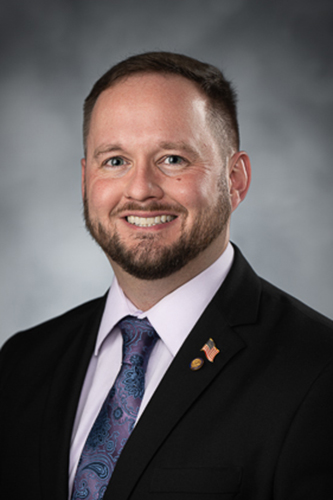
Maddy summaryHB 2932 would amend West Virginia law to reduce the number of Associate State Superintendent of Schools positions from two to one. The bill directly affects the State Department of Education's staffing structure by changing the legal limit on this specific role. It does not address salaries or other responsibilities, only establishing a maximum of one position instead of the current two. This is a structural change to the department's organization, not a salary adjustment as the title mistakenly suggests. The bill is currently in the House Education Committee for review.
Del. Elliott Pritt
Sponsored bills
Maddy summaryHB 2877 requires the West Virginia Division of Motor Vehicles to provide the Tax Assessor with records of all personal property (such as registered vehicles) maintained by the DMV. This combines the DMV's records with the Assessor's office to streamline personal property tax assessments. The bill directly affects state agencies (DMV and Assessor's office) and aims to improve the accuracy of tax valuations for property owners. It is a procedural change focused on data sharing, not a modification to tax rates or policies.
Maddy summaryHB 2896 would change how West Virginia's Public Service Commission (PSC) commissioners are selected. Currently appointed by the governor, the bill requires the three commissioners to be elected by voters starting in 2026, with elections held every four years alongside other statewide offices. The bill specifies that commissioners must appear on the general election ballot and establishes procedures for filling vacancies. This directly affects the PSC (which regulates utilities like gas, water, and electricity) and West Virginia voters who would elect these officials for the first time.
Maddy summaryHB 2840 defines a "critical vacancy" in West Virginia public schools as a position essential for student success, safety, or meeting compliance/certification standards. The bill requires school districts to have certified staff members in the relevant subject area fill such vacancies temporarily until a permanent hire is made. It mandates that districts post critical need positions for at least 10 days before hiring prospective teachers and allows one-time financial incentives for recruitment. This bill directly affects school districts, certified educators, and students in schools facing staffing shortages.
Maddy summaryHB 2841 (2025) establishes a population-based formula to set maximum salaries for all 55 West Virginia county school superintendents, effective July 1, 2026. The bill requires the West Virginia Department of Education to create a salary schedule where maximum pay for each superintendent is determined by their county's student population, ensuring equitable pay per pupil across all counties. Salaries must be prorated so that the maximum amount per student remains consistent regardless of county size, with the schedule updated at least every five years. This directly affects county school superintendents by replacing current salary-setting methods with a standardized, population-linked system.
Maddy summaryHB 2923 requires West Virginia's Commissioner of Highways to install rumble strips on all double-yellow lined highways during any road upgrade project, beginning July 1, 2025. This mandate applies specifically to roadways marked with double yellow lines, which typically separate opposing traffic flows. The bill directly affects state highway maintenance operations and drivers traveling on these roads by adding a physical safety feature to reduce run-off-road collisions. It creates a concrete, enforceable requirement for highway upgrades rather than proposing new funding or altering existing traffic laws.
Maddy summaryHB 2926 removes all fees West Virginia teachers pay to the state for obtaining or renewing teaching licenses, certifications, and registering continuing education credits. It requires the West Virginia Department of Education to eliminate these fees by January 30, 2026. This directly affects all teachers seeking to maintain or advance their teaching credentials within the state. The bill removes administrative costs but does not change the educational requirements for certification or continuing education.
Maddy summaryHB 2930 removes the 140-day annual limit on work for retired teachers who substitute teach, allowing them to work beyond that threshold during actual teaching vacancies. The bill specifically permits retired substitute teachers to exceed 140 days without penalty when school districts face genuine staffing shortages. It prohibits retirement benefit reductions or additional contributions for retired teachers working under these conditions. This change directly affects retired substitute teachers in West Virginia school districts experiencing teacher shortages.
Maddy summaryHCR 65 is a West Virginia legislative resolution urging the U.S. Congress and Department of Energy to fulfill federal obligations under the Nuclear Waste Policy Act of 1982 regarding spent nuclear fuel. It highlights that over 90,000 metric tons of spent fuel are stored at 76 sites nationwide, with taxpayers bearing $9 billion in costs and nuclear customers having prepaid $46 billion for disposal, yet no permanent repository exists. The resolution specifically requests Congress and the DOE to implement recommendations from the Blue-Ribbon Commission, streamline regulations, and establish a deep geologic repository. It directly affects nuclear utilities, taxpayers, and communities hosting nuclear sites that face long-term storage challenges. The resolution is procedural and non-binding, aiming to prompt federal action on a decades-old policy gap.
Maddy summaryHB 2766 creates a tax credit program to help low-income workers obtain vehicles by providing refundable tax credits to individuals and dealers. It allows individual taxpayers who donate eligible vehicles to qualified charities to receive up to $6,000 per vehicle, and licensed automobile dealers who sell or donate such vehicles to low-income workers to receive up to $6,000 per vehicle based on the discount from fair market value. Eligible vehicles must be safe (no salvage history, no open safety recalls, and with a 90-day warranty) and are provided to workers in households earning at or below 150% of the federal poverty level through qualified charitable organizations. The program has a maximum annual tax credit limit of $300,000 for 2021-2022 and $1 million for subsequent years, with the Tax Commissioner tracking claims.