

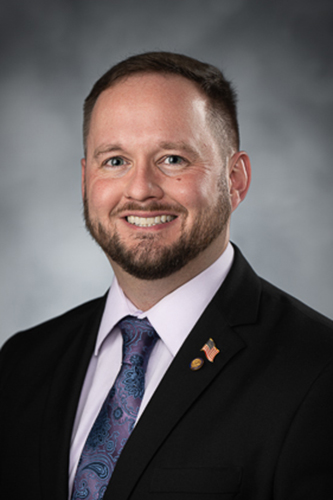
Photo of Elliott Pritt
R West Virginia House of Delegates · District 50 On the 2026 ballot

Del. Elliott Pritt

Compare
Total votes
3,175
all sessions
Attendance
92%
255 missed
Lower than 78% of chamber peers
With party
90%
of cast votes
Lower than 93% of chamber peers
Bipartisan score
5%
crosses aisle rarely
Higher than 92% of chamber peers
Sponsored
520
bills & resolutions
Higher than 99% of chamber peers
Committees
4
assignments
520 bills and resolutions

Sponsored bills

Total
520
Primary
176
Co-sponsor
344
This page
520
matching current filters
Primary HB 4046
In committee · West Virginia House of Delegates · Lead sponsor
Relating to Rural Recycling Co-ops

Maddy summaryHB 4046 creates a new exception in West Virginia law to protect established rural recycling cooperatives from being displaced by certified commercial waste carriers. It allows these cooperatives to continue operating in the same area if they have served members continuously for at least 12 consecutive months before a waste carrier receives a certificate of need for identical services. The bill specifically applies to cooperatives collecting recyclable materials generated by their members, excluding items already handled by certified waste carriers in the area. This directly affects rural communities by preserving locally-run recycling programs that serve members through community-based collection systems.

In committee Jan 14, 2026 0 co-sponsors
Primary HB 4144
In committee · West Virginia House of Delegates · Lead sponsor
To require the state to pay all state employees a $500 Holiday Bonus (Christmas) if state surplus revenues exceed 100$ million annually

Maddy summaryHB 4144 would require West Virginia to pay eligible state employees a $500 Christmas bonus annually if the state's surplus revenues exceed $100 million in a given year. The bonus applies to state employees with at least three years of service and is paid in addition to any other salary increases approved by the Legislature. This provision directly affects state workers meeting the service requirement, contingent on the state having sufficient excess funds. The bill does not specify how surplus revenue is calculated or who administers the payment, focusing solely on the bonus trigger and eligibility.

In committee Jan 14, 2026 0 co-sponsors
Primary HB 4054
In committee · West Virginia House of Delegates · Lead sponsor
WV code §19-20-20 apply to all animals, not just dogs

Maddy summaryHB 4054 would expand West Virginia's existing law (§19-20-20) to apply to all animals, not just dogs and cats, by removing the current limitation. The bill prohibits owning any "vicious pet" (defined as an animal known to be dangerous or prone to biting) and allows humane officers to euthanize such animals after a court authorizes it. This change directly affects pet owners who keep animals deemed vicious, including those currently covered under the dog/cat-specific law. The key mechanism replaces the current "dogs and cats" language with a general reference to "any animal," broadening the law's scope. The bill is currently in the House Judiciary Committee for review.

In committee Jan 14, 2026 0 co-sponsors
Primary HB 4187
In committee · West Virginia House of Delegates · Lead sponsor
Require Certified Fire Investigators to be classified as professionals under the State Sales and Usage Tax exemptions

Maddy summaryHB 4187 amends West Virginia's tax code to classify certified fire investigators as "professional services" eligible for state sales tax exemptions. This change directly affects certified fire investigators and the businesses or individuals who hire them, as their services would no longer be subject to sales tax. The bill achieves this by adding "certified fire investigators" to the existing definition of professional services under Section 11-15-2 of the state tax code. The provision applies to all services provided by certified fire investigators meeting the state's certification requirements.

In committee Jan 14, 2026 0 co-sponsors
Co-sponsor HB 4153
In committee · West Virginia House of Delegates · Co-sponsor
West Virginia Skilled and Ready to Work Internship and Apprenticeship Incentive Act

Maddy summaryHB 4153 creates a tax credit for West Virginia employers who hire interns or apprentices in high-demand fields like advanced manufacturing, IT, healthcare, and skilled trades. Eligible employers receive a 50% tax credit on wages paid to qualifying interns/apprentices, up to $10,000 per person annually (capped at $150,000 total per employer yearly). To qualify, positions must include at least 120 hours of structured training and exclude retail, food service, janitorial, and general administrative roles. Employers must apply for certification through the West Virginia Department of Economic Development and report details annually to claim the credit.

In committee Jan 14, 2026 1 co-sponsor
Co-sponsor HB 4162
In committee · West Virginia House of Delegates · Co-sponsor
WV Economic Development and Property Revitalization Tax Credit

Maddy summaryHB 4162 creates a tax credit program to encourage property rehabilitation in West Virginia. It provides businesses and property owners a 25% credit (up to $2 million) on eligible renovation costs or a 50% credit on increased property value (annual for 5 years), requiring a $50,000 investment, 30% value increase, and 5 years of active commercial use. Additional credits (up to 15% total) apply for projects in rural areas (population <50,000, high unemployment, or designated zones), brownfield sites, or registered historic properties. The program is budget-neutral, capped at $50 million annually, and requires annual reporting on investments, jobs created, and property use.

In committee Jan 14, 2026 1 co-sponsor
Primary HB 4052
In committee · West Virginia House of Delegates · Lead sponsor
To enhance the safety of first responders at emergency scenes (Halo Law)

Maddy summaryHB 4052, known as the HALO Act, makes it a misdemeanor to approach within 14 feet of a first responder after being warned not to, if the person intends to interfere with their duties, threaten them with harm, or harass them. The bill defines "first responder" to include police officers, correctional probation officers, and emergency medical personnel. It criminalizes specific actions like disrupting emergency operations or causing emotional distress, with penalties under existing obstruction laws. The law aims to protect first responders at active emergency scenes by creating clear boundaries for public conduct.

In committee Jan 14, 2026 0 co-sponsors
Primary HB 4197
In committee · West Virginia House of Delegates · Lead sponsor
Mandating health insurance coverage treatment of pediatric patients diagnoced with PANDAS or PANS

Maddy summaryHB 4197 requires all health insurance plans in West Virginia to cover medically necessary treatments for pediatric patients diagnosed with PANDAS (Pediatric Autoimmune Neuropsychiatric Disorders Associated with Streptococcal Infections) or PANS (Pediatric Acute-onset Neuropsychiatric Syndrome). The bill mandates coverage for specific treatments including antibiotics, medications, behavioral therapies, immunomodulating medicines, plasma exchange, and IVIG therapy, without higher copays or deductibles than other covered services. Insurers cannot deny or delay coverage based on prior treatment history, alternative diagnoses (like autoimmune encephalopathy), or previous coverage for similar conditions. This applies to all group health insurance plans and managed care organizations issued or renewed in West Virginia on or after January 1, 2027.

In committee Jan 14, 2026 0 co-sponsors
Primary HB 2499
Signed into law · West Virginia House of Delegates · Lead sponsor
Training course for principals in public schools; informing teachers of their rights and protections; IEP format

Maddy summaryThis bill requires public school principals to complete mandatory training on teachers' rights and workplace protections. It also mandates that principals inform all teachers about their specific rights and protections in the workplace. Additionally, the bill standardizes the format for Individualized Education Programs (IEPs) used in special education. These requirements directly affect principals, teachers, and special education staff in public schools across the state.

Signed into law Jul 31, 2025 0 co-sponsors
Co-sponsor HB 2354
Signed into law · West Virginia House of Delegates · Co-sponsor
Banning certain products from food in West Virginia

Maddy summaryThis bill prohibits specific food additives deemed unsafe from being used in school nutrition programs in West Virginia, directly affecting schools and meal providers participating in state and federal school feeding initiatives. The legislation explicitly bans butylated hydroxyanisole, propylparaben, and six FD&C food colorings from meals served in schools, while allowing these ingredients in other food products outside of school nutrition programs. The law also updates existing definitions of adulterated food to include these specific additives and exempts minor violations from criminal penalties if the total value of adulterated food sold under $5,000 per month. These changes take effect on August 1, 2025, for school programs and January 1, 2028, for broader food safety provisions.

Signed into law Jul 31, 2025 1 co-sponsor
Showing 211 to 220 of 520 bills
Previous 1 … 21 22 23 … 52 Next