

Maddy summaryHB 4985, the "Strategic and Critical Resources Act," defines specific minerals (like lithium, cobalt, and rare earth elements) as critical to West Virginia's security and economy. It prohibits local governments outside cities from regulating the extraction of these resources or the development of related facilities, preempting local ordinances. The bill also restricts foreign adversaries (entities designated by federal law) from owning or controlling land used for extracting these resources. Importantly, the law does not override federal environmental regulations or state building codes, and it aligns with existing federal restrictions on foreign ownership.
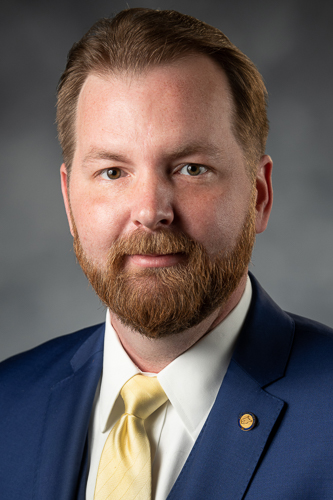
Del. Daniel Linville
Sponsored bills
Maddy summaryHB 4972 prohibits motorcycle lane splitting (riding between lanes of moving traffic) and lane filtering (riding between stopped/slow vehicles) on West Virginia roads, directly affecting motorcycle riders. The bill preserves a motorcycle’s right to occupy an entire lane and bans maneuvers that would force motorcycles to share lanes. Exceptions include following law enforcement direction, avoiding immediate hazards like debris, or participating in permitted events with traffic control. Violations carry fines up to $500 for repeat offenses, with rules to be developed for driver education and licensing. The law aims to clarify existing traffic rules without restricting motorcycles’ full use of a single lane.
Maddy summaryThis bill adjusts state funding for West Virginia school districts when counties cannot collect full property taxes due to court orders, valuation errors, or pending legal cases. It requires the state to increase aid by the amount of lost property tax revenue (e.g., from tax refunds, incorrect valuations, or court delays), but only if the legislature funds the state share adequately. The adjustment also applies to counties receiving payments in lieu of property taxes. This ensures school funding remains stable despite fluctuations in local tax collections.
Maddy summaryHB 4478 creates legal immunity for West Virginia racing facilities from certain civil claims by surrounding property owners. It protects facilities operating lawfully for five or more years against lawsuits based on noise, vibration, nuisance, or similar claims brought by owners who acquired property after the facility opened or failed to sue within five years. The bill also prohibits local governments from enacting rules that conflict with this immunity. Key provisions include defining "racing facility" broadly and stating that compliance with state/federal law is prima facie evidence of reasonable operation. The law would take effect immediately upon passage.
Maddy summaryHB 4766 increases West Virginia's homestead property tax exemption for eligible homeowners from a flat $20,000 to 50% of a property's assessed value (capped at $20,000 if the property is valued below $40,000). This change directly affects homeowners aged 65 or older or certified as permanently and totally disabled who meet the state's residency requirements. The bill modifies existing law (§11-6B-3) to adjust the exemption calculation method while preserving the same eligibility criteria. It does not alter residency rules or other qualifying conditions for the exemption.
Maddy summaryHB 4746, the First Amendment Preservation Act, prohibits West Virginia state agencies from entering contracts with advertising or marketing firms that use media monitoring organizations to rate news sources for bias or misinformation. It requires all companies bidding for state advertising contracts to provide written certification they comply with this rule, and mandates agencies to obtain such certification before renewing existing contracts. The law specifically targets firms that assess content accuracy or bias (like fact-checkers), but excludes those measuring audience size or compiling news clippings. It applies to all state contracts executed on or after July 1, 2026, affecting state departments, universities using state funds, and advertising agencies seeking state business.
Maddy summaryHB 4753 prohibits public utility companies (like electricity, gas, and water providers) from using funds collected from customers to make political contributions or charitable donations. Specifically, it bans contributions to political candidates, campaigns, political action committees, or charitable organizations using ratepayer money. Violations would be classified as criminal offenses with penalties, and the bill creates new legal definitions to clarify these restrictions. The law directly affects utility companies and their use of customer funds, aiming to prevent public money from influencing politics or charity.
Maddy summaryHCR 11 is a West Virginia state resolution urging Congress to call an Article V constitutional convention. It seeks to propose amendments requiring that U.S. Representatives, Senators, federal judges (Article III), and Cabinet Secretaries be natural-born U.S. citizens with sole U.S. citizenship. The resolution does not change existing law but applies to Congress under Article V of the Constitution to initiate a convention focused solely on this citizenship requirement for those federal positions. This is a procedural step by West Virginia to join other states in seeking a constitutional amendment, not a legislative bill with immediate effect.
Maddy summaryHCR 12 is a West Virginia House Concurrent Resolution requesting Congress to call a constitutional convention to propose an amendment. It specifically seeks to amend the U.S. Constitution to establish a fixed number of nine justices on the Supreme Court, as Article III currently does not specify the number. The resolution cites Article V of the Constitution, which allows states to request such a convention, and urges Congress to fulfill this duty. This resolution does not change the Court's size itself but formally requests action from Congress and other states to pursue the proposed amendment.
Maddy summaryWest Virginia House Bill 4583 establishes November 7 annually as "Victims of Communism Day" for public schools. It requires high school students in U.S. Government classes (mandated under §18-2-9(a)(1)) to receive at least 45 minutes of instruction about communist regimes' impacts, including specific examples like Mao Zedong's Cultural Revolution, Stalin's Soviet system, and Pol Pot's Khmer Rouge. The bill mandates that curriculum content cover how victims suffered through poverty, starvation, migration, violence, and speech suppression under these regimes. The State Board of Education must adopt revised social studies standards incorporating these requirements by April 1, 2026, with implementation beginning in the 2026-2027 school year.