

Maddy summaryThis House Resolution (HR 11) encourages West Virginia's K-12 students to design a new state highway route number shield for the 2026 anniversaries of the U.S. founding (250th) and the U.S. numbered highway system (100th). It directs the West Virginia Division of Highways and Department of Tourism to hold a statewide student design competition, requiring the shield to maintain federal safety standards for legibility while incorporating West Virginia identity. The winning design would be implemented gradually on state highways starting July 2027, replacing existing signs only as they wear out, and the student designer would receive legislative recognition. The resolution is procedural and non-binding, focusing on celebration and civic engagement rather than new policy.
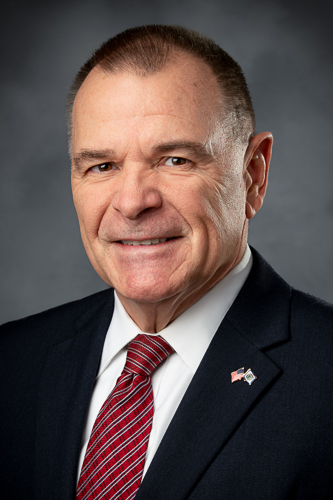
Del. Bill Ridenour
Sponsored bills
Maddy summaryHR 9 is a ceremonial resolution honoring the late West Virginia House Delegate Douglas John Skaff Jr. It expresses the House of Delegates' condolences to his family and commemorates his service, including his roles as a delegate representing multiple districts and as Minority Leader. The resolution has no policy impact - it is purely symbolic, acknowledging his career in public service, business, and community leadership. It was unanimously adopted by the House on February 5, 2026, the same day it was introduced.
Maddy summaryHB 5215 limits landowner liability when all-terrain vehicles (ATVs) are operated for recreational purposes on their property. It specifically protects landowners from legal responsibility if the ATV use qualifies as "noncommercial recreational activity" under the bill - meaning no charge exceeding $50 per year per participant is collected. The law defines "recreational purposes" to explicitly include ATV riding, while excluding commercial operations or activities charging more than the $50 annual limit. This policy change modifies West Virginia's liability laws to shield landowners from lawsuits related to ATV accidents during permitted recreational use.
Maddy summaryHB 4446 establishes a four-year pilot program in Kanawha, Ohio, Mineral, and Raleigh counties to provide free Fire Fighter I and II training through community colleges. It directly affects eligible high school and college students in those counties by covering tuition and fees for courses meeting West Virginia State Fire Commission standards. The program requires each county to provide at least one certified fire service instructor, funded by the Higher Education Policy Commission, with annual reports tracking participation, certifications earned, costs, and student employment. The pilot runs from July 2026 through June 2030, with mandatory evaluations to determine future expansion or termination.
Maddy summaryThis bill clarifies and expands cooperation between law enforcement agencies within West Virginia and with agencies in neighboring states. It defines key terms such as "criminal justice enforcement personnel" and "law-enforcement agency" to establish who can participate in joint efforts. The legislation allows agency heads to request temporary assistance for investigations, including sharing personnel, equipment, and technical resources, with written requests required except in emergencies involving immediate danger to life. Personnel assigned to other agencies retain their original benefits and jurisdiction while operating under the operational command of the host agency's leadership. Agreements must be filed with local circuit clerks to remain in effect.
Maddy summaryHB 5160 prohibits all unauthorized atmospheric modification activities - such as cloud seeding, stratospheric aerosol injection, and directed-energy heating - within or above West Virginia. The law establishes the West Virginia Department of Environmental Protection (DEP) as the lead agency to enforce the ban, deny permits for such activities, and pursue penalties for violations. It applies to all individuals, organizations, and government entities conducting atmospheric modification without state authorization. Violations could trigger state enforcement actions, fines, and cooperative investigations with law enforcement agencies. The bill aims to protect public health, agriculture, and environmental integrity by preventing unregulated atmospheric changes.
Maddy summaryHB 4994 requires utilities (like power and gas companies) to move or adjust their lines from state highway rights-of-way when needed for road construction projects. It mandates the state’s Highway Division to provide utilities with up to 18 months’ written notice and specific procedures for submitting relocation plans and work schedules. The bill also requires the state to reimburse utilities for work they must redo if highway project plans change after construction begins. Utilities are not held liable for delays caused by state schedule changes, incomplete right-of-way acquisitions, or extreme weather, as outlined in the bill.
Maddy summaryHB 5113 requires healthcare providers in West Virginia to ask patients in advance if they consent to being treated by a medical resident (a doctor in training) or having a resident observe a procedure during routine appointments. If a patient declines, the appointment must be rescheduled with a licensed physician instead, applying only to non-emergency situations. This bill directly affects patients seeking routine care and healthcare facilities, ensuring they can choose their primary provider. Emergency or urgent care is exempt from this requirement, as stated in the bill's provisions.
Maddy summaryHB 5111 prohibits all public and private higher education institutions in West Virginia from requiring vaccines as a condition for student enrollment, faculty or staff employment, or participation in campus activities. The bill bans institutions from offering rewards for vaccinations and requires that any free vaccines provided on campus must include informed consent. It also ensures students, faculty, and staff cannot be denied access to educational programs or jobs solely due to declining vaccination. The law applies immediately upon passage and does not prevent institutions from offering free vaccines with consent.
Maddy summaryHB 5112 prohibits any West Virginia law from requiring residents to receive or use medical products, such as vaccines or treatments. It directly affects all West Virginia residents and ensures no penalties (like fines) or loss of benefits (such as services or programs) can be imposed for refusing a medical product or declining to disclose its use. The bill amends health code §16-3-1 to state that no law may coerce medical product use, penalize refusal, or deny benefits based on refusal or disclosure. This applies broadly to all medical products under state law, not limited to specific treatments. The law would override existing or future state mandates requiring medical products during public health emergencies.