

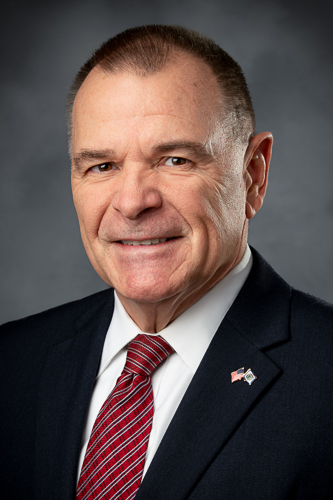
Photo of Bill Ridenour
R West Virginia House of Delegates · District 100 On the 2026 ballot

Del. Bill Ridenour

Compare
Total votes
3,175
all sessions
Attendance
96%
133 missed
Near the chamber average
With party
90%
of cast votes
Lower than 87% of chamber peers
Bipartisan score
5%
crosses aisle rarely
Higher than 86% of chamber peers
Sponsored
536
bills & resolutions
Higher than 98% of chamber peers
Committees
3
assignments
536 bills and resolutions

Sponsored bills

Total
536
Primary
115
Co-sponsor
421
This page
536
matching current filters
Primary HB 4845
In committee · West Virginia House of Delegates · Lead sponsor
Prohibiting entry by illegal aliens

Maddy summaryHB 4845 (West Virginia) creates new state-level criminal offenses for "illegal entry into the state" and "illegal reentry," directly affecting individuals entering West Virginia without legal authorization. Key provisions establish penalties for these offenses, prohibit probation or parole for convictions, require the Criminal Identification Bureau to maintain records of such entries, and grant immunity to officials enforcing these provisions. The bill also mandates court procedures for deportation orders and ensures prosecution continues regardless of federal immigration status. It does not address border security but defines state-level criminal liability for unauthorized entry.

In committee Jan 27, 2026 0 co-sponsors
Co-sponsor HB 4843
In committee · West Virginia House of Delegates · Co-sponsor
Relating to consumer protection and the collection of certain personally identifiable information.

Maddy summaryHB 4843 prohibits businesses in West Virginia from using scanner technology to collect personal details like driver's license numbers, Social Security numbers, or medical history during consumer transactions - except for verifying age. The bill defines "scanner technology" as devices that capture license barcodes/magnetic strips, print age results, store transaction records, and transfer data, banning their use for collecting non-age PII. It directly affects retailers, bars, or any business using such scanners for age verification or data collection. Violations are classified as unfair or deceptive business practices under West Virginia law, creating enforceable penalties. The bill focuses solely on restricting specific scanner technology, not general data privacy rules.

In committee Jan 27, 2026 1 co-sponsor
Primary HB 4837
In committee · West Virginia House of Delegates · Lead sponsor
Establish time limits on Legislators becoming lobbyists

Maddy summaryHB 4837 extends the waiting period for former state legislators and other public officials to become lobbyists, changing the current one-year ban to five years. This bill directly affects former state legislators, county officials, and public employees who leave their government roles. The key mechanism requires these individuals to wait five years before lobbying state agencies or officials, aiming to reduce potential conflicts of interest from recent government service. The change applies to all public officials covered under West Virginia’s ethics code, including those in county and municipal positions.

In committee Jan 26, 2026 0 co-sponsors
Primary HB 4812
In committee · West Virginia House of Delegates · Lead sponsor
To ensure that West Virginia law enforcement entities are not compelled or commandeered by federal authorities to conduct activities that violate our citizens’ Constitutional rights

Maddy summaryHB 4812, the West Virginia Anti-Federal Commandeering Act, prohibits federal authorities from compelling state or local law enforcement agencies to conduct activities that violate constitutional rights. It defines "commandeering" as federal control of state resources without explicit state authorization and requires such authorization for any federal request. The bill empowers the West Virginia Attorney General to challenge federal actions deemed unconstitutional and to publish model policies for law enforcement. It directly affects all West Virginia law enforcement entities, including local police departments and state agencies, by preventing federal coercion of their personnel or resources. The law aims to protect constitutional rights while allowing cooperation on lawful federal-state law enforcement efforts.

In committee Jan 26, 2026 0 co-sponsors
Primary HB 4766
In committee · West Virginia House of Delegates · Lead sponsor
Change the Homestead Exemption

Maddy summaryHB 4766 increases West Virginia's homestead property tax exemption for eligible homeowners from a flat $20,000 to 50% of a property's assessed value (capped at $20,000 if the property is valued below $40,000). This change directly affects homeowners aged 65 or older or certified as permanently and totally disabled who meet the state's residency requirements. The bill modifies existing law (§11-6B-3) to adjust the exemption calculation method while preserving the same eligibility criteria. It does not alter residency rules or other qualifying conditions for the exemption.

In committee Jan 23, 2026 0 co-sponsors
Primary HB 4788
In committee · West Virginia House of Delegates · Lead sponsor
Allow school board members to run for the state legislature

Maddy summaryHB 4788 allows current West Virginia county school board members to run for state legislative seats while retaining their school board position during the campaign. It amends eligibility rules to explicitly permit school board members to seek other public office (including the state legislature) without resigning from the school board, as long as they do not receive compensation for other boards related to public schools. The bill also provides legal protections, requiring county boards to reimburse members for legal costs if they rely on an Ethics Commission advisory opinion confirming eligibility. This directly affects school board members who wish to pursue state legislative office without leaving their current role. The change removes a previous restriction that barred school board members from holding other public office during campaigns.

In committee Jan 23, 2026 0 co-sponsors
Primary HB 4787
In committee · West Virginia House of Delegates · Lead sponsor
The Anti-Terrorism Act

Maddy summaryHB 4787, the Anti-Terrorism Act, creates new felony charges for terrorism in West Virginia, directly affecting individuals or groups committing acts defined as terrorism (including violent protests, riots, or attacks on critical infrastructure). Key provisions include mandatory consecutive prison sentences with no probation, restitution payments to victims up to three times their economic harm (such as lost wages or business shutdown costs), and requiring the Attorney General to designate terroristic entities. The bill also explicitly defines fentanyl as a weapon of mass destruction and prohibits "terrorist swatting" (false emergency reports to harass targets). It applies to anyone committing terrorism within West Virginia, regardless of where the act occurred.

In committee Jan 23, 2026 0 co-sponsors
Co-sponsor HB 4797
In committee · West Virginia House of Delegates · Co-sponsor
To create the Charlie Kirk Memorial First Amendment Freedom Act.

Maddy summaryHB 4797 creates two ceremonial observances in West Virginia: "First Amendment Freedom of Speech Day" (designated as the Friday following October 14 each year) and "First Amendment Freedom of Speech Appreciation Week" (the week beginning the Sunday before Thanksgiving). The bill amends state law to add these to the list of official legal holidays and special memorial weeks, affecting state government operations, courts, and schools that observe these days. It is a memorial bill honoring Charlie Kirk, with no substantive policy changes beyond the holiday designation. The bill is procedural and does not alter existing laws or regulations.

In committee Jan 23, 2026 1 co-sponsor
Co-sponsor HB 4761
In committee · West Virginia House of Delegates · Co-sponsor
Raise the Penalties for Murder and attempted Murder

Maddy summaryHB 4761 modifies parole eligibility for individuals convicted of murder or attempted murder in West Virginia. It increases the minimum time inmates must serve before becoming parole-eligible: 20 years for second-degree murder (up from 10), and 10-40 years for attempted first-degree murder (up from 3-15) or 5-20 years for attempted second-degree murder (up from 1-3). The bill also adds provisions allowing prosecutors and victims' families to attend parole hearings remotely or in person. These changes directly affect inmates serving sentences for these specific violent offenses. The bill does not alter sentence lengths but restricts early release opportunities for these crimes.

In committee Jan 22, 2026 1 co-sponsor
Co-sponsor HB 4757
In committee · West Virginia House of Delegates · Co-sponsor
Establishing privacy regarding medical treatments

Maddy summaryHB 4757 (West Virginia, 2026) prohibits requiring patients to receive, be administered, or disclose medical treatment history unless the manufacturer of the medical product is liable for death or serious injury caused by it. The bill directly affects patients and healthcare providers by blocking mandatory treatments or disclosure of medical product use, applying to all medical devices, drugs, and biologics. Its key mechanism requires manufacturer liability as a condition before any medical product use or disclosure can be mandated. The bill aims to establish privacy rights around medical treatments but does not create new penalties or enforcement procedures.

In committee Jan 22, 2026 1 co-sponsor
Showing 131 to 140 of 536 bills
Previous 1 … 13 14 15 … 54 Next