

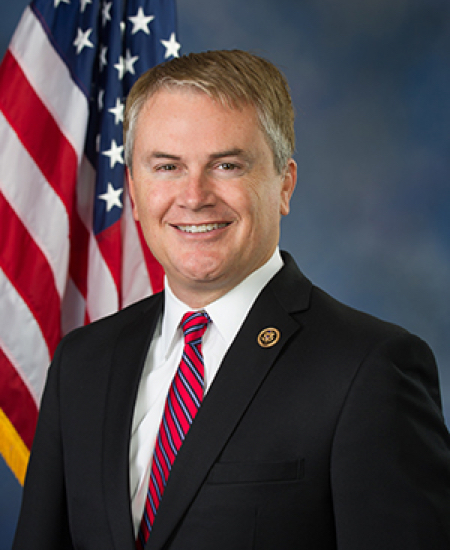
Photo of James Comer
R United States House · District 1 · Kentucky On the 2026 ballot

Rep. James Comer

Compare
Total votes
2,818
all sessions
Attendance
99%
39 missed
Near the chamber average
With party
93%
of cast votes
Near the chamber average
Bipartisan score
4%
crosses aisle rarely
Near the chamber average
Sponsored
354
bills & resolutions
Lower than 96% of chamber peers
Committees
4
assignments
354 bills and resolutions

Sponsored bills

Total
354
Primary
34
Co-sponsor
320
This page
354
matching current filters
Primary HR 8464
Passed · Washington House · Lead sponsor
Stopping Fraudulent Payments Act

Maddy summaryThe Stopping Fraudulent Payments Act directs federal agencies to temporarily delay, condition, or split payments when there is a high risk of fraud or if a recipient is flagged in the Do Not Pay system. Under this law, agencies must notify payees of any pauses, explain the specific risk indicators involved, and allow recipients to contest the decision within a set timeframe. The bill requires that payments be resolved within 45 days and protects government officials from personal liability if they act in good faith to stop suspicious transactions. Additionally, it allows for the exemption of routine, historically consistent payment amounts while investigating anomalous or unusually large portions of a transfer.

Passed Jun 11, 2026 0 co-sponsors
Primary HR 8463
Passed · Washington House · Lead sponsor
Pre-Payment Fraud Prevention and Treasury Data Access Act

Maddy summaryThis bill establishes new pre-payment verification requirements for federal agencies to prevent fraud before any money is disbursed. It mandates that agencies confirm a payee's identity, bank account validity, and eligibility using a centralized "Do Not Pay" system that cross-references data from the Treasury, IRS, and Social Security Administration. Additionally, the legislation requires recipients of federal awards over $50,000 to submit a one-time report detailing how they intend to use the funds within 180 days of receiving them. The act also expands the types of sensitive data the Treasury can access to detect improper payments while including specific privacy protections and penalties for unauthorized disclosure.

Passed Jun 9, 2026 0 co-sponsors
Co-sponsor HR 3490
Signed into law · Washington House · Co-sponsor
Gerald E. Connolly Esophageal Cancer Awareness Act of 2025

Maddy summaryHR 3490, the Gerald E. Connolly Esophageal Cancer Awareness Act of 2025, requires the Government Accountability Office (GAO) to study federal health benefits coverage for esophageal cancer. Specifically, the GAO must report on healthcare spending for federal employees and retirees diagnosed with esophageal cancer and how often high-risk individuals under this program undergo recommended screenings. The bill targets federal employees and retirees covered by the Federal Employees Health Benefits Program who meet specific risk factors (such as age 50+, smoking history, or GERD). It does not create new programs but mandates a study to assess current screening practices and costs. The goal is to inform future policy based on data about screening adherence and healthcare impacts.

Signed into law Jun 9, 2026 1 co-sponsor
Co-sponsor HR 1041
Passed · Washington House · Co-sponsor
Veterans 2nd Amendment Protection Act

Maddy summaryHR 1041, the Veterans 2nd Amendment Protection Act, prevents the Department of Veterans Affairs (VA) from automatically sending veterans' personal information to the national background check system (NICS) solely because a court has appointed a fiduciary (like a guardian) to manage their benefits. This directly affects veterans who have a fiduciary appointed due to mental health or cognitive challenges but are not deemed a danger to themselves or others. The bill requires a court order finding the veteran poses a danger before any such information can be shared with the NICS. It changes VA procedures to block unnecessary barriers to firearm ownership for veterans who qualify for fiduciary support without a judicial determination of danger.

Passed Jun 2, 2026 1 co-sponsor
Co-sponsor HR 2145
In committee · Washington House · Co-sponsor
Recycling Infrastructure and Accessibility Act of 2025

Maddy summaryThe Recycling Infrastructure and Accessibility Act of 2025 establishes a competitive federal grant program to fund projects improving recycling access in underserved communities. It authorizes $30 million annually (2025-2029) for grants to states, local governments, tribes, or public-private partnerships to build infrastructure like transfer stations, expand curbside collection, or reduce transport costs. Grants must be $500,000-$15 million, with 70% reserved for projects in communities lacking a materials recovery facility within 75 miles. The program requires grantees to report on implementation and outcomes, excluding funding for recycling education.

In committee May 21, 2026 1 co-sponsor
Co-sponsor HR 7024
In committee · Washington House · Co-sponsor
Hemp Planting Predictability Act

Hemp Planting Predictability Act This bill extends by two years the implementation of changes to the regulation of hemp products, which reimpose certain federal controls over some hemp products. Specifically, Congress enacted the FY2026 agriculture appropriations act (P.L. 119-37) on November 12, 2025. Effective November 12, 2026, the act modifies the statutory definition of hemp products that are considered to be lawful. This bill extends the effective date to November 12, 2028. As background, the 2018 farm bill excluded hemp from the Controlled Substances Act definition of marijuana and defined hemp . As a result, hemp and hemp-derived products at or below the 0.3% delta-9 tetrahydrocannabinol (THC, the psychoactive component of marijuana) concentration threshold were no longer regulated as Schedule I controlled substances and registration with the Drug Enforcement Administration was no longer required to cultivate or handle hemp and hemp-derived products. However, hemp remained subject to Department of Agriculture and Food and Drug Administration regulation. The 2025 changes to the definition of hemp, include changing the limit to a total THC concentration of not more than 0.3% on a dry weight basis rather than only delta-9 THC, explicitly including industrial hemp, excluding seeds from a cannabis plant that exceed a certain THC concentration, and excluding various types of hemp-derived cannabinoid products. Cannabinoids refer to unique chemical compounds that are found in hemp and marijuana (e.g., THC) and are known to exhibit a range of psychological and physiological effects.

In committee May 20, 2026 1 co-sponsor
Co-sponsor HR 7010
In committee · Washington House · Co-sponsor
To amend the Agriculture, Rural Development, Food and Drug Administration, and Related Agency Appropriations Act, 2026, to delay the implementation of amendments made by such Act to the hemp production provisions of the Agricultural Marketing Act of 1946.

This bill extends by two years the implementation of changes to the regulation of hemp products, which reimpose certain federal controls over some hemp products. Specifically, Congress enacted the FY2026 agriculture appropriations act (P.L. 119-37) on November 12, 2025. Effective November 12, 2026, the act modifies the statutory definition of hemp products that are considered to be lawful. This bill extends the effective date to November 12, 2028. As background, the 2018 farm bill excluded hemp from the Controlled Substances Act definition of marijuana and defined hemp . As a result, hemp and hemp-derived products at or below the 0.3% delta-9 tetrahydrocannabinol (THC, the psychoactive component of marijuana) concentration threshold were no longer regulated as Schedule I controlled substances and registration with the Drug Enforcement Administration was no longer required to cultivate or handle hemp and hemp-derived products. However, hemp remained subject to Department of Agriculture and Food and Drug Administration regulation. The 2025 changes to the definition of hemp, include changing the limit to a total THC concentration of not more than 0.3% on a dry weight basis rather than only delta-9 THC, explicitly including industrial hemp, excluding seeds from a cannabis plant that exceed a certain THC concentration, and excluding various types of hemp-derived cannabinoid products. Cannabinoids refer to unique chemical compounds that are found in hemp and marijuana (e.g., THC) and are known to exhibit a range of psychological and physiological effects.

In committee May 20, 2026 1 co-sponsor
Co-sponsor HR 1346
Passed · Washington House · Co-sponsor
To amend the Clean Air Act with respect to the ethanol waiver for Reid Vapor Pressure under that Act, and for other purposes.

Nationwide Consumer and Fuel Retailer Choice Act of 2025 This bill amends the Clean Air Act to address the limitations on Reid Vapor Pressure (a measure of gasoline's volatility) that are placed on gasoline during the summer ozone season. Specifically, the bill applies the waiver for Reid Vapor Pressure requirements that is applicable to gasoline blended with 10% ethanol (E10) to gasoline blended with up to 15% ethanol (E15). This change allows gasoline that is blended with 10% to 15% ethanol to be sold year-round. Currently, states may be excluded from the waiver for Reid Vapor Pressure requirements by submitting documentation supporting that the waiver would increase air pollution. The bill nullifies existing state exclusions, but states may submit documentation after enactment of the bill to be excluded going forward. The bill also modifies the Renewable Fuel Standard Program, which requires transportation fuel sold or introduced into commerce in the United States to contain minimum volumes of renewable fuel. Under the existing program, obligated parties, such as small refineries, must satisfy the volume obligations by either blending renewable fuels into their gasoline or diesel fuel products or by acquiring credits that represent the required renewable fuel volume. The bill directs the Environmental Protection Agency to return compliance credits to small refineries under certain circumstances.

Passed May 14, 2026 1 co-sponsor
Co-sponsor HR 5750
In committee · Washington House · Co-sponsor
EQUALS Act of 2025

Maddy summaryThe EQUALS Act of 2025 extends the probation period for most federal employees in the competitive service from one year to two years, while setting a one-year probation for preference-eligible employees (such as veterans). It also establishes a two-year "trial period" for employees in the excepted service (e.g., certain security roles), with a one-year period for preference eligibles. The bill requires federal agencies to formally evaluate employees during this period and certify in writing whether continued employment serves the public interest before the probation ends, with specific notice deadlines for employees and supervisors. Exceptions include supervisors, the U.S. Postal Service, and Congress.

In committee Apr 9, 2026 1 co-sponsor
Co-sponsor HR 8200
In committee · Washington House · Co-sponsor
Interstate Ferry Fairness Act

Maddy summaryThe Interstate Ferry Fairness Act allows privately owned ferries and ferry terminals operating between two adjoining states to receive federal funding for construction and purchase. Under this legislation, private ferry operators can apply for federal assistance if the Secretary of Transportation determines the project provides substantial public benefits or meets surface transportation needs. The bill also permits privately owned ferries to charge fares that cover operational costs plus a reasonable rate of return approved by the Secretary. These changes expand eligibility for the Ferry Boat Program beyond publicly owned vessels, while maintaining oversight on fare structures and fund usage.

In committee Apr 7, 2026 1 co-sponsor
Showing 11 to 20 of 354 bills