

Early childhood care; Child Care Subsidy Programexpansion; provision of free child care to certain child care provideremployees. Requires the Child Care Subsidy Program, establishedpursuant to applicable regulations, to be expanded to assist employeesof any licensed child care provider in the Commonwealth with thecosts of child care by providing any such employee who meets the eligibilitycriteria set forth in the bill child care at no cost to and withno copayment required of such employee. The bill directs the Boardof Education to adopt any regulations and the Department of Educationto implement any policies and procedures necessary for the implementationand administration of the provisions of the bill.
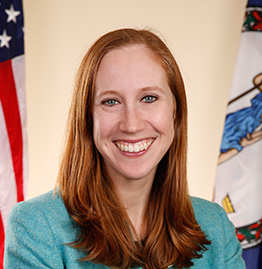
Sen. Elizabeth Bennett-Parker
Sponsored bills
Public schools; classified instructional supportstaff; competitive compensation; biennial review. Declares thatit is a goal of the Commonwealth that its classified instructional support staff, defined in the bill as any individual who works morethan 90 days total in a 200-day school year as a substitute for alicensed teacher, be compensated at a rate that is competitive inorder to provide a quality education in the absence of a licensedteacher. The bill requires the Department of Education to conducta biennial review of the compensation for classified instructionalsupport staff and to consider the Commonwealth's compensation forclassified instructional support staff relative to the national averageteacher salary and report the results of such review to the Governor,the General Assembly, and the Board of Education by June 1 of eachodd-numbered year.
Public school staffing ratios; teachers; Englishlanguage learner students. Requires state funding to be providedpursuant to the general appropriation act to support divisionwideratios of English language learner students in average daily membershipto full-time equivalent teaching positions as follows: (i) for eachEnglish language learner identified as proficiency level one, oneposition per 25 students; (ii) for each English language learneridentified as proficiency level two, one position per 30 students;(iii) for each English language learner identified as proficiency level three, one position per 40 students; and (iv) for all otherEnglish language learners, one position per 50 students. Currentlaw requires state funding to be provided pursuant to the general appropriation act to support one such teaching position per 50 Englishlanguage learner students, regardless of the identified English proficiencylevel of such students.
Child Care Subsidy Program vendors; basis forperiodic reimbursement. Requires the Department of Educationto periodically reimburse child care providers that are vendors through the Child Care Subsidy Program on the basis of authorizedchild enrollment but provides that if any such enrolled child isabsent from the provider for 10 or more days during one month, theDepartment shall periodically reimburse such provider on the basisof such child's attendance.
Reports relating to PFAS; Department of Environmental Quality; one-time report. Requires all facilities that have engaged since January 1, 2021, in the manufacture of or knowing use in the production process of one or more chemicals listed as PFAS target analytes to produce a one-time report on the use of such chemicals. The report shall be limited to facilities that discharge to (i) a surface water under a Virginia Pollutant Discharge Elimination System permit issued by the Department of Environmental Quality (the Department) or (ii) a publicly owned treatment works under an industrial pretreatment program permit or other written authorization issued by a local permit control authority. The report shall be submitted to the Department and, if such facility discharges to a publicly owned treatment works, also to the local permit control authority no later than October 1, 2024. The bill also requires certain facilities to perform a limited PFAS discharge characterization during the one-year period from October 1, 2024, to September 30, 2025, for each waterway discharge outfall consisting of representative quarterly monitoring using the applicable laboratory test method, as specified in the bill. Such facilities shall report results to the Department and, if the facility discharges to a publicly owned treatment works, also to the local permit control authority, within 30 days after the end of each quarter. This bill was incorporated into HB 1085.
Board of Medicine; continuing education; implicitbias and cultural competency in health care. Requires the Boardof Medicine to adopt and implement policies that require each practitionerlicensed by the Board who has direct contact with persons who areor may become pregnant to complete two hours of continuing educationrelated to implicit bias, defined in the bill, and cultural competencyin health care at least once every other license renewal cycle.
Firearm locking device required for sale or transfer of handguns; child safety warning required; penalty. Makes it a Class 1 misdemeanor for any licensed manufacturer, licensed importer, or licensed dealer to sell, deliver, or transfer any handgun to any person, other than a licensed manufacturer, licensed importer, or licensed dealer, unless the transferee is provided with a locking device for such handgun and the handgun is accompanied by a warning, in conspicuous and legible type in capital letters printed on a label affixed to the gun and on a separate sheet of paper included within the packaging enclosing the handgun, that handguns should be locked and kept away from children and that there may be civil and criminal liability for failing to do so. The bill provides exceptions for law-enforcement and governmental agencies. This bill was incorporated into HB 158.
Commending Sandra Gioia Treadway.
Public institutions of higher education; Hunger-Free Campus Grant Program; established. Establishes the Hunger-Free Campus Grant Program to address student hunger at public institutions of higher education. The bill provides that the Program shall be managed by the State Council of Higher Education for Virginia and available for participation by public institutions of higher education; however, participation in the Program shall be optional for such institutions. Under the bill, if a public institution of higher education satisfies certain criteria set out in the bill, including creating initiatives on campus to address student hunger, it shall be designated as a "Hunger-Free Campus" and the Council shall award a grant to such institution. A public institution of higher education that receives a grant under the bill shall utilize the funds to support on-campus efforts and initiatives to eliminate student hunger at such institution. The bill requires the Council to submit a report to the Chairmen of the Senate Committee on Education and Health and the House Committee on Education no later than two years after the establishment of the Program that shall include (i) the total number and amounts of grant awards, (ii) information about the impact that the Program has had on establishing additional hunger-free campuses at public institutions of higher education and reducing the number of students experiencing food insecurity, and (iii) recommendations regarding the potential establishment of an annual appropriation for the Program.
Local correctional facilities; fees. Eliminates certain fees charged to inmates within a local correctional facility,including a fee to defray the costs associated with an inmate's keep,travel and other expenses associated with an inmate's work releaseemployment or participation in an educational or rehabilitative program,and telephone systems. The bill also reduces certain fees chargedto inmates within a local correctional facility, including that thecost of items within a correctional facility's store or commissaryshall not exceed 10 percent of the typical market rate for the samegoods or services, and that the fee associated with electronic visitationand messaging systems shall not exceed the actual costs of establishingand operating such systems. The bill removes provisions that if aninmate is unable to pay in full such fees, the inmate must enter intoa deferred or installment payment agreement with the local correctionalfacility, or that such facility may enter into a contract for collectionof such fees with a private entity, a local governing body, or thecounty or city treasurer. The bill also provides that, upon dischargefrom a local correctional facility, an inmate shall receive, in theform of a check, electronic transfer, or a debit or other accountcard, the balance of all accounts maintained by the facility foran inmate's use.