

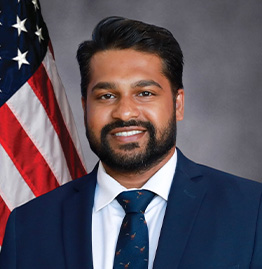
Photo of Saddam Salim
D Virginia Senate · District 37

Sen. Saddam Salim

Compare
Total votes
11,483
all sessions
Attendance
100%
12 missed
Near the chamber average
With party
99%
of cast votes
Near the chamber average
Bipartisan score
0%
crosses aisle rarely
Lower than 77% of chamber peers
Sponsored
601
bills & resolutions
Higher than 88% of chamber peers
Committees
4
assignments
601 bills and resolutions

Sponsored bills

Total
601
Primary
94
Co-sponsor
507
This page
601
matching current filters
Co-sponsor HB 1278
Signed into law · Virginia House · Co-sponsor
School bd. policies; communication & language accessibility for limited English proficient parents.

School boards; language access plan for limited English proficient parents. Requires each school board to develop, implement, and post in a publicly accessible location on its website a language access plan consisting of policies and procedures designed to ensure meaningful communication with and informational accessibility for limited English proficient (LEP) parents, as that term is defined in the bill. The bill has a delayed effective date of July 1, 2027. This bill is identical to SB 685.

Signed into law Apr 13, 2026 1 co-sponsor
Co-sponsor HB 911
Signed into law · Virginia House · Co-sponsor
Limited-duration licenses, driver privilege cards, and permits; validity periods for documents.

Limited-duration licenses, driver privilege cards and permits, and identification privilege cards; expiration. Extends the validity of limited-duration licenses, driver privilege cards and permits, and identification privilege cards, other than REAL ID credentials and commercial driver's licenses and permits, to a period of time consistent with the validity of driver's licenses, which, under current law, is a period not to exceed eight years or, for a person age 75 or older, a period not to exceed five years, and permits and special identification cards. The bill aligns requirements for eligibility for limited-duration commercial driver's licenses and permits and REAL ID-compliant limited-duration commercial driver's licenses with federal requirements and clarifies the validity periods for such documents. The bill directs the Department of Motor Vehicles to implement the extended validity periods for limited-duration licenses, driver privilege cards, or permits upon renewal or reissuance. This bill is identical to SB 446.

Signed into law Apr 13, 2026 1 co-sponsor
Co-sponsor HB 965
Signed into law · Virginia House · Co-sponsor
National Popular Vote Compact; enters Virginia into an interstate compact.

Presidential electors; National Popular Vote Compact. Enters Virginia into an interstate compact known as the Agreement Among the States to Elect the President by National Popular Vote. Article II of the Constitution of the United States gives the states exclusive and plenary authority to decide the manner of awarding their electoral votes. Under the compact, Virginia agrees to award its electoral votes to the presidential ticket that receives the most popular votes in all 50 states and the District of Columbia. The compact goes into effect when states cumulatively possessing a majority of the electoral votes have joined the compact. A state may withdraw from the compact; however, a withdrawal occurring within six months of the end of a President's term shall not become effective until a President or Vice President has qualified to serve the next term. The bill also provides for the manner of appointing electors when such agreement does and does not govern the appointment of electors. This bill is identical to SB 322.

Signed into law Apr 13, 2026 1 co-sponsor
Co-sponsor HB 1263
Vetoed · Virginia House · Co-sponsor
Public employees; repeals existing prohibition on collective bargaining, etc.

Collective bargaining by public employees; individual home care providers; Virginia Home Care Council established; Public Employee Relations Board established; exclusive bargaining representatives. Repeals the existing prohibition on collective bargaining by public employees. The bill creates the Public Employee Relations Board, which shall determine appropriate bargaining units and provide for certification and decertification elections for exclusive bargaining representatives of state employees and local government employees. The bill requires public employers and employee organizations that are exclusive bargaining representatives to meet at reasonable times to negotiate in good faith with respect to wages, hours, and other terms and conditions of employment. The bill establishes the Virginia Home Care Council within the Department of Medical Assistance Services to promote the stability of the individual provider workforce in the Commonwealth and tasks the Council with serving as the public employer of individual providers, as defined in the bill, for purposes of collective bargaining pursuant to the bill's provisions. The bill repeals a provision that declares that in any procedure providing for the designation, selection, or authorization of a labor organization to represent employees the right of an individual employee to vote by secret ballot is a fundamental right that shall be guaranteed from infringement. The bill directs the Department of Labor and Industry to promulgate any regulations necessary to effectuate the bill's provisions by July 1, 2028, and provides that upon the establishment of the Public Employee Relations Board, such regulations shall be transferred to the Board. The bill provides that until such regulations are adopted, no petitions or elections shall take place pursuant to the bill's provisions except pursuant to an ordinance or resolution adopted under current law. This bill is identical to SB 378.

Vetoed Apr 13, 2026 1 co-sponsor
Co-sponsor SB 199
Vetoed · Virginia Senate · Co-sponsor
Employment; paid sick leave, civil penalties.

Employment; paid sick leave; civil penalties; civil actions. Requires one hour of paid sick leave for every 30 hours worked for all employees of private employers and state and local governments, with certain exceptions. The bill requires that employees who are employed and compensated on a fee-for-service basis accrue paid sick leave in accordance with regulations adopted by the Commissioner of Labor and Industry. The bill provides that employees transferred to a separate division or location remain entitled to previously accrued paid sick leave and that employees retain their accrued paid sick leave under any successor employer. The bill allows employers to provide a more generous paid sick leave policy than prescribed by its provisions and specifies that employees, in addition to using paid sick leave for their physical or mental illness or to care for a family member, may use paid sick leave to seek or obtain certain services or to relocate or secure an existing home due to domestic abuse, sexual assault, or stalking. The bill requires the Commissioner to promulgate regulations for the implementation and enforcement of the bill's provisions by July 1, 2027. The bill authorizes the Commissioner, in the case of a knowing violation, to subject an employer to a civil penalty not to exceed $150 for the first violation, $300 for the second violation, and $500 for each successive violation. The Commissioner or Attorney General may commence administrative proceedings or bring a civil action to enforce the bill's provisions. Additionally, the bill authorizes an aggrieved employee to bring a civil action against the employer in which he may recover double the amount of any unpaid sick leave and the amount of any actual damages suffered as the result of the employer's violation. Certain provisions of the bill have a delayed effective date of July 1, 2027. This bill incorporates SB 372 and is identical to HB 5.

Vetoed Apr 13, 2026 1 co-sponsor
Co-sponsor SB 364
Vetoed · Virginia Senate · Co-sponsor
Virginia Gun Violence Prevention Center; work group to develop policy, etc., to establish.

Secretary of Public Safety; firearm violence. Directs the Secretary of Public Safety to convene a work group to develop policy and legislative recommendations to establish the Virginia Gun Violence Prevention Center. The bill allows the work group to (i) meet both in-person and virtually, (ii) have small group breakouts for the purpose of advancing work in a timely and efficient manner, and (iii) collaborate with experts and other representatives as needed. The bill requires the work group to report its findings and any legislative and policy recommendations to the General Assembly by December 15, 2026. This bill is identical to HB 969.

Vetoed Apr 13, 2026 1 co-sponsor
Primary SB 489
Signed into law · Virginia Senate · Lead sponsor
Financial institutions and services; virtual currency kiosk operators, license required, penalties.

Financial institutions and services; virtual currency kiosk operators; license required; penalties. Establishes requirements for the operation of virtual currency kiosks, as defined in the bill, including a requirement that a virtual currency kiosk operator obtain licensure with the State Corporation Commission. The bill requires operators to file annual and quarterly reports, provide certain disclosures, and take reasonable steps to detect and prevent fraud and money laundering. The bill prohibits operators from accepting transactions above specified daily and monthly limits and establishes a maximum transaction charge of 18 percent of the value of such transaction. A person who violates the bill's provisions is subject to a fine of up to $1,000 per violation as well as the existing enforcement provisions of the Virginia Consumer Protection Act. This bill is identical to HB 665.

Signed into law Apr 13, 2026 0 co-sponsors
Co-sponsor HB 967
Signed into law · Virginia House · Co-sponsor
Voting Rights Act of Virginia; revises provisions.

Elections; Voting Rights Act of Virginia. Revises provisions of the Voting Rights Act of Virginia (the Act) by (i) clarifying the legal standards for evaluating claims of alleged voter suppression and vote dilution, (ii) providing guidance to the courts to follow when determining whether a violation of the prohibition against voter suppression or vote dilution has occurred, and (iii) outlining the factors that the courts are permitted to consider and those factors that the courts are prohibited from considering. The bill expands the class of persons who may initiate a cause of action for an alleged violation of the Act to include organizations whose membership includes members of a protected class, organizations whose mission would be frustrated by a violation of the Act, and organizations that would expend resources in order to fulfill their mission as a result of a violation of the Act. The population thresholds for a locality to be designated as a covered locality for purposes of minority language accessibility pursuant to the Act are also amended. Current law designates a locality as a covered locality if, in the locality, (a) more than five percent of the voting age population or (b) more than 10,000 of the voting age population are members of a single language minority and are unable to speak or understand English adequately enough to participate in the electoral process; the bill reduces those thresholds from five to three percent and from 10,000 to 5,000. The bill contains technical amendments for organizational purposes.

Signed into law Apr 13, 2026 1 co-sponsor
Co-sponsor HB 1337
Signed into law · Virginia House · Co-sponsor
State Health Services Plan Task Force; designated areas of state in need of additional project.

Certificate of public need; expedited review of certain projects; duties of the State Health Services Plan Task Force. Directs the State Health Services Plan Task Force to develop recommendations for designating areas of the state with an identifiable need for additional projects, taking into account numerous barriers of access to health care. The bill also directs the Board of Health to promulgate updated regulations for expedited application and review processes for certain projects. This bill is identical to SB 239.

Signed into law Apr 13, 2026 1 co-sponsor
Co-sponsor SB 446
Signed into law · Virginia Senate · Co-sponsor
Limited-duration licenses, driver privilege cards, and permits; validity periods for documents.

Limited-duration licenses, driver privilege cards and permits, and identification privilege cards; expiration. Extends the validity of limited-duration licenses, driver privilege cards and permits, and identification privilege cards, other than REAL ID credentials and commercial driver's licenses and permits, to a period of time consistent with the validity of driver's licenses, which, under current law, is a period not to exceed eight years or, for a person age 75 or older, a period not to exceed five years, and permits and special identification cards. The bill aligns requirements for eligibility for limited-duration commercial driver's licenses and permits and REAL ID-compliant limited-duration commercial driver's licenses with federal requirements and clarifies the validity periods for such documents. The bill directs the Department of Motor Vehicles to implement the extended validity periods for limited-duration licenses, driver privilege cards, or permits upon renewal or reissuance. This bill is identical to HB 911.

Signed into law Apr 13, 2026 1 co-sponsor
Showing 21 to 30 of 601 bills
Previous 1 2 3 4 61 Next