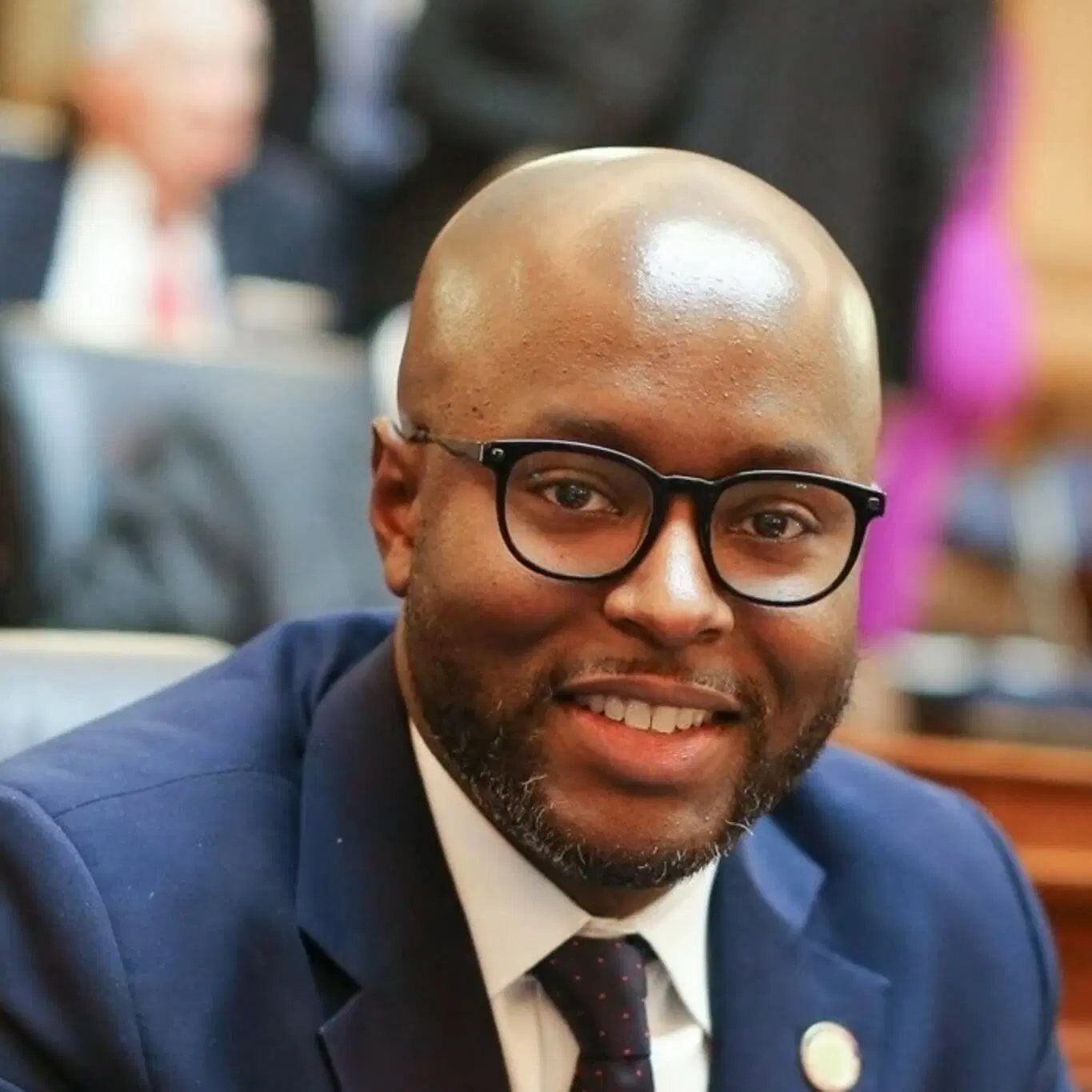
Photo of Alex Askew
D Virginia House · District 95

Rep. Alex Askew

Compare
Total votes
7,767
all sessions
Attendance
100%
28 missed
Near the chamber average
With party
99%
of cast votes
Near the chamber average
Bipartisan score
0%
crosses aisle rarely
Near the chamber average
Sponsored
393
bills & resolutions
Near the chamber average
Committees
3
assignments
393 bills and resolutions

Sponsored bills

Total
393
Primary
68
Co-sponsor
325
This page
393
matching current filters
Co-sponsor HJ 206
Passed · Virginia House · Co-sponsor
Commending the Virginia Hospital & Healthcare Association.

Maddy summaryThis bill formally recognizes the Virginia Hospital & Healthcare Association for its contributions to the state's healthcare system. It does not change laws, allocate funds, or create new regulations, but instead serves as an official commendation. The measure was passed by both the House and Senate through voice votes without requiring a formal ballot. This type of legislation is ceremonial and does not have direct policy impact on healthcare operations or funding.

Passed Apr 9, 2026 1 co-sponsor
Co-sponsor HJ 165
Passed · Virginia House · Co-sponsor
Celebrating the life of Lieutenant Colonel Richard Thomas Bulova, USAR.

Maddy summaryHJ 165 is a ceremonial resolution honoring Lieutenant Colonel Richard Thomas Bulova of the U.S. Army Reserve (USAR). It formally recognizes his service and life through a legislative expression of respect. This resolution directly affects no individuals or policies, as it has no legal effect beyond the symbolic act of commemoration. The bill passed both the House and Senate in early March 2026 as a non-binding gesture of tribute.

Passed Apr 9, 2026 1 co-sponsor
Co-sponsor HJ 153
Passed · Virginia House · Co-sponsor
Celebrating the life of Sincere B. Allah.

Maddy summaryHJ 153 is a ceremonial resolution passed by both the House and Senate in February 2026 to honor the life of Sincere B. Allah. It does not create any new laws or affect policy, as it is a symbolic gesture without legislative substance. The resolution simply expresses recognition and tribute to the individual, with no concrete policy changes or affected parties. Such resolutions are common for commemorating individuals' contributions and are typically non-binding.

Passed Apr 9, 2026 1 co-sponsor
Co-sponsor HJ 131
Passed · Virginia House · Co-sponsor
Commending the Honorable S. Bernard Goodwyn.

Maddy summaryHJ 131 is a ceremonial resolution commending the Honorable S. Bernard Goodwyn for his service. It does not create any new laws or affect policies, as it is a formal expression of recognition. The resolution passed unanimously in both the House (by voice vote) and Senate (by voice vote) in February 2026. This type of resolution honors individuals without implementing substantive changes.

Passed Apr 9, 2026 1 co-sponsor
Co-sponsor HJ 190
Passed · Virginia House · Co-sponsor
Commending Timothy Zachery Mosley.

Maddy summaryThis resolution (HJ 190) formally commends Timothy Zachery Mosley, serving as a ceremonial gesture of recognition. It does not create any legal obligations, alter policies, or affect any specific group or individual beyond the honor itself. As a procedural resolution, it has no substantive policy mechanisms or implementation requirements. The bill was introduced and placed on the Speaker's table on February 27, 2026, with no further legislative action noted.

Passed Apr 9, 2026 1 co-sponsor
Co-sponsor HJ 177
Passed · Virginia House · Co-sponsor
Celebrating the life of the Honorable Barry D. Knight.

Maddy summaryHJ 177 is a ceremonial resolution honoring the late Honorable Barry D. Knight, a former state official. It has no policy provisions or direct impact on constituents, as it solely commemorates his life and service. The resolution was unanimously adopted by the Senate on February 26, 2026, following standard procedural steps for commemorative measures. This type of resolution does not create law or affect any legal rights or obligations.

Passed Apr 9, 2026 1 co-sponsor
Co-sponsor HJ 91
Passed · Virginia House · Co-sponsor
Celebrating the life of Gladys Mae West.

Maddy summaryHJ 91 is a joint resolution celebrating the life of Gladys Mae West. It does not create new laws or affect specific policies, but formally honors her contributions through a legislative resolution. The resolution was unanimously passed by the Senate on January 30, 2026, with no recorded opposition.

Passed Apr 9, 2026 1 co-sponsor
Primary HB 401
Signed into law · Virginia House · Lead sponsor
Virginia Museum of Fine Arts; powers of the board.

Public institutions of higher education; other educational and cultural institutions; Virginia Museum of Fine Arts; powers of the board. Amends the enumerated powers of the board of trustees of the Virginia Museum of Fine Arts by replacing the authority to adopt regulations to establish classes of membership in the Museum with the authority to adopt regulations and set fees relating to the use and visitation of properties under the control of the board. The bill clarifies that the regulations on museum and grounds use and access set forth in the Virginia Administrative Code shall continue in effect and be deemed to constitute the regulations adopted pursuant to the bill.

Signed into law Apr 8, 2026 0 co-sponsors
Co-sponsor HB 1208
Signed into law · Virginia House · Co-sponsor
Public education; early childhood care and education, child care access calculations, report.

Public education; early childhood care and education; child care access calculations; report. Requires the Department of Education to establish and maintain calculations for the provision of early childhood care and education services based on cost of quality rate per child, actual data from the prior year, an estimate of parental demand and choice preferences based on historic growth trends and current eligibility criteria, and an estimate of the number of slots to be added to support local or regional economic development efforts and public-private partnerships focused on increasing the supply of child care services, giving priority to localities or regions identified as child care deserts, as determined by the Department. The bill also contains several provisions relating to the use and appropriation of funds as applicable to such calculations, including (i) providing that the calculations shall not obligate the General Assembly to a specific appropriation, (ii) requiring the calculations to be used to provide information to guide the General Assembly in making decisions about the proportion of parental demand for and supply of early childhood care and education services to be addressed and level of appropriation required to address such demand, and (iii) providing that the annual overall funding available for slots shall be subject to appropriation as determined by the General Assembly. The bill also provides that if waitlists for slots at early childhood care and education sites remain, up to $5 million from prior-year unexpended state general funds appropriated for such purpose in a general appropriation act may be carried forward to the current fiscal year to temporarily provide additional slots during the current fiscal year solely to reduce or eliminate waitlists, unless the general appropriation act authorizes a greater amount to be carried forward and that such prior-year funds shall not be used to increase the base amount of funding required in the subsequent fiscal year and the Department shall monitor program utilization and attrition to ensure that no families will lose access at the end of the current fiscal year. Finally, the bill requires the Department to annually submit to the Commission on Early Childhood Care and Education and post on its website a report on the data used to calculate the minimum funding and number of slots for the calculations in accordance with the provisions of the bill. This bill is identical to SB 134.


Signed into law Apr 8, 2026 1 co-sponsor
Co-sponsor HB 17
Signed into law · Virginia House · Co-sponsor
Fines and costs; period of limitations on collection, responsibility for collections.

Fines and costs; period of limitations on collection; deferred payment agreement. Changes the period of limitations for the collection of court fines and costs from within 60 years from the date of the offense or delinquency giving rise to imposition of such penalty if imposed by a circuit court or within 30 years if imposed by a general district court to within 10 years from the date of the judgment whether imposed by a circuit court or general district court. The bill provides that upon the expiration of the period of limitations, no action shall be brought to collect the debt.The bill extends the time period for commencing collection activity from 90 days to 180 days after judgment, but provides that no collection activity shall be commenced while a defendant is incarcerated on an active term of imprisonment and subject to a deferred payment agreement.The bill also provides that for any defendant sentenced to an active term of incarceration and ordered to pay any fine, cost, forfeiture, or penalty related to the charge that such defendant is incarcerated for, or any other charge for which such defendant was sentenced on the same day, the court shall enter such defendant into a deferred payment agreement for such fines, costs, forfeitures, or penalties. The bill requires the due date for such deferred payment agreement to be set no earlier than 180 days after the defendant's scheduled release from incarceration on the charge for which such defendant was sentenced on the same day. This bill is identical to SB 180. The bill has a delayed effective date of January 1, 2027.

Signed into law Apr 8, 2026 1 co-sponsor
Showing 61 to 70 of 393 bills
Previous 1 6 7 8 40 Next