

Use of restraints on juveniles in court prohibited; exceptions. Prohibits the use of instruments of restraint, as defined in the bill, on a juvenile appearing before the juvenile and domestic relations district court unless, upon motion of the attorney for the Commonwealth or on the court's own motion sua sponte, the court makes a finding that (i) the use of such restraints is necessary (a) to prevent physical harm to such juvenile or another person, (b) because such juvenile has a history of disruptive courtroom behavior that has placed others in potentially harmful situations or presents a substantial threat of serious harm to himself or others as evidenced by recent behavior, or (c) because such juvenile presents a substantial risk of flight from the courtroom and (ii) there are no less restrictive alternatives to such restraints that will prevent flight of or harm to such juvenile or another person, including court personnel or law-enforcement officers. The bill provides that the juvenile shall be entitled to an attorney prior to a hearing on the use of instruments of restraint. The bill also requires the court to provide the juvenile's attorney an opportunity to be heard before the court orders the use of instruments of restraint, and the juvenile's attorney may waive the juvenile's appearance at such hearing. Lastly, the bill requires the court, if such restraints are ordered, to communicate to the parties the basis of the decision either orally or in writing. This bill is identical to SB 1255.
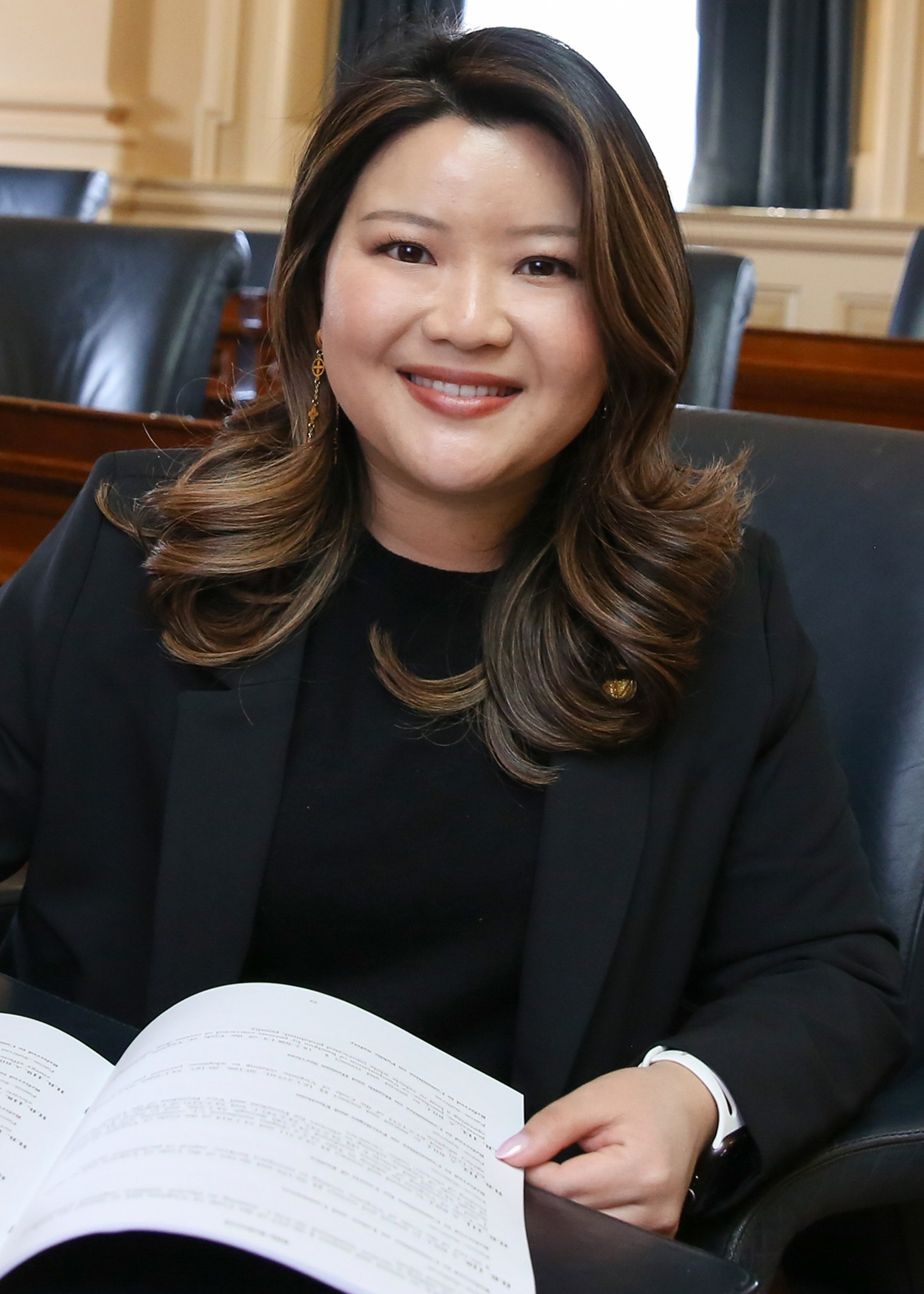
Del. Irene Shin
Sponsored bills
Maddy summaryHJ 659 is a ceremonial resolution commending Mekhi Becton, Sr., for his contributions to the community. It does not create new laws, alter policies, or directly affect any individuals or groups beyond expressing legislative recognition. The resolution passed unanimously in the Senate via voice vote after being introduced and quickly advanced through procedural steps. As a non-binding resolution, it serves only to honor an individual and has no legal or practical impact on governance or public policy.
Health insurance; cost sharing for breast examinations. Prohibits health insurance carriers from imposing cost sharing for diagnostic breast examinations and supplemental breast examinations, as those terms are defined in the bill, under certain insurance policies, subscription contracts, and health care plans delivered, issued for delivery, or renewed in the Commonwealth on and after January 1, 2026. The bill provides that such examinations include examinations using diagnostic mammography, breast magnetic resonance imaging, or breast ultrasound. As introduced, this bill was a recommendation of the Health Insurance Reform Commission. This bill incorporates HB 2133 and is identical to SB 1436.
Special license plates; Washington Commanders. Updates provisions related to special license plates issued to supporters of the Washington Redskins to specify that such special license plates shall be issued to supporters of the Washington Commanders. The bill allows special license plates issued to supporters of the Washington Redskins prior to July 1, 2025, to be used until their expiration and renewed if the proper fee is paid, except that $15 from such fee formerly paid to the Washington Redskins Leadership Council Fund is to be paid to the Washington Commanders Foundation Fund.
Institutions of higher education; Hunger-Free Campus Food Pantry Grant Program established; report. Establishes the Hunger-Free Campus Food Pantry Grant Program to address student food insecurity at public institutions of higher education and eligible private institutions of higher education, as defined by the bill. The bill provides that the Program shall be managed by the State Council of Higher Education for Virginia and available for participation by public institutions of higher education and eligible private institutions of higher education; however, participation in the Program is optional for such institutions. Under the bill, if a public institution of higher education or eligible private institution of higher education satisfies certain criteria set out in the bill, including creating initiatives on campus to address student food insecurity, it will receive a "Hunger-Free Campus Food Pantry" designation and the Council will award a grant to such institution. Any such institution that receives a grant under the bill is required to utilize the funds to support on-campus efforts and initiatives to eliminate student food insecurity at such institution through the maintenance and operation of the on-campus food pantry established pursuant to the Program. The bill requires the Council to submit a report to the Chairmen of the Senate Committee on Education and Health and the House Committee on Education no later than two years after the establishment of the Program. This bill is identical to SB 1016.
Services for sexual assault patients; provision of information for sexual assault patients; Task Force on Services for Survivors of Sexual Assault; work group; report. Changes instances of "sexual assault survivor" and its variations to "sexual assault patient." The bill requires health care facilities to provide information on local or statewide sexual and domestic violence advocacy services to adult and pediatric patients. The bill removes language requiring hospitals to enter into a memorandum of understanding with rape crisis centers, removes language allowing sexual assault patients to be transferred to clinics, and repeals the statute establishing the Task Force on Services for Survivors of Sexual Assault. The bill directs the Director of the Department of Criminal Justice Services to convene a work group to address sustainable funding for sexual assault medical forensic examinations and services. The bill requires the work group to submit a report with recommendations to the Chairs of the House Committee on Health and Human Services, the House Committee on Appropriations, the Senate Committee on Education and Health, and the Senate Committee on Finance and Appropriations by November 1, 2025. This bill is identical to HB 1731.
Public schools; temporarily employed teachers; rules and requirements; extension of time limitation. Extends from 90 to 180 teaching days the maximum period of time during one school year for which a school board may employ a temporarily employed teacher, as defined in relevant law, to fill a teacher vacancy, with certain conditions and restrictions. The bill contains technical amendments. The bill has an expiration date of July 1, 2027, and is identical to SB 1230.
Real property tax; exemption for elderly and disabled individuals. Revises various provisions of the local real property tax exemption and deferral program for elderly and disabled individuals. The bill allows a locality to require that an individual (i) pay all delinquent taxes, penalties, and interest assessed by the locality and incurred prior to becoming eligible for an exemption or deferral; (ii) enter into an installment agreement with the locality for the payment of all such delinquent amounts in installments over a period that is reasonable under the circumstances, but that in no event shall exceed 72 months; (iii) submit and obtain the treasurer's agreement to an offer in compromise with respect to all amounts of delinquent taxes, penalties, and interest; or (iv) carry out a combination thereof. Additionally, the bill provides that notice of the terms and conditions of the exemption and deferral program may be included in any notice of change in assessment and that the treasurer shall post such information on the locality's website. Finally, the bill allows a locality to provide a prorated exemption or deferral for the portion of the taxable year during which the taxpayer would have qualified for such exemption or deferral but had not yet filed an application. This bill is identical to SB 816.
School boards; student access to telehealth services; policies. Directs each school board to consider, for the purpose of increasing access to health care services for students, developing and implementing policies for permitting any public school student in the school division to schedule and participate in telehealth services, including mental health teletherapy services pursuant to a memorandum of understanding with a nationally recognized school-based telehealth provider developed in accordance with applicable law, on school property during regular school hours with parental consent. The bill requires any such policies developed and implemented by a school board to (i) require each public elementary and secondary school to designate a location in the school for student use for such telehealth appointments and implement measures to ensure the safety and privacy of any student participating in a telehealth appointment, (ii) prohibit any student from being subject to any disciplinary measure or consequence for participating in a telehealth appointment during regular school hours if such student would not be subject to any disciplinary measure or consequence for an absence for the purpose of receiving any health care services in person during regular school hours, and (iii) include such other requirements as the school board deems necessary and appropriate. Finally, the bill requires any school board that develops and implements any policies for permitting students to schedule and participate in telehealth services pursuant to the bill to provide and post in a publicly accessible location on its website at the beginning of each school year guidance relating to the implementation of such policies for administrative and instructional personnel. This bill is identical to SB 1037.
Medicare supplement policies; annual open enrollment period. Requires an insurer, health services plan, or health maintenance organization issuing individual Medicare supplement policies or certificates in the Commonwealth to offer to an individual currently insured under any such policy an annual open enrollment period commencing on the day of the individual's birthday and remaining open for at least 60 days thereafter, during which time the individual may purchase any Medicare supplement policy made available by any insurer in the Commonwealth that offers the same benefits as those provided by the current coverage. The bill also requires such insurer, health services plan, or health maintenance organization to notify, at least 15 days but not more than 30 days prior to the commencement of such annual open enrollment period, each individual to whom such open enrollment period applies of the dates of that open enrollment period, the rights of the individual during that open enrollment period, and any modification of benefits provided by or adjustment of premiums charged for such Medicare supplement policy. This bill is identical to SB 1199.