

Siting of data centers; site assessment; high energy use facility. Provides that, prior to any approval of a rezoning application, special exception application, or special use permit for the siting of a new high energy use facility (HEUF), as defined in the bill, a locality shall require that an applicant perform and submit a site assessment to examine the sound profile of the HEUF on residential units and schools located within 500 feet of the HEUF property boundary. The bill also allows a locality to require that a site assessment examine the effect of the proposed facility on (i) ground and surface water resources, (ii) agricultural resources, (iii) parks, (iv) registered historic sites, and (v) forestland on the HEUF site or immediately contiguous land. The provisions of the bill shall not apply to a site with an existing legislative or administrative approval where an applicant is seeking an expansion or modification of an already existing or approved facility and such expansion does not exceed an additional 100 megawatts or more of electrical power. Finally, the bill provides that its provisions shall not be construed to prohibit, limit, or otherwise supersede existing local zoning authority. This bill incorporates HB 511 and is identical to SB 94.
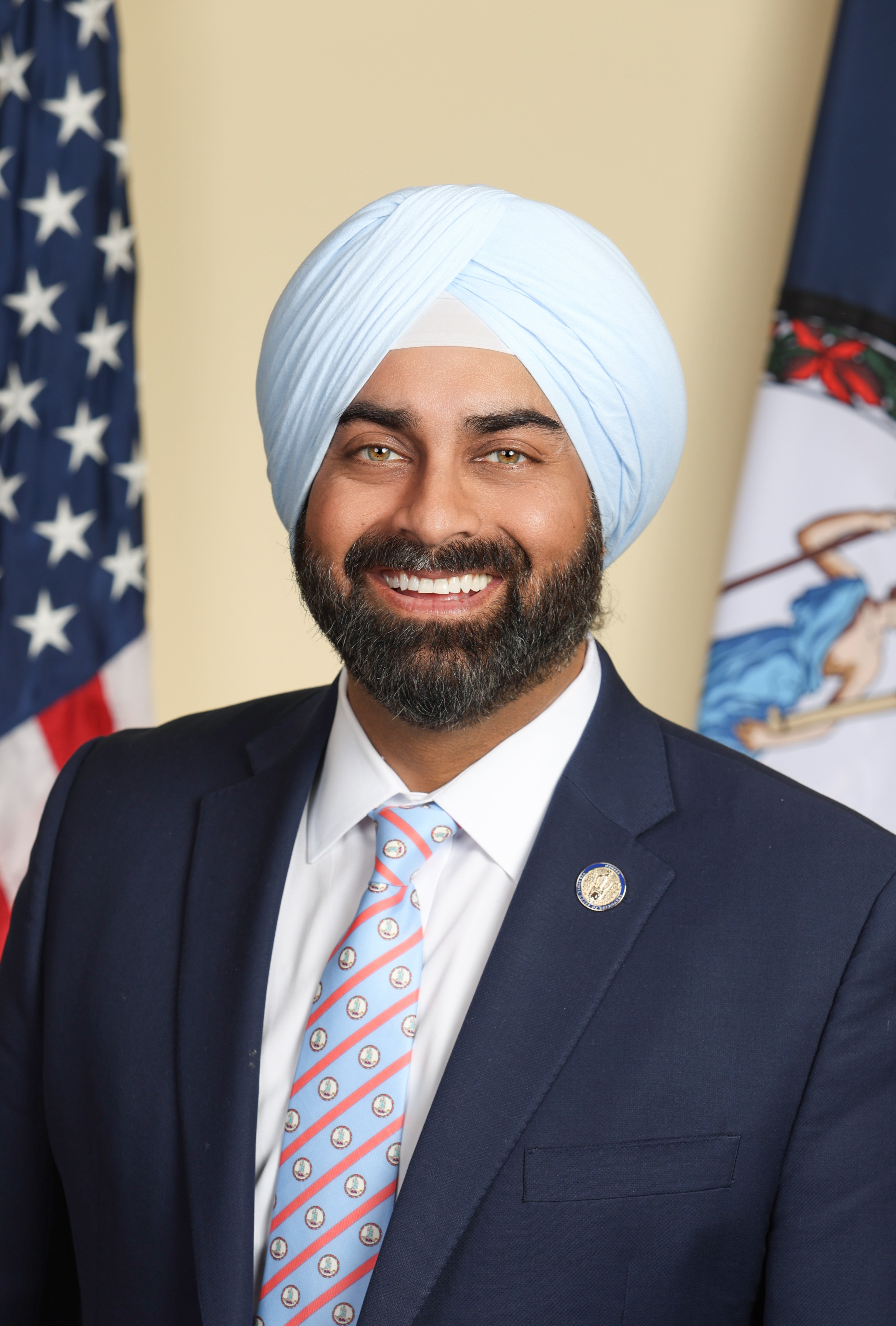
Del. J.J. Singh
Sponsored bills
Substantial Risk Order Reporting System established. Requires the Department of State Police to establish a Substantial Risk Order Reporting System for the purpose of tracking and reporting substantial risk orders by locality and to publish such reports on a monthly basis and make such reports available to the public online. The bill provides that the Department shall remove the names and other personal identifying information from the data before the reports are published.
Employee Child Care Assistance Program established. Establishes the Employee Child Care Assistance Program to provide matching funds in order to incentivize employers to contribute to the child care costs of their employees. The Program shall be administered by the Virginia Early Childhood Foundation. To participate in the Program, an employer shall agree to make child care contributions to the eligible mixed delivery provider on behalf of the employee or to a third-party administrator, as defined by the bill, and shall provide any other information deemed necessary by the Foundation. The bill specifies that, to the extent funds are available, the Foundation shall issue a state match to a third-party administrator. Program funds shall be awarded on a first-come, first-served basis; however, the bill clarifies that the Foundation is encouraged to prioritize awards to proposals involving contributions from small businesses. The bill requires the Foundation to provide an interim report to the General Assembly by September 1, 2028, and a summative report to the General Assembly by September 1, 2030, on the effectiveness and impact of the Program.
Virginia Residential Landlord and Tenant Act; enforcement by localities. Provides that if a condition exists in a dwelling unit that constitutes a material noncompliance by the landlord with the rental agreement or with any provision of law that, if not remedied within a reasonable time frame, constitutes a fire hazard or serious threat to the life, health, or safety of a tenant or occupant of the premises, a locality may institute an action on behalf of any tenant or occupant of the premises who is injured by such material noncompliance for injunction and damages to enforce the landlord's duty to maintain the dwelling unit in a fit and habitable condition, provided that (i) the premises where the violation occurred is within the jurisdictional boundaries of the locality and (ii) the locality has notified the landlord who owns the premises, either directly or through the managing agent, of the nature of the violation and the landlord has failed to remedy the violation to the satisfaction of the locality within a reasonable time after receiving such notice. This bill is identical to SB 290.
Retail franchise agreements; governing law; competition restrictions. Provides that retail franchise agreements shall be governed by the laws of the Commonwealth and prohibits any person from offering or entering into a franchise agreement that includes competition restrictions that extend beyond termination or expiration of the franchise agreement, except as a term of sale in the event that a franchisee sells a franchise to a third party or back to the franchisor. This bill is identical to SB 240.
Employment; paid sick leave; civil penalties; civil actions. Requires one hour of paid sick leave for every 30 hours worked for all employees of private employers and state and local governments, with certain exceptions. The bill requires that employees who are employed and compensated on a fee-for-service basis accrue paid sick leave in accordance with regulations adopted by the Commissioner of Labor and Industry. The bill provides that employees transferred to a separate division or location remain entitled to previously accrued paid sick leave and that employees retain their accrued paid sick leave under any successor employer. The bill allows employers to provide a more generous paid sick leave policy than prescribed by its provisions and specifies that employees, in addition to using paid sick leave for their physical or mental illness or to care for a family member, may use paid sick leave to seek or obtain certain services or to relocate or secure an existing home due to domestic abuse, sexual assault, or stalking. The bill requires the Commissioner to promulgate regulations for the implementation and enforcement of the bill's provisions by July 1, 2027.The bill authorizes the Commissioner, in the case of a knowing violation, to subject an employer to a civil penalty not to exceed $150 for the first violation, $300 for the second violation, and $500 for each successive violation. The Commissioner or Attorney General may commence administrative proceedings or bring a civil action to enforce the bill's provisions. Additionally, the bill authorizes an aggrieved employee to bring a civil action against the employer in which he may recover double the amount of any unpaid sick leave and the amount of any actual damages suffered as the result of the employer's violation. Certain provisions of the bill have a delayed effective date of July 1, 2027. This bill is identical to SB 199.
Elections; conduct of election; ranked choice voting; locally elected offices; report. Expands the option to use ranked choice voting from only elections for county board of supervisors and city councils to any local governing body. The bill requires the State Board of Elections to provide standards and to approve vote tabulating software for use with existing voting systems in elections conducted by ranked choice voting. The bill provides for copying damaged or defective ballots that cannot be properly counted by electronic voting systems. The bill allows localities to request risk-limiting audits of elections conducted using ranked choice voting and provides that no such election may be included in any random drawing required to satisfy the general requirements for risk-limiting audits. The bill specifies that the State Board is required to produce generalized voter education materials on ranked choice voting and is also permitted to create and modify recount procedures to the extent necessary to accommodate a recount of an election. The bill directs the Department of Elections to review the testing and approval framework for voting equipment in the Commonwealth and submit a report of such review no later than the first day of the 2027 Regular Session of the General Assembly. Finally, the bill repeals the 2031 expiration of the option to use ranked choice voting in elections, making such option permanent. This bill is identical to SB 176.
Transportation network companies; publishing and disclosure requirements. Requires a transportation network company (TNC) to (i) issue a confidential annual report to the Commissioner of the Department of Motor Vehicles containing the aggregate data regarding the average fare collected from passengers, the total time driven by TNC partners while transporting a passenger, and the total amount earned by TNC partners in connection with prearranged rides; (ii) disclose to TNC partners information about the deactivation process; (iii) provide a weekly summary that includes the total fare collected from passengers, the total amount earned, and the percentage earned by such TNC partner that week; and (iv) provide an itemized receipt within 24 hours of the completion of each ride. The bill has a delayed effective date of January 1, 2027. This bill is identical to SB 550.
Elections administration; certain activities or conduct prohibited at polling places applicable to locations for absentee voting in person; prohibited possession of firearm within 100 feet of certain locations. Clarifies that the provisions of law prohibiting certain activities or conduct in and around a polling place shall also apply to locations where absentee voting in person is available. The bill also prohibits any person, with certain exceptions, from (i) knowingly carrying any firearm and (ii) knowingly doing so within 100 feet of the entrance of a polling place, the building used by the local electoral board to meet to ascertain election results, the building used to conduct a recount of an election, and other additional locations used for voting-related and elections-related activities. Under current law, this prohibition applies within 40 feet of such entrances.
Firearm industry members; standards of responsible conduct; civil liability. Creates standards of responsible conduct for firearm industry members and requires such members to establish and implement reasonable controls regarding the manufacture, sale, distribution, use, and marketing of the firearm industry member's firearm-related products, as those terms are defined in the bill. Such reasonable controls include reasonable procedures, safeguards, and business practices that are designed to (i) prevent the sale or distribution of a firearm-related product to a straw purchaser, a firearm trafficker, a person prohibited from possessing a firearm under state or federal law, or a person who the firearm industry member has reasonable cause to believe is at substantial risk of using a firearm-related product to harm themselves or unlawfully harm another or of unlawfully possessing or using a firearm-related product; (ii) prevent the loss of a firearm-related product or theft of a firearm-related product from a firearm industry member; (iii) ensure that the firearm industry member complies with all provisions of state and federal law and does not otherwise promote the unlawful manufacture, sale, possession, marketing, or use of a firearm-related product; (iv) prevent the installation and use of an auto sear on firearm-related products; and (v) ensure that the firearm industry member does not engage in an act or practice in violation of the Virginia Consumer Protection Act. The bill also provides that a firearm industry member may not knowingly create, maintain, or contribute to a public nuisance, as defined in the bill, through the sale, manufacturing, importing, or marketing of a firearm-related product. The bill creates a civil cause of action for the Attorney General or a local county, city, or town attorney to enforce the provisions of the bill or for any person who has been injured as a result of a firearm industry member's violation to seek an injunction and to recover costs and damages. The bill also allows the Attorney General to issue a civil investigative demand if he has reasonable cause to believe that any person has engaged in, is engaging in, or is about to engage in any violation of such standards of responsible conduct.