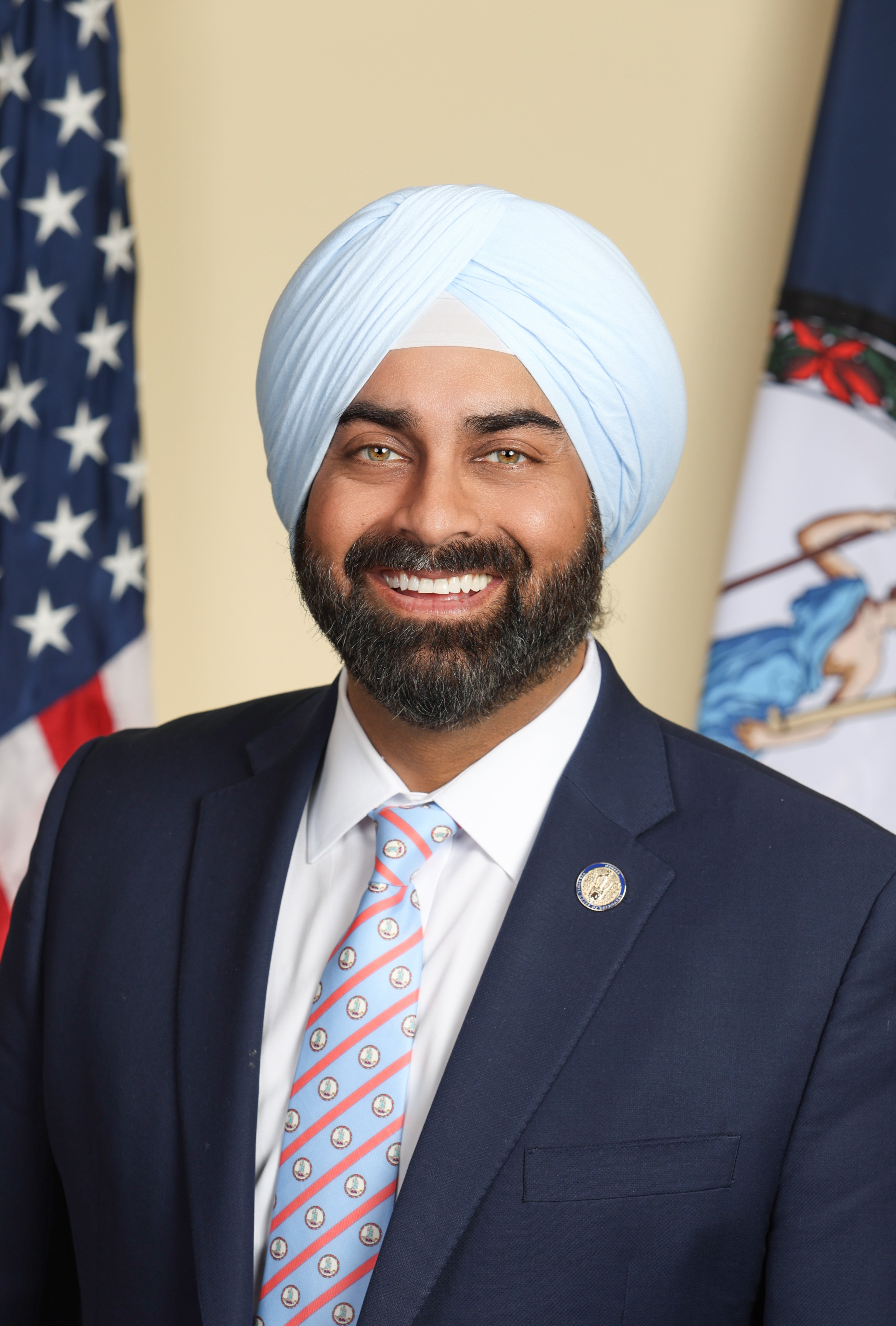
Photo of J.J. Singh
D Virginia House · District 26

Rep. J.J. Singh

Compare
Total votes
4,570
all sessions
Attendance
95%
194 missed
Near the chamber average
With party
99%
of cast votes
Near the chamber average
Bipartisan score
1%
crosses aisle rarely
Near the chamber average
Sponsored
151
bills & resolutions
Near the chamber average
Committees
3
assignments
151 bills and resolutions

Sponsored bills

Total
151
Primary
29
Co-sponsor
122
This page
151
matching current filters
Co-sponsor HJ 267
Passed · Virginia House · Co-sponsor
Commending Community Eligibility Provision schools in Virginia.

Maddy summaryThis bill formally recognizes and commends schools in Virginia that participate in the Community Eligibility Provision, a federal program that provides free breakfast and lunch to all students in qualifying schools. The legislation does not create new funding or policy changes but serves as a symbolic acknowledgment of these schools' achievements in serving their student populations. It directly affects school administrators, staff, and students in Virginia who benefit from the Community Eligibility Provision by highlighting their contributions to school nutrition programs. The bill is a ceremonial measure intended to honor rather than alter existing educational policies or funding structures.

Passed Apr 13, 2026 1 co-sponsor
Co-sponsor HJ 311
Passed · Virginia House · Co-sponsor
Commending Virginia Youth Poet Laureate.

Maddy summaryThis bill formally recognizes the Virginia Youth Poet Laureate through a commendation resolution. It does not create new laws or alter existing policies but serves as an official acknowledgment of the program's contribution to youth arts and culture. The measure passed both the House and Senate by voice vote without requiring further legislative action.

Passed Apr 13, 2026 1 co-sponsor
Co-sponsor HB 392
Signed into law · Virginia House · Co-sponsor
Sickle cell disease education and screening program; cancer risk.

Sickle cell disease education and screening program; cancer risk. Requires the sickle cell screening and treatment program to include the offering of educational resources to health care providers on the increased risks for certain cancers among individuals with sickle cell disease or the sickle cell trait.

Signed into law Apr 13, 2026 1 co-sponsor
Co-sponsor SB 827
Signed into law · Virginia Senate · Co-sponsor
Underground transmission lines; pilot program, clarifies qualifying projects, report.

Pilot program for underground transmission lines; qualifying projects; levy; report. Authorizes the State Corporation Commission, in reviewing any application submitted by a public utility for a certificate of public convenience and necessity for the construction of an electrical transmission line of 500 kilovolts filed between January 1, 2025, and July 1, 2033, to approve up to four applications for qualifying projects to be constructed in whole or in part underground as part of the pilot program for underground transmission lines and to provide an expedited review of any such application. The bill removes certain provisions related to the existing pilot program.Under the bill, a project shall be qualified if (i) the Commission finds that an engineering analysis demonstrates that it is technically feasible to place the proposed line in whole or in part underground, (ii) the application contains certain information regarding projections of project costs, (iii) the application contains evidence that the governing body of each locality in which at least a portion of the proposed line will be placed underground supports the project's inclusion in the program and agrees to meet its related funding obligations, and (iv) the Commission finds the overall cost of the project reasonable and consistent with the public interest. The bill permits the Commission to deny an application for a project that otherwise meets the criteria to qualify, provided that the Commission publicly shares its rationale for doing so.The bill requires at least 50 percent of the marginal costs, as defined in the bill, of the portion of a qualifying project chosen to be placed underground within a locality pursuant to its provisions to be paid by such locality. The bill permits such a locality to meet such requirement through imposing a levy that meets certain requirements on electric utility customers within the locality, issuing a general obligation bond subject to a referendum, allocating its own funds, or any combination of such methods. The bill extends the Commission's final report deadline for the pilot program from December 1, 2024, to December 1, 2034. This bill is identical to HB 1487.


Signed into law Apr 13, 2026 1 co-sponsor
Co-sponsor HB 1446
Signed into law · Virginia House · Co-sponsor
School nurses; sickle cell disease training.

School nurses; sickle cell disease training. Directs local school divisions to require school nurses to complete, within six months of employment and at least every three years thereafter, an online or in-person course of instruction approved by the Board in collaboration with the Department of Health regarding recognition and management of sickle cell disease. This bill is identical to SB 822.

Signed into law Apr 13, 2026 1 co-sponsor
Co-sponsor HB 1263
Vetoed · Virginia House · Co-sponsor
Public employees; repeals existing prohibition on collective bargaining, etc.

Collective bargaining by public employees; individual home care providers; Virginia Home Care Council established; Public Employee Relations Board established; exclusive bargaining representatives. Repeals the existing prohibition on collective bargaining by public employees. The bill creates the Public Employee Relations Board, which shall determine appropriate bargaining units and provide for certification and decertification elections for exclusive bargaining representatives of state employees and local government employees. The bill requires public employers and employee organizations that are exclusive bargaining representatives to meet at reasonable times to negotiate in good faith with respect to wages, hours, and other terms and conditions of employment. The bill establishes the Virginia Home Care Council within the Department of Medical Assistance Services to promote the stability of the individual provider workforce in the Commonwealth and tasks the Council with serving as the public employer of individual providers, as defined in the bill, for purposes of collective bargaining pursuant to the bill's provisions. The bill repeals a provision that declares that in any procedure providing for the designation, selection, or authorization of a labor organization to represent employees the right of an individual employee to vote by secret ballot is a fundamental right that shall be guaranteed from infringement. The bill directs the Department of Labor and Industry to promulgate any regulations necessary to effectuate the bill's provisions by July 1, 2028, and provides that upon the establishment of the Public Employee Relations Board, such regulations shall be transferred to the Board. The bill provides that until such regulations are adopted, no petitions or elections shall take place pursuant to the bill's provisions except pursuant to an ordinance or resolution adopted under current law. This bill is identical to SB 378.

Vetoed Apr 13, 2026 1 co-sponsor
Primary HB 1487
Signed into law · Virginia House · Lead sponsor
Underground transmission lines; pilot program, clarifies qualifying projects, report.

Pilot program for underground transmission lines; qualifying projects; levy; report. Authorizes the State Corporation Commission, in reviewing any application submitted by a public utility for a certificate of public convenience and necessity for the construction of an electrical transmission line of 500 kilovolts filed between January 1, 2025, and July 1, 2033, to approve up to four applications for qualifying projects to be constructed in whole or in part underground as part of the pilot program for underground transmission lines and to provide an expedited review of any such application. The bill removes certain provisions related to the existing pilot program. Under the bill, a project shall be qualified if (i) the Commission finds that an engineering analysis demonstrates that it is technically feasible to place the proposed line in whole or in part underground, (ii) the application contains certain information regarding projections of project costs, (iii) the application contains evidence that the governing body of each locality in which at least a portion of the proposed line will be placed underground supports the project's inclusion in the program and agrees to meet its related funding obligations, and (iv) the Commission finds the overall cost of the project reasonable and consistent with the public interest. The bill permits the Commission to deny an application for a project that otherwise meets the criteria to qualify, provided that the Commission publicly shares its rationale for doing so.The bill requires at least 50 percent of the marginal costs, as defined in the bill, of the portion of a qualifying project chosen to be placed underground within a locality pursuant to its provisions to be paid by such locality. The bill permits such a locality to meet such requirement through imposing a levy on electric utility customers within the locality, issuing a general obligation bond subject to a referendum, or allocating its own funds. The bill extends the Commission's final report deadline for the pilot program from December 1, 2024, to December 1, 2034.

Signed into law Apr 13, 2026 0 co-sponsors
Primary HB 1491
Signed into law · Virginia House · Lead sponsor
Electric utilities; construction of new overhead transmission lines, siting requirements.

Electric utilities; construction of certain electrical transmission lines; siting requirements. Requires the State Corporation Commission, in order to approve the construction of an electrical transmission line of 138 kilovolts or more, to determine that the corridor or route chosen for the line will avoid or reasonably minimize adverse impact to the greatest extent reasonably practicable on dwelling houses. For overhead transmission lines of 500 kilovolts or more constructed by Dominion Energy Virginia, the bill directs the Commission to prioritize approving corridors or routes for construction for which the center is located farther than 150 feet from any dwelling house, public or private school building, day care, or place of worship unless no other practicable alternative exists.

Signed into law Apr 13, 2026 0 co-sponsors
Primary HB 1120
Signed into law · Virginia House · Lead sponsor
Electric power-assisted bicycles, etc.; improving safety for operators and general public, report.

Department of Motor Vehicles; improving the safety of electric power-assisted bicycles, motorized skateboards and scooters, electric personal assistive mobility devices, and mopeds for operators and the general public; report. Directs the Department of Motor Vehicles to convene a work group of relevant stakeholders to examine and make recommendations for options and measures for improving the safety of electric power-assisted bicycles, motorized skateboards and scooters, electric personal assistive mobility devices, and mopeds for operators and the general public and submit a report of its findings to the Chairs of the House and Senate Committees on Transportation no later than November 1, 2026.

Signed into law Apr 13, 2026 0 co-sponsors
Co-sponsor HB 1414
Signed into law · Virginia House · Co-sponsor
Children; certain injuries to be reported by physicians, etc., penalties for failure to report.

Requirement that certain injuries to children be reported by physicians, nurses, teachers, etc.; penalties for failure to report. Creates a Class 1 misdemeanor for any person required to file a report, pursuant to relevant law, who fails to do so as soon as possible, but not longer than 24 hours after having reason to suspect a reportable offense of child abuse or neglect where such reportable offense is alleged to have occurred at a private or state-operated hospital, institution, or facility to which children have been committed or where children have been placed for care and treatment. The bill also provides that a second or subsequent conviction is a Class 6 felony. The bill further expands the mandatory reporting requirements for certain enumerated persons in their professional or official capacities to include certain offenses related to children and certain obscenity and related offenses and applies all such mandatory reporting requirements to all public and private school athletics program coaches, directors, and adult volunteers, including those associated with interscholastic teams and clubs. Under current law, the mandatory reporting requirements apply to such enumerated persons who suspect that a child is an abused or neglected child and to public or private sports organization or team athletic coaches, directors, or adult volunteers.

Signed into law Apr 13, 2026 1 co-sponsor
Showing 21 to 30 of 151 bills
Previous 1 2 3 4 16 Next