

Maddy summaryThe ePermit Act requires federal agencies to adopt standardized digital systems for environmental reviews and authorizations, creating a unified online portal for project sponsors to submit documents, track progress, and access real-time data. It mandates data standards for consistent information sharing, automated tools for screening projects and managing public comments, and a deadline for full implementation by December 2027. The bill directly affects federal agencies (like the EPA and Army Corps of Engineers), project developers seeking permits, and the public by replacing fragmented paper-based processes with a transparent, digital platform. Key provisions include requiring agencies to report on current systems within 90 days, implement minimum functional tools within 180 days, and prioritize vendor-neutral interoperability to reduce delays and redundancy.
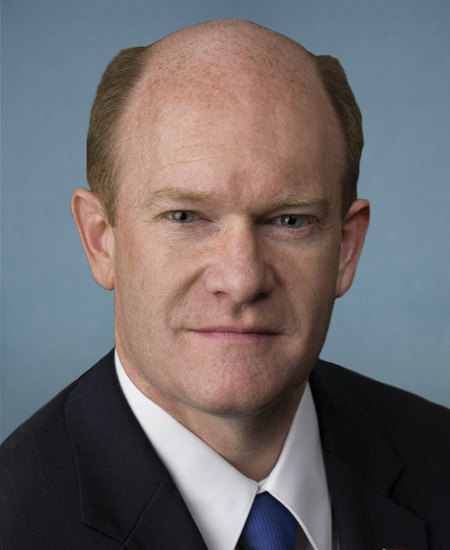
Sen. Christopher A. Coons
Sponsored bills
Maddy summaryThe SCAM Act requires online platforms that accept payment for advertisements to verify advertiser identities (including government ID and business documentation) and implement systems to detect and remove scam ads within 72 hours of reporting. It mandates platforms to conduct investigations, remove verified fraudulent ads within 24 hours, and maintain active impersonation detection programs. The law directly affects major social media and digital advertising platforms by imposing new verification and monitoring obligations to prevent deceptive ads targeting consumers. Enforcement falls to the Federal Trade Commission, treating violations as unfair or deceptive practices under existing law.
Maddy summarySRES 581 is a commemorative resolution honoring Corporal Matthew T. "Ty" Snook, a 10-year Delaware State Police officer who died in the line of duty on December 23, 2025, while protecting others at a New Castle DMV facility. The resolution expresses the Senate’s deepest condolences to his family and recognizes his heroic sacrifice, including his actions that saved lives despite being mortally wounded. It does not create new laws or policies but formally honors his service and legacy as a mentor, coach, and public servant. Introduced by Senators Blunt Rochester and Coons, the resolution reaffirms support for law enforcement officers nationwide.
Maddy summaryThe ALS Better Care Act amends Medicare to cover a specific set of ALS-related services - including specialized physician support, therapy, equipment coordination, and respiratory care - for patients diagnosed with ALS, starting January 1, 2027. Medicare will pay providers a single, annual amount per patient visit (beginning at $800 in 2027), adjusted yearly based on cost increases or recommendations from the Comptroller General. The bill also requires a report on challenges in funding and staffing ALS clinical trials to improve research progress. This addresses current low Medicare reimbursements that have caused long wait times and limited care access for ALS patients.
This resolution supports the designation of 2026 as the International Year of the Woman Farmer and recognizes the critical role of women in agriculture. The resolution also encourages citizens to celebrate the impact these women have on the food systems and agricultural workforce of the United States by encouraging and empowering women to pursue careers in agriculture and cultivate leadership opportunities.
Maddy summaryThis bill requires companies that synthesize DNA or RNA (like those selling synthetic nucleic acids) to screen customer orders for dangerous sequences and verify customer identities. It mandates a federal system to maintain a list of "sequences of concern" (DNA patterns that could create harmful pathogens), with regular updates based on public input and rapid additions for emerging threats. The bill also creates a "biotechnology governance sandbox" for testing new security tools and streamlines federal oversight by having agencies coordinate under one plan to reduce duplication. These rules apply directly to biotech manufacturers and distributors of gene synthesis equipment, aiming to prevent misuse while supporting innovation.
Maddy summarySRES 585 is a commemorative resolution honoring Ben Nighthorse Campbell, a former U.S. Senator from Colorado and the first Native American to chair the Senate Committee on Indian Affairs. It recognizes his military service, Olympic judo career, legislative work (including authoring the National Museum of the American Indian Act), and advocacy for tribal communities. The resolution has no policy impact - it formally expresses the Senate’s respect for his legacy, requests transmission to his family, and directs a moment of silence. It directly affects Campbell’s legacy and family, not any current policy or population. (Note: This is a procedural resolution, not a bill with legislative provisions.)
Maddy summaryThe NDO Fairness Act of 2026 amends federal law to regulate when law enforcement can delay notifying individuals whose electronic communications data is accessed via warrants or subpoenas. It requires courts to issue written findings before granting "preclusion of notice" orders, limiting delays to 1 year for child exploitation cases or 90 days for other investigations, and mandates that such orders must be narrowly tailored to avoid unnecessary secrecy. After the delay period ends, law enforcement must notify the affected person within 5 business days and provide a copy of the warrant, along with details about the investigation and the data accessed (with redactions for sensitive materials like child exploitation evidence). This bill directly affects law enforcement agencies, technology providers (like internet or phone companies), and customers whose data is accessed under these orders, while requiring annual public reports on how often these orders are used.
Maddy summaryS 3683 establishes strict limits on force used by federal immigration officers, requiring non-deadly force only when no safer alternative exists and prohibiting deadly force except under DOJ standards. It mandates body cameras for all officers within 180 days, requires annual de-escalation and civil rights training, and bans equipment like flashbangs without supervisor-approved tactical plans. The bill creates new reporting requirements for the DHS and DOJ, including semiannual congressional reports on force incidents, assaults on officers, and equipment use. These provisions directly affect all federal immigration enforcement personnel, aiming to increase accountability and transparency in enforcement operations.
This joint resolution directs the President to terminate the use of U.S. Armed Forces for hostilities within or against Venezuela unless a declaration of war or authorization to use military force for such purpose has been enacted. The joint resolution specifies that it shall not be construed to prevent the United States from defending itself from an armed attack or threat of an imminent armed attack.