

Maddy summaryS 3400, the Ally’s Act, requires most private health insurance plans and group health plans to cover hearing implants and related services for eligible individuals. It mandates coverage for cochlear implants, bone conduction devices, maintenance, repairs, upgrades every five years, hearing assessments, pre- and post-surgery care, and aural rehabilitation. Insurers cannot impose stricter cost-sharing or treatment limits for these services than for other medical care, and cannot deny coverage based on medical necessity determinations by a physician or audiologist. The law applies to plans covering individuals with hearing loss (including unilateral or bilateral) who meet medical criteria, effective for plan years starting January 1, 2026.
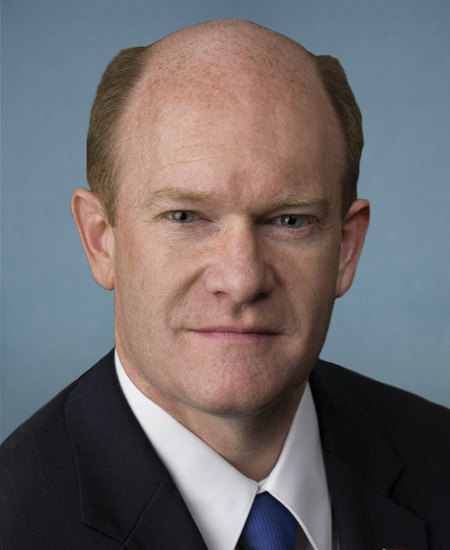
Sen. Christopher A. Coons
Sponsored bills
Maddy summaryThis bill authorizes $74 million annually for fiscal years 2026 and 2027 to restore U.S. funding for the United Nations Population Fund (UNFPA), directly supporting its global reproductive health programs. It specifically funds UNFPA's work to end preventable maternal deaths, address unmet contraceptive needs, prevent gender-based violence, and combat harmful practices like female genital mutilation and child marriage across 150+ countries. The funding applies to UNFPA's core operations in humanitarian crises (e.g., Yemen, Afghanistan, Sudan) and excludes programs in China. This would reverse the 2025 funding halt that already caused health center closures and service disruptions for millions of women and girls.
Maddy summarySRES 536 is a non-binding Senate resolution designating December 2, 2025, as "World Nuclear Energy Day." It commemorates nuclear energy's role in clean power generation, highlighting historical milestones like the first nuclear chain reaction (1942) and the first commercial nuclear plant (1957). The resolution celebrates nuclear energy's contributions to U.S. electricity (18% of generation, 43% carbon-free), job creation (over 70,000 direct jobs), and national security, without creating new laws or affecting any group. It serves as a symbolic recognition of the industry's achievements.
Maddy summarySRES 533 is a non-binding Senate resolution condemning white supremacy, hate, and antisemitism, with specific focus on the promotion of these ideologies by white supremacist Nick Fuentes and his platforming by Tucker Carlson. It highlights Fuentes' Holocaust denial, antisemitic conspiracy theories (like the "Great Replacement" myth), and use of dog whistles, while criticizing Carlson for hosting Fuentes without challenge and Heritage Foundation's Kevin Roberts for defending such views. The resolution urges all elected officials and leaders to reject these ideologies whenever they occur, and affirms condemnation of Nazism and the Holocaust. As a formal expression of Senate opinion, it does not create new laws but serves as a public stance against harmful rhetoric.
Maddy summaryThe HUSTLE Act creates tax-advantaged investment accounts for student athletes to save income from name, image, and likeness (NIL) deals. Eligible student athletes at participating colleges can contribute NIL earnings (like endorsements and social media content) to these accounts, which are tax-exempt for the athlete. Distributions before graduation are taxed as ordinary income, but distributions after graduation or transfer qualify for lower long-term capital gains tax rates. The accounts have annual contribution limits based on the gift tax exclusion and require management by banks or approved entities. The bill also includes new rules for sports agents, such as a 5% fee cap on endorsement contracts and registration requirements.
Maddy summaryThe SAFE Chips Act of 2025 requires U.S. exporters to obtain government licenses before sending advanced computer chips to "foreign adversary countries" (including China, Hong Kong, and Macau) or to entities owned by such countries. It defines "advanced integrated circuits" using specific technical standards, such as high processing power (e.g., 4,800+ performance points) or bandwidth (e.g., 4,100+ gigabytes per second), excluding chips designed for data centers. The bill mandates license denials for these exports and allows the Commerce Secretary to update technical definitions after 30 months, with required Congressional briefings on national security impacts. This directly affects chip manufacturers and companies exporting to specified regions, imposing strict controls on advanced semiconductor trade.
Maddy summaryS 3379 (EARLY Benefits for Workers Act) allows states to use up to 20% of their unemployment grant funds (or $3 million) to provide job training and support services to workers *immediately* after they file for unemployment benefits, rather than waiting for later stages of their claim. This directly affects unemployed workers filing initial claims for regular unemployment benefits, enabling faster access to reemployment help. States cannot deny benefits solely because a worker didn’t use these early services during the initial claim period. If a worker later loses eligibility, states keep the grant funds spent on the early services and aren’t penalized for providing them. The bill changes how states administer unemployment grant funds to speed up job support access.
Maddy summaryThis Senate resolution (SRES 525) condemns the Iranian government's ongoing, state-sponsored persecution of the Baha'i minority, citing decades of systemic abuses including executions, job dismissals, education bans, and property confiscations. It references UN reports and Human Rights Watch findings documenting Iran's violation of international human rights treaties, such as the Universal Declaration of Human Rights and the International Covenant on Civil and Political Rights. The resolution calls on Iran to immediately release imprisoned Baha'is, end discriminatory policies restricting their education and employment, and cease hate propaganda, while urging the U.S. President and Secretary of State to impose sanctions on Iranian officials responsible for these abuses.
Maddy summaryThis bill increases the tax exclusion for capital gains when selling a primary residence. It doubles the exclusion amount from $250,000 (for single filers) to $500,000 and from $500,000 (for married couples) to $1,000,000. The bill also adds an inflation adjustment for amounts after 2025, tying future increases to the cost-of-living adjustment. It directly affects homeowners who sell their primary residence and would otherwise owe tax on profits exceeding the previous limits. The changes apply to sales after the bill's enactment date.
Maddy summaryS 3341, the Investing in All of America Act of 2025, modifies rules for Small Business Investment Companies (SBICs) to adjust their debt limits and expand eligible investments. It lowers the maximum leverage ratio for certain SBICs from $300 million to $200 million and sets a new $125 million cap on excluded investments for companies funding businesses in rural areas, critical technology sectors, or small manufacturers. The bill specifically affects SBICs licensed under the Small Business Investment Act of 1958 and the businesses they finance in targeted geographic or industry areas. Key changes include revised financial thresholds and updated definitions for "rural" and "critical technology" to qualify for debt exclusions. These provisions directly alter how SBICs calculate allowable debt when supporting small businesses.