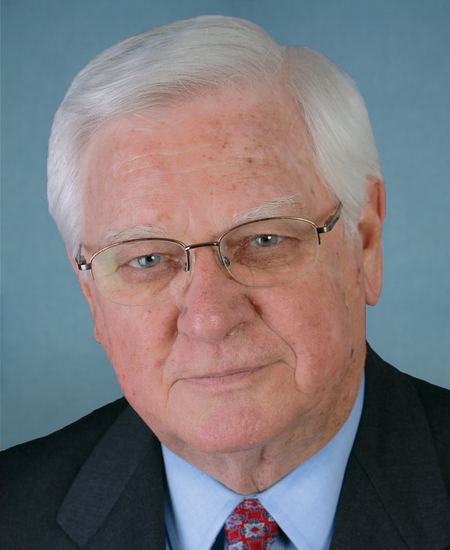
Photo of Harold Rogers
R United States House · District 5 · Kentucky On the 2026 ballot

Rep. Harold Rogers

Compare
Total votes
2,818
all sessions
Attendance
97%
85 missed
Near the chamber average
With party
92%
of cast votes
Near the chamber average
Bipartisan score
4%
crosses aisle rarely
Near the chamber average
Sponsored
271
bills & resolutions
Lower than 97% of chamber peers
Committees
4
assignments
271 bills and resolutions

Sponsored bills

Total
271
Primary
15
Co-sponsor
256
This page
271
matching current filters
Co-sponsor HR 5947
Passed · Utah House · Co-sponsor
To provide for the rescission of certain waivers and licenses relating to Iran, and for other purposes.

Maddy summaryHR 5947 terminates specific U.S. waivers and licenses related to Iran, ending a 2023 waiver that allowed funds transfer from South Korea to Qatar. It prohibits the Treasury Department from reissuing similar waivers or licenses for the same purpose and blocks the President from granting Iran access to certain designated financial accounts established under prior laws. The bill directly affects U.S. foreign policy implementation by restricting how Treasury handles Iran-related financial transactions. It enacts concrete policy changes by ending existing authorizations and preventing future approvals for Iran to access specific accounts.

Passed Apr 17, 2024 1 co-sponsor
Co-sponsor HRES 1148
In committee · Utah House · Co-sponsor
Condemning the Iranian regime's terrorism, regional proxy war, internal suppression, and for other purposes.

Maddy summaryHRES 1148 is a resolution passed by the U.S. House of Representatives that condemns the Iranian government for supporting terrorism, regional proxy conflicts, and internal suppression of dissent - including its crackdown on protests following Mahsa Amini's death in 2022. It specifically calls for maintaining sanctions against Iran, supporting the Iranian Resistance's Ten-Point Plan (which advocates for a democratic, secular, nonnuclear Iran), and protecting Iranian political refugees in Albania. The resolution also affirms the Iranian people's right to self-determination under international law and urges the U.S. to recognize their struggle for freedom. As a non-binding resolution, it does not create new laws but formally expresses congressional stance.

In committee Apr 15, 2024 1 co-sponsor
Co-sponsor HCONRES 103
In committee · Utah House · Co-sponsor
Authorizing the use of the rotunda of the Capitol for the lying in honor of the remains of Ralph Puckett, Jr., the last Medal of Honor recipient for acts performed during the Korean conflict.

Maddy summaryHCONRES 103 authorizes the use of the U.S. Capitol rotunda for a "lying in honor" ceremony for the remains of Army Colonel Ralph Puckett, Jr., the last Medal of Honor recipient for actions during the Korean War (1950-1953). The resolution directs the Architect of the Capitol to arrange this ceremony on April 29, 2024, to honor Puckett and recognize the service of over 5.7 million U.S. military personnel who served in the Korean conflict, often called the "Forgotten War." This is a ceremonial resolution with no policy changes, solely granting permission for a specific honorific event.

In committee Apr 12, 2024 1 co-sponsor
Co-sponsor HR 6655
Passed · Utah House · Co-sponsor
A Stronger Workforce for America Act

Maddy summary# Summary of Proposed WIOA Amendment This document proposes significant amendments to the Workforce Innovation and Opportunity Act (WIOA), with key changes including: 1. **YouthBuild Program Enhancement**: - Increased annual funding authorization to $108,150,000 - New performance reporting requirements - Added focus on opioid-related training and services 2. **New Reentry Employment Opportunities Program** (Section 172): - Creates a competitive grant program for justice-involved individuals - Requires evidence-based practices and performance metrics - Includes specific requirements for recidivism reduction - Defines "eligible adult" (age 25+) and "eligible youth" (age 14-24) 3. **Strengthening Community Colleges Program** (Section 173): - Creates new grant program with $65,000,000 annual funding - Requires industry partnerships for workforce development - Mandates evidence-based program design - Focuses on recognized postsecondary credentials and career pathways 4. **Performance Accountability System**: - Enhanced data collection and reporting requirements - New requirement for making data available in "linked, open, and interoperable data formats" - More detailed performance metrics for all programs 5. **Funding Increases**: - Increased authorizations for multiple programs: - Native American programs: $61,800,000 annually - Migrant and seasonal farmworker programs: $100,317,900 annually - Technical assistance: $5,000,000 annually - Evaluations and research: $12,720,000 annually 6. **Administrative Changes**: - New consultation requirement with labor organizations for on-the-job training - Revised definitions (e.g., "English language learners" changed to "English learners") - New requirements for public reporting of matching funds 7. **Data Infrastructure**: - New "Workforce Data Infrastructure" provisions (Section 174) - Requirements for interoperable data systems - Focus on credential registries and data sharing The proposed amendment emphasizes data-driven decision making, industry-aligned training, performance accountability, and expanded opportunities for underserved populations including justice-involved individuals, opioid treatment participants, and individuals with barriers to employment.


Passed Apr 10, 2024 1 co-sponsor
Co-sponsor HR 7185
In committee · Utah House · Co-sponsor
HIDTA Reauthorization Act of 2024

Maddy summaryHR 7185 reauthorizes the High Intensity Drug Trafficking Areas (HIDTA) program through 2030, with specific focus on fentanyl. It allocates $302 million annually for HIDTA operations and adds $14.2 million yearly for grants to enhance fentanyl seizure efforts through competitive grants. The bill requires annual reports detailing fentanyl seizures and trafficking data, and directs the Attorney General to assign at least 16 assistant U.S. attorneys to prioritize fentanyl trafficking cases. This directly affects federal drug task forces, law enforcement agencies, and prosecutors working on fentanyl-related investigations.

In committee Feb 1, 2024 1 co-sponsor
Co-sponsor HR 6662
In committee · Utah House · Co-sponsor
Transforming Hiring in Rural Industries and Vital Economies Act of 2023

Maddy summaryHR 6662 establishes the White House Rural Council, chaired by the Secretary of Agriculture, to coordinate federal efforts supporting rural economic development. The Council requires regular meetings among 26+ federal departments and agencies (including Agriculture, Labor, Commerce, and Energy) to share data, identify collaboration opportunities, and address rural economic challenges. Key provisions mandate joint planning to improve services for rural stakeholders like small businesses, Tribal governments, and agricultural organizations, while identifying gaps in current programs. The bill requires no new funding, directing agencies to use existing resources and personnel to fulfill these coordination duties. It directly affects federal departments and agencies responsible for rural economic initiatives across the U.S.

In committee Jan 25, 2024 1 co-sponsor
Co-sponsor HR 4531
Passed · Utah House · Co-sponsor
Support for Patients and Communities Reauthorization Act

Maddy summaryThis bill reauthorizes and extends funding for programs addressing substance use disorders and opioid addiction, including residential treatment for pregnant and postpartum women, first responder training, and community recovery initiatives. It increases funding levels for these programs, adds xylazine to Schedule III of controlled substances, and requires a study on remote monitoring for patients prescribed opioids. The bill also expands Medicaid coverage requirements for medication-assisted treatment and mandates reporting on mental health condition data alongside substance use disorder data, directly affecting individuals with substance use disorders, healthcare providers, and state and tribal governments.

Passed Dec 13, 2023 1 co-sponsor
Co-sponsor HRES 921
In committee · Utah House · Co-sponsor
Honoring the 30th anniversary of the National Guard Youth Challenge Program.

Maddy summaryHRES 921 is a ceremonial resolution honoring the 30th anniversary of the National Guard Youth Challenge Program. It recognizes the program’s work supporting at-risk youth aged 16-18 by providing free, structured education and discipline through a 5.5-month residential phase (covering life skills, leadership, academics, and physical fitness) followed by a 12-month mentoring phase. The resolution highlights that the program, operating in 28 states and territories, has served over 8,000 cadets annually and helped more than 200,000 youth graduate with academic credentials since its inception. The resolution expresses the House’s reaffirmed commitment to the program’s mission of developing character and preparing youth for societal success.

In committee Dec 11, 2023 1 co-sponsor
Co-sponsor HR 6600
In committee · Utah House · Co-sponsor
Tyler’s Law

Maddy summaryHR 6600, "Tyler’s Law," requires the Secretary of Health and Human Services to study how often hospital emergency departments test for fentanyl during overdose cases, along with the costs, benefits, risks, and patient privacy impacts. The study must be completed within one year of the bill’s enactment, followed by guidance issued within six months on whether fentanyl testing should become routine. This guidance will address how hospitals can inform clinicians about testing protocols and how fentanyl testing might affect future overdose risks and patient health outcomes. The bill directly affects hospitals and emergency departments treating overdose patients, focusing on improving data-driven practices for fentanyl detection.

In committee Dec 8, 2023 1 co-sponsor
Primary HR 6644
In committee · Utah House · Lead sponsor
John White Ensuring Timely Black Lung Benefits Act

Maddy summaryThis bill requires the Secretary of Labor to pay black lung benefits to eligible miners within 60 days if a liability determination (who is responsible for payment) hasn't been made. It directly affects miners diagnosed with black lung disease (pneumoconiosis) who face delays in benefit processing. The key mechanism is a 60-day deadline: if liability isn't determined by then, benefits are paid immediately from the existing trust fund. Operators later found liable must still repay the benefits, so the bill doesn't eliminate their financial responsibility. The change aims to prevent prolonged delays in critical health benefits for miners.

In committee Dec 6, 2023 0 co-sponsors
Showing 111 to 120 of 271 bills
Previous 1 11 12 13 28 Next