Kids Eat Local Act This bill modifies Department of Agriculture requirements for the national school food programs relating to the purchases of locally produced food. The bill allows institutions participating in the school food programs to use locally grown, locally raised, or locally caught as a product specification in food procurement requests.
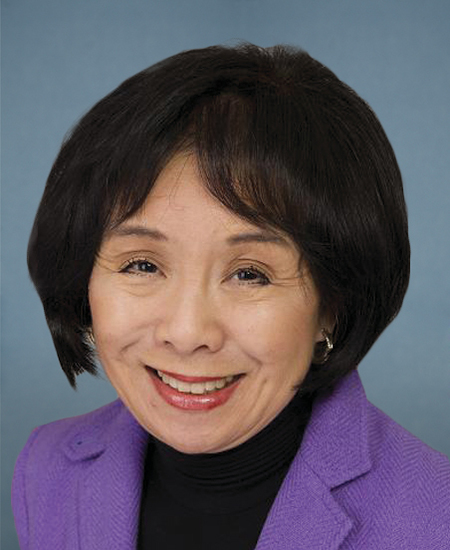
Rep. Doris O. Matsui
Sponsored bills
Mental Health Justice Act of 2021 This bill creates a grant program for states and local governments to train and dispatch mental health professionals to respond, instead of law enforcement officers, to emergencies that involve people with behavioral health needs. The Substance Abuse and Mental Health Services Administration (SAMHSA) must manage the program in consultation with the Department of Justice (DOJ). SAMHSA may cancel grants that increase incarceration or institutionalization. Grantees must use funds for purposes including de-escalation and anti-racism training. The Department of Health and Human Services and the DOJ must evaluate this program.
Do No Harm Act This bill prohibits the application of the Religious Freedom Restoration Act of 1993 (RFRA) to specified federal laws or the implementation of such laws. Currently, RFRA prohibits the government from substantially burdening a person's exercise of religion even if the burden results from a rule of general applicability, except in furtherance of a compelling governmental interest when using the least restrictive means. Under the bill, RFRA is inapplicable to laws or the implementation of laws that protect against discrimination or the promotion of equal opportunity (e.g., the Civil Rights Act of 1964); require employers to provide wages, other compensation, or benefits, including leave; protect collective activity in the workplace; protect against child labor, abuse, or exploitation; or provide for access to, information about, referrals for, provision of, or coverage for, any health care item or service. The bill prevents RFRA from being used to deny (1) goods or services the government has contracted, granted, or made an agreement to provide to a beneficiary of or participant in a program or activity funded by such government contract, grant, agreement, or other award; or (2) a person's full and equal enjoyment of a government-provided good, service, benefit, facility, privilege, advantage, or accommodation. In order for a person to assert a RFRA claim or defense in a judicial proceeding, the government must be a party to the proceeding.

Democracy Is Strengthened by Casting Light On Spending in Elections Act of 2021 or the DISCLOSE Act of 2021 This bill addresses campaign finance, including by expanding the prohibition on campaign spending by foreign nationals, requiring additional disclosures of campaign expenditures, and requiring additional disclosures regarding certain political advertisements. First, the bill prohibits foreign nationals from participating in the decision-making process regarding an election expenditure. Additionally, the bill expands existing foreign money prohibitions to include disbursements for paid web-based or digital communications and federal judicial nomination communications. It also prohibits foreign nationals from contributing to campaigns related to ballot initiatives and referenda. The Federal Election Commission (FEC) must conduct an audit after each federal election cycle to determine the incidence of illicit foreign money. Next, the bill makes it unlawful to establish or use a corporation, company, or other entity with the intent to conceal an election contribution or donation by a foreign national. A violator is subject to criminal penalties—a fine, a prison term of up to five years, or both. Covered organizations (e.g., corporations, labor organizations, and political organizations) must, within 24 hours, file reports with the FEC to disclose campaign expenditures of more than $10,000 during an election cycle. Finally, the bill requires organizations to provide additional disclosures regarding political advertisements, including the donors who contributed the most money to that organization in the last year.
Mainstreaming Addiction Treatment Act of 2021 This bill removes the requirement that a health care practitioner apply for a separate waiver through the Drug Enforcement Administration (DEA) to dispense certain narcotic drugs (e.g., buprenorphine) for maintenance or detoxification treatment (i.e., substance use disorder treatment). Further, a community health aide or community health practitioner may dispense certain narcotic drugs for maintenance or detoxification treatment without registering with the DEA if the drug is prescribed by a health care practitioner through telemedicine. It preempts state laws related to licensure for this activity. The bill also directs the Substance Abuse and Mental Health Services Administration to conduct a national campaign to educate health care practitioners and encourage them to integrate substance use disorder treatment into their practices.
Duty to Report Act This bill requires political committees, candidates for federal office, and other individuals to report to the Federal Election Commission (FEC) and the Federal Bureau of Investigation (FBI) any offers of prohibited contributions, including offers of nonpublic information regarding other candidates, by foreign nationals. Specifically, political committees and candidates must report to the FEC within 24 hours any (1) offers of prohibited contributions from foreign nationals, and (2) meetings with foreign governments or their agents. In addition, the bill requires political committees, candidates, immediate family members of candidates, and individuals affiliated with a campaign (e.g., employees and independent contractors) to report to the FBI within 24 hours any offers of prohibited contributions from foreign nationals. Further, the bill establishes a new criminal offense for knowingly and willfully failing to comply with this reporting requirement. A violator is subject to criminal penalties—a fine, a prison term of up to two years, or both. Such reported information may not be used to enforce certain immigration provisions related to the removal of undocumented aliens.
U.S. Citizenship Act This bill establishes a path to citizenship for certain undocumented individuals. The bill also replaces the term alien with noncitizen in the immigration statutes and addresses other related issues. Specifically, the bill establishes a new status of lawful prospective immigrant . This status shall be available to an applying noncitizen who meets certain requirements, including being continually present in the United States from January 1, 2021, and passing background checks. After at least five years with this status, an eligible noncitizen may apply for and receive permanent resident status. The bill also provides permanent resident status to certain applying noncitizens, specifically for eligible noncitizens who (1) entered the United States as a minor, (2) were eligible for temporary protected status or deferred enforced departure on January 1, 2017, or (3) worked a certain amount of agricultural labor in the five years prior to applying. Among other things, the bill also redefines for immigration purposes the term conviction to exclude convictions that have been expunged or vacated, requires the Department of State to implement a strategy to advance reforms in Central America and address key factors contributing to migration from the region to the United States, requires the State Department to establish refugee processing centers in Central America, requires Customs and Border Patrol sectors and stations to have a certain number of employees with certain qualifications such as paramedic training, generally prohibits religious discrimination in granting or denying immigration benefits, and establishes grant programs for providing training and services to immigrants.
New Opportunities to Expand Healthy Air Using Sustainable Transportation Act of 2021 or the NO EXHAUST Act of 2021 This bill establishes incentives and related requirements to encourage the manufacture and use of electric, fuel-efficient, or zero-emission vehicles. For example, the bill directs the Department of Energy to establish a program to provide rebates for expenses associated with publicly accessible electric vehicle supply equipment (e.g., power outlets). In addition, the bill reauthorizes existing grant programs and creates new grant programs, such as grants for the deployment of electric vehicle charging infrastructure in underserved or disadvantaged communities. It also revises a loan program that provides incentives to manufacture advanced vehicles, including by allowing loans to be awarded through FY2031. Finally, the bill establishes minimum conservation requirements for federal fleets of vehicles.
Utility Resilience and Reliability Act This bill addresses the reliability of electric energy provided by the bulk-power system, which includes facilities and control systems necessary for operating an interconnected electric energy transmission network. Specifically, the Electric Reliability Organization must file with the Federal Energy Regulatory Commission a proposed reliability standard that addresses the resilience of the bulk-power system. For example, the standard must address the system's ability to withstand and rapidly recover from disruptions, such as extreme weather conditions. The standard must take into account regional differences. In addition, the Department of Energy (DOE) must establish a program to provide information and recommendations to states and electric utilities on how to improve the resilience of electric grids. DOE must also post on its website a report that provides recommendations on how to minimize the need for, effects of, and duration of planned electric power outages that are due to extreme weather conditions.
Ensuring Access to Lower-Cost Medicines for Seniors Act of 2021 This bill establishes additional requirements for prescription drug plan (PDP) sponsors that use formularies under the Medicare prescription drug benefit. Specifically, the bill requires PDP formularies to include covered generic drugs and biosimilars for which the wholesale acquisition cost is less than that of the reference (i.e., brand-name) product. PDP sponsors must also establish specific cost-sharing tiers that apply lower cost-sharing requirements for such covered generic drugs and biosimilars as compared to those for brand-name products. The bill also prohibits PDP sponsors from instituting certain requirements relating to access to such covered generic drugs and biosimilars that are more restrictive than those for brand-name products (e.g., prior authorization requirements).