

Public Service Freedom to Negotiate Act of 20 21 This bill provides minimum collective bargaining rights and procedures for public employees and prohibits strikes by certain public safety workers. The Federal Labor Relations Authority (FLRA) shall determine for each state whether the laws of such state substantially provide for each of the minimum standard collective bargaining rights and procedures specified by this bill, including the right of public employees and supervisory employees to self-organize, form or join a labor organization, or collectively bargain. The FLRA must issue rules and take actions to establish and administer bargaining rights and procedures for those states that do not substantially provide for them. No employers, emergency services employees, or law enforcement officers may engage in a lockout, strike, or any other organized job action that is likely to result in a measurable disruption of the delivery of emergency or public safety services. Furthermore, no labor organization may be the cause of a violation of such prohibition.
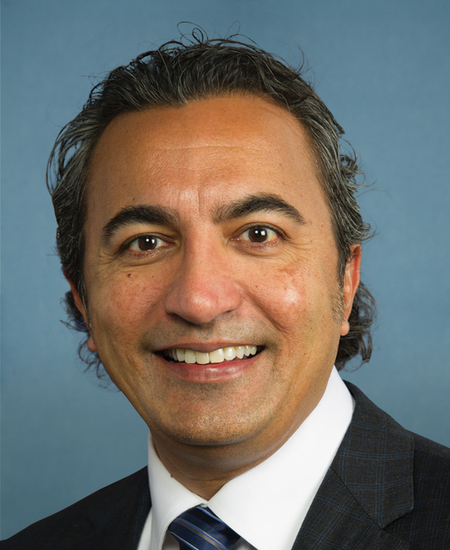
Rep. Ami Bera
Sponsored bills
Easy Enrollment in Health Care Act This bill revises the procedures related to enrollment in health insurance affordability programs, including Medicaid, the Children's Health Insurance Program (CHIP), and state-operated Basic Health Programs. The bill provides funding to support the changes. Specifically, the bill permits individuals who do not have minimum essential coverage to, in conjunction with filing their tax return, determine whether any members of their household are eligible for an insurance affordability program and enroll in minimum essential coverage. The bill makes individuals eligible for Medicaid or CHIP based on a prior finding of eligibility for the Temporary Assistance for Needy Families program or the Supplemental Nutrition Assistance Program. It also revises the continuous coverage standards under Medicaid and CHIP. Additionally, the bill provides access to certain information to support enrollment in insurance affordability programs.
Khalid Jabara and Heather Heyer National Opposition to Hate, Assault, and Threats to Equality Act of 2021 or the Jabara-Heyer NO HATE Act of 2021 This bill creates grants for state and local governments to combat hate crimes. It also authorizes additional penalties for hate crime offenses. Specifically, it establishes grants for states to create state-run hate crimes reporting hotlines. It also authorizes grants for states and local governments to implement the National Incident-Based Reporting System and to conduct law enforcement activities or crime reduction programs to prevent, address, or respond to hate crimes. Finally, in the case of an individual convicted of a hate crime offense and placed on supervised release, the bill allows a court to order that the individual participate in educational classes or community service as a condition of supervised release.
Healthcare Workforce Resilience Act This bill makes previously unused immigrant visas available to nurses and physicians who petition for such a visa before the date that is 90 days after the end of the declared national emergency relating to the COVID-19 (i.e., coronavirus disease 2019) outbreak. The number of visas available shall be the total number of unused employment-based immigrant visas from FY1992-FY2020, up to 40,000. Of such visas, 25,000 shall be reserved for nurses and 15,000 for physicians. Certain family members may accompany the principal beneficiary of a visa provided under this bill, and visas for such family members shall (1) be made available from the unused visas from FY1992-FY2020, and (2) not be counted against the 40,000 cap. Visas provided under this bill shall be exempt from per-country limitations.
Equal Access to Abortion Coverage in Health Insurance Act of 2021 or the EACH Act of 2021 This bill requires federal health care programs to provide coverage for abortion services and requires federal facilities to provide access to those services. The bill also permits qualified health plans to use funds attributable to premium tax credits and reduced cost sharing assistance to pay for abortion services.
Countering China Economic Coercion Act This bill establishes an interagency task force to respond to the Chinese government's acts of economic coercion. The task force must oversee the development and implementation of an integrated U.S. government strategy to respond to such acts of economic coercion. The strategy must include an evaluation of the costs such acts have on U.S. businesses and economic performance. The task force must also report to Congress on the strategy as well as a comprehensive review on the economic tools that the Chinese government uses (or can use) to coerce other governments, non-Chinese companies, and multilateral institutions and organizations.
Maddy summaryHR 5544 would remove the requirement for annual U.S. presidential determinations about Kazakhstan's trade status under the Trade Act of 1974. Specifically, it allows the President to formally extend permanent "normal trade relations" (NTR) treatment to Kazakhstan's products, ending the need for yearly reviews under Title IV of the Trade Act. This bill directly affects U.S. trade with Kazakhstan by making the country's trade status with the U.S. permanent and predictable, rather than subject to annual renewal. The key provision streamlines trade relations by eliminating the existing Title IV review process once the President extends NTR treatment.
Designates the facility of the United States Postal Service located at 9317 Bolsa Avenue, in Westminster, California, as the "General Tran Hung Dao Post Office."
This bill requires the Department of Defense (DOD) to conduct outreach to build awareness among former members of the Armed Forces of the process established for the review of discharge characterizations related to sexual orientation (i.e., on the basis of Don't Ask, Don't Tell or a similar policy). DOD must also provide for specified relief for former members of the Armed Forces who were impacted by the discharge characterizations and ensure that DOD oral historians review related facts and receive testimony from affected individuals.
Israel Relations Normalization Act of 2021 This bill requires the Department of State to take certain actions promoting the normalization of relations between Israel, Arab states, and other relevant countries and regions. Specifically, the State Department must develop a strategy on expanding and strengthening the Abraham Accords (the term used to refer collectively to agreements between Israel and the United Arab Emirates and between Israel and Bahrain marking the public normalization of relations between the two Arab countries and Israel). The strategy must include a description of how the U.S. government will encourage further normalization of relations with Israel. In addition, the State Department must report on options for U.S. international efforts to promote the strengthening of ties between Israel, Arab states, and other relevant countries and regions. The State Department must also report on the status of the normalization of relations with Israel, including information on (1) laws that punish individuals for people-to-people relations with Israelis (i.e., anti-normalization laws), and (2) evidence of steps taken by Arab governments toward permitting or encouraging normalized relations between their citizens or residents and Israeli citizens.