

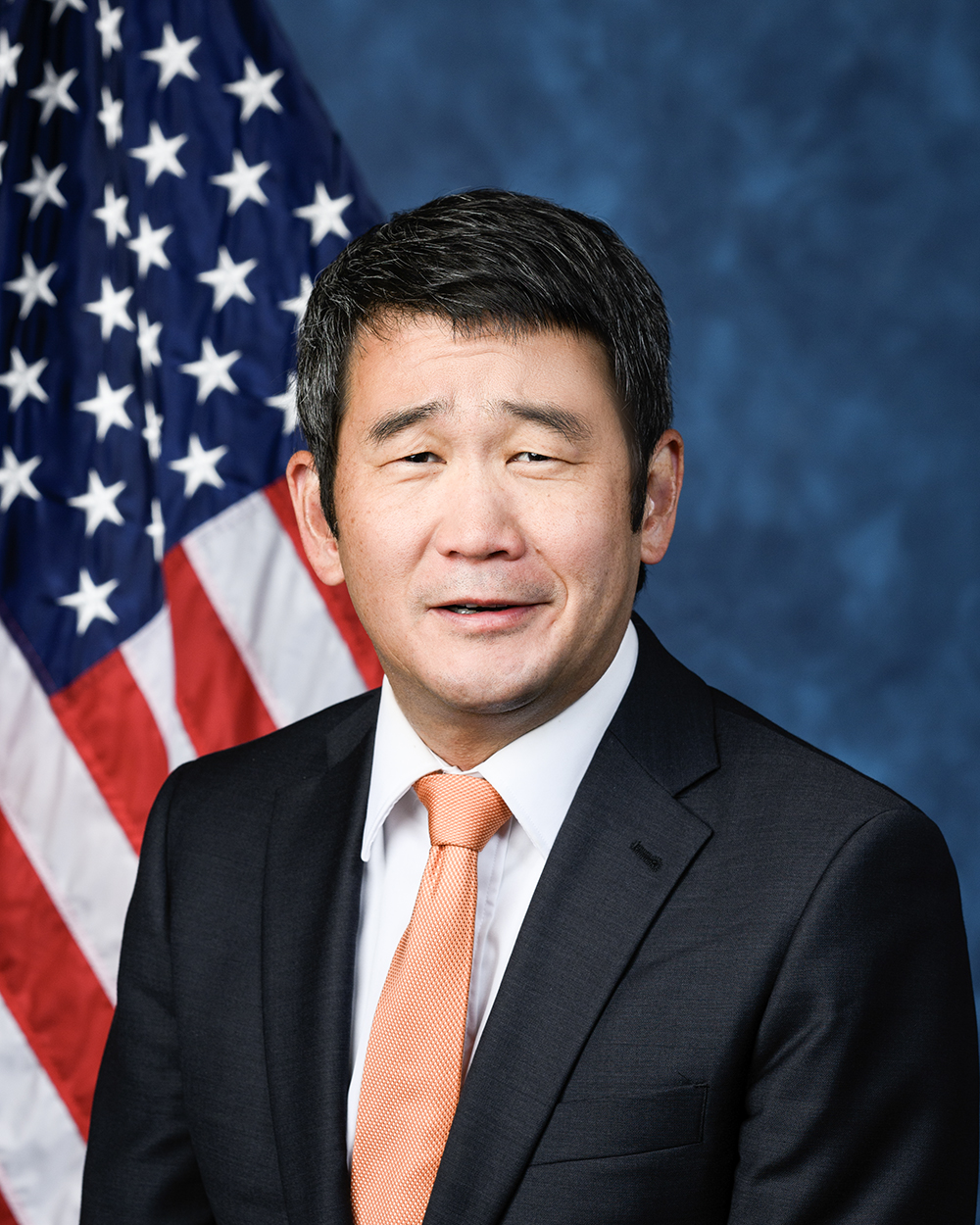
Photo of Dave Min
D United States House · District 47 · California On the 2026 ballot

Rep. Dave Min

Compare
Total votes
669
all sessions
Attendance
100%
2 missed
Higher than 89% of chamber peers
With party
95%
of cast votes
Lower than 78% of chamber peers
Bipartisan score
3%
crosses aisle rarely
Higher than 77% of chamber peers
Sponsored
427
bills & resolutions
Near the chamber average
Committees
6
assignments
427 bills and resolutions

Sponsored bills

Total
427
Primary
28
Co-sponsor
399
This page
427
matching current filters
Co-sponsor HR 4382
In committee · Utah House · Co-sponsor
America’s Olympic and Paralympic Games Commemorative Coins Act

Maddy summaryHR 4382 authorizes the U.S. Mint to produce commemorative coins for the 2028 Los Angeles Olympics/Paralympics and 2034 Salt Lake City Winter Olympics/Paralympics. It specifies gold, silver, and half-dollar coin designs with defined mintage limits (e.g., up to 100,000 $5 gold coins for each event), all bearing inscriptions like "2028" or "2034" and standard coin features. A surcharge ($5-$50 per coin) is added to sales, with all funds directed to the respective Olympic committees to support event hosting and legacy programs like youth sports. The bill ensures no net cost to the government by requiring surcharge revenues to cover all design, production, and marketing expenses before funds are disbursed.

In committee Jul 14, 2025 1 co-sponsor
Co-sponsor HR 4351
In committee · Utah House · Co-sponsor
To amend the Family and Medical Leave Act of 1993 to reduce the qualifying time for a spouse of an active duty member of the Armed Forces to take leave.

Maddy summaryHR 4351 amends the Family and Medical Leave Act (FMLA) to shorten the employment duration required for spouses of active-duty military members to qualify for leave. It reduces the qualifying time from 12 months to 90 calendar days with the employer. This change directly affects spouses of service members on covered active duty, making it easier for them to access FMLA leave for their partner’s military service. The bill achieves this by revising the FMLA’s definition of "eligible employee" to include this new 90-day requirement for military spouses.

In committee Jul 10, 2025 1 co-sponsor
Co-sponsor HR 4253
In committee · Utah House · Co-sponsor
Expanding Access to Mental Health Services in Schools Act of 2025

Maddy summaryThe Expanding Access to Mental Health Services in Schools Act of 2025 creates a federal grant program to help high-need schools hire and retain mental health professionals like counselors, psychologists, and social workers. It targets schools in the top 15% of need (based on student poverty or counts) that lack required staff ratios, such as one counselor per 250 students. Grants fund recruitment incentives (e.g., student loan repayment), retention programs, and evidence-based mental health services, with recipients required to contribute 25% of costs from non-federal funds. Schools must report annually on staff numbers, student-to-staff ratios, and retention rates to track progress toward improved mental health access.

In committee Jun 30, 2025 1 co-sponsor
Co-sponsor HRES 543
In committee · Utah House · Co-sponsor
Recognizing the right to peacefully protest and condemning violence and authoritarian responses to expressions of dissent.

Maddy summaryHRES 543 is a symbolic House resolution (not a law) introduced by multiple representatives. It affirms the constitutional right to peaceful protest under the First Amendment and condemns violent acts by some individuals during demonstrations, such as vandalism and looting. The resolution specifically criticizes the President’s 2025 deployment of National Guard and Marines to Los Angeles without proper legal authority (violating 10 U.S.C. § 12406 and the Posse Comitatus Act) and without coordination with California’s governor. It also denounces inflammatory rhetoric that escalated tensions and supports law enforcement efforts to protect public safety during protests. The resolution has no binding effect but formally expresses congressional position on these issues.

In committee Jun 27, 2025 1 co-sponsor
Primary HR 4237
In committee · Utah House · Lead sponsor
Stopping Executive Clearance Unfair Revocation Efforts Act

Maddy summaryThis bill amends two sections of the National Security Act to improve transparency around security clearance decisions. It broadens due process protections to cover all individuals (not just executive branch employees) seeking or holding security clearances. The key provision requires agencies to publish annual reports detailing every clearance denial or revocation, including the specific reasons, the employing agency or company, and outcomes of appeals. These reports directly affect anyone with or seeking a security clearance, whether working for the government or in the private sector. The bill focuses on requiring more detailed public reporting, not changing clearance standards or eligibility.

In committee Jun 27, 2025 0 co-sponsors
Co-sponsor HR 4176
In committee · Utah House · Co-sponsor
No Secret Police Act of 2025

Maddy summaryThe No Secret Police Act of 2025 requires U.S. Immigration and Customs Enforcement (ICE) and other Department of Homeland Security officers working on border security or immigration enforcement to visibly display their official badges or uniforms and provide identification during detentions or arrests. It prohibits officers from wearing face coverings that conceal their face during these interactions. The bill also mandates that the Department report to Congress about tactical gear policies and research technology to improve badge visibility in different conditions like weather or lighting. These changes aim to increase transparency in immigration enforcement encounters.

In committee Jun 27, 2025 1 co-sponsor
Co-sponsor HR 4206
In committee · Utah House · Co-sponsor
CONNECT for Health Act of 2025

Maddy summaryThe CONNECT for Health Act of 2025 expands Medicare telehealth coverage by removing geographic restrictions that limited where patients could receive care, expanding the types of health care providers who can offer telehealth services, and eliminating the requirement for an in-person visit before receiving telemental health services. The bill includes specific provisions to support telehealth use for Native American health facilities, rural health clinics, and Federally Qualified Health Centers. It requires the Centers for Medicare & Medicaid Services to collect and publish data on telehealth usage and impacts, and to develop resources to improve accessibility for people with disabilities and limited English proficiency. Program integrity measures are added to monitor telehealth billing practices and prevent fraud while maintaining coverage for telehealth services during public health emergencies.

In committee Jun 26, 2025 1 co-sponsor
Co-sponsor HR 4166
In committee · Utah House · Co-sponsor
Strengthening Protections for Domestic Violence and Stalking Survivors Act of 2025

Maddy summaryThis bill expands legal protections for domestic violence and stalking survivors by broadening key definitions. It adds current and former dating partners to the definition of "intimate partner" and includes children of dating partners in domestic violence protections. The bill also creates a new federal definition for "misdemeanor crime of stalking," requiring a course of harassment causing fear for specific people (including intimate partners, family, or shared-residence individuals) or their pets/service animals. Convictions under this new definition would trigger firearm restrictions, with specific safeguards for due process in court proceedings. These changes directly affect survivors in dating relationships and their children, strengthening federal protections for vulnerable individuals.

In committee Jun 26, 2025 1 co-sponsor
Co-sponsor HR 4180
In committee · Utah House · Co-sponsor
Canyon’s Law

Maddy summaryHR 4180, "Canyon’s Law," prohibits the use of M-44 devices - predator control tools containing highly toxic sodium cyanide - on public lands managed by federal agencies like the National Park Service, Fish and Wildlife Service, and Forest Service. The bill requires all federal, state, and county agencies to remove existing M-44 devices from public lands within 30 days of enactment. It directly affects agencies and land managers who previously deployed these devices, which have caused human poisonings (including incidents involving children), killed over 50 family dogs, and harmed endangered species. The law aims to eliminate the risk of accidental exposure and non-target wildlife deaths by banning the devices' use on public lands.

In committee Jun 26, 2025 1 co-sponsor
Co-sponsor HR 4127
In committee · Utah House · Co-sponsor
Tech Safety for Victims of Domestic Violence, Dating Violence, Sexual Assault, and Stalking Act

Maddy summaryThis bill establishes two grant programs to address technological abuse against victims of domestic violence, dating violence, sexual assault, and stalking. It authorizes a 5-year pilot program (with up to 15 grants of $2 million each) for partnerships between tech-focused schools, tech companies, and domestic violence centers to provide victims with new devices and combat tech abuse. A separate $20 million grant program funds nonprofits and schools to develop training materials for service providers on preventing and responding to technological abuse. The bill directly affects victims experiencing tech-based stalking or monitoring and the organizations that support them, focusing on practical resources and education rather than new legal requirements.

In committee Jun 25, 2025 1 co-sponsor
Showing 241 to 250 of 427 bills
Previous 1 24 25 26 43 Next