

Maddy summaryThis symbolic resolution (HCONRES 23) expresses Congress's support for International Transgender Day of Visibility, observed annually on March 31. It encourages Americans to recognize and celebrate transgender community achievements while acknowledging ongoing challenges like discrimination in employment, healthcare, and public accommodations. The resolution does not create new laws or policies but formally endorses the day's purpose through non-binding statements of support and recognition. It directly affects the broader public by promoting awareness and respect for transgender individuals' rights and contributions.
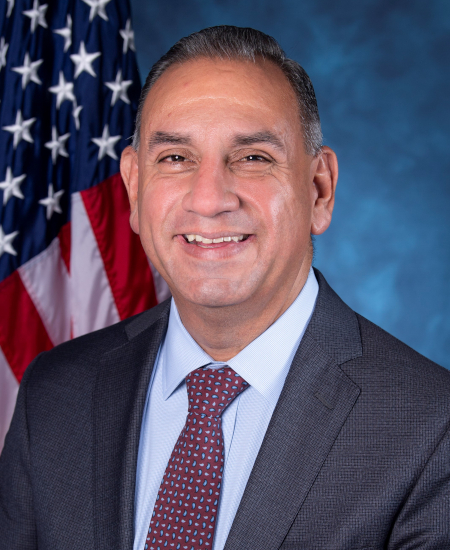
Rep. Gilbert Ray Cisneros, Jr.
Sponsored bills
Maddy summaryThis resolution (HRES 271) is a symbolic House of Representatives measure honoring César Estrada Chávez, a civil rights leader who co-founded the United Farm Workers and advocated for farmworkers' rights through nonviolent action. It recognizes his life, legacy, and the "¡Sí se puede!" (Yes, we can!) slogan, referencing his work on fair wages, safe conditions, and the 1975 California Agricultural Labor Relations Act. The resolution encourages the public to commemorate his legacy through service and education, consistent with existing state observances of his birthday (March 31) in multiple states. It has no legal effect or policy changes, as it is purely commemorative.
Maddy summaryThis bill directs the U.S. Department of Health and Human Services to launch a national public education campaign about abortion access. The campaign must provide medically accurate information on where to obtain abortion services (including medication abortion), legal rights for out-of-state care, identifying misleading anti-abortion centers, spotting disinformation, and protecting personal health data. It specifically targets underserved communities like people of color, immigrants, LGBTQ+ individuals, rural residents, and those with low incomes, while prohibiting the promotion of misinformation or abstinence-only programs.
Save America's Forgotten Equines Act of 2025 or the SAFE Act of 2025 This bill permanently prohibits the slaughter of equines (e.g., horses and mules) for human consumption. (Current law prohibits the slaughter of dogs and cats for human consumption. This bill extends the prohibition to equines.) Specifically, this bill prohibits a person from knowingly (1) slaughtering an equine for human consumption; or (2) shipping, transporting, possessing, purchasing, selling, or donating an equine to be slaughtered for human consumption or equine parts for human consumption. The bill subjects a violator to a fine. The bill applies to conduct in or affecting interstate or foreign commerce or within the special maritime and territorial jurisdiction of the United States. However, it does not apply to an activity carried out by an Indian for a religious ceremony. As background, in recent years, the appropriations acts have prohibited the Department of Agriculture (USDA) from using federal funds to inspect horses before they are slaughtered for human consumption. Therefore, there are currently no USDA-inspected horse slaughter facilities in the United States.
Maddy summaryHRES 261 is a symbolic resolution recognizing the heritage, culture, and contributions of Latinas in the United States. It celebrates Latinas' historical and ongoing roles in fields like business, military service, science, arts, and public office, while acknowledging persistent challenges like wage gaps and systemic barriers. The resolution specifically highlights that Latinas make up approximately 1 in 6 U.S. women (31 million people) and emphasizes their economic impact (contributing $1.3 billion to GDP in 2021) and cultural achievements. It does not create new policies or allocate funds but formally honors these contributions and calls for continued efforts to address inequities. This resolution directly affects Latinas as a recognized demographic group within U.S. society.
Maddy summaryHR 2402, the No Hungry Kids in Schools Act, creates a new option for states to implement a statewide program under the National School Lunch Act starting in 2025. States would cover costs from non-federal funds to allow all schools in the state to receive full federal reimbursement for meals served, eliminating income-based eligibility thresholds. Key provisions include setting the eligibility threshold to zero and calculating student eligibility statewide instead of by individual school district. This directly affects state education agencies (which must fund the program) and schools (which gain simplified access to full meal reimbursement), benefiting students in qualifying schools.
Maddy summaryThis bill would require federal firearms licensees to prohibit sales of specific high-capacity rifles and shotguns to people under 21. It targets semiautomatic centerfire rifles and shotguns capable of holding more than 5 rounds in their magazines, raising the age limit from 18 to 21 for these weapons. Exceptions apply for active military members and certain government employees authorized to carry firearms. The law directly affects gun retailers and individuals under 21 seeking to purchase these specific firearms. It modifies existing federal gun sale rules without changing age requirements for other firearms.
Protecting Students with Disabilities Act This bill prohibits the use of appropriated funds to eliminate the Department of Education's (ED's) oversight of the Individuals with Disabilities Education Act (IDEA). (The IDEA authorizes grant programs that support special education and early intervention services for children with disabilities. Currently, the IDEA is administered by the Office of Special Education Programs in the Office of Special Education and Rehabilitative Services in ED.) Specifically, the bill prohibits the use of appropriated funds to eliminate, consolidate, or otherwise restructure any office within ED that administers or enforces programs under the IDEA. Further, appropriated funds may not be used to (1) terminate, reassign, or alter the responsibilities of any personnel of any such office; or (2) contract with, or delegate to, any entity outside of ED to administer or enforce IDEA programs. (On March 20, 2025, President Donald Trump signed an executive order titled Improving Education Outcomes by Empowering Parents, States, and Communities , calling for the closure of ED and giving authority over education to the states. Further, the Trump Administration has announced plans to transfer ED's oversight of services for students with disabilities to the Department of Health and Human Services.)
Maddy summaryThis bill establishes an EPA program to support community water systems and treatment works in joining the Water Information Sharing and Analysis Center (Water ISAC). It offsets costs for these entities to maintain or join the center, enhances EPA coordination with the center for threat data, and improves tools for monitoring water sector threats and natural hazards. The EPA would receive $10 million annually for 2026-2027 to implement these provisions. The focus is on strengthening preparedness for attacks or disasters affecting drinking water infrastructure.
Maddy summaryThe Paycheck Fairness Act strengthens equal pay protections by expanding the definition of "sex" to include pregnancy, childbirth, sexual orientation, gender identity, and sex characteristics. It modifies employer defenses for pay disparities to require proof that any pay difference is job-related, not based on sex, and accounts for the entire pay gap. The bill prohibits employers from asking about salary history, enhances penalties for violations, and requires employers with 100+ employees to collect and report detailed pay data by race, sex, and job category. It also establishes training programs for employers on eliminating pay bias and creates a National Equal Pay Enforcement Task Force to coordinate enforcement efforts. This legislation directly affects employers, particularly those with 100+ employees, and aims to address pay disparities impacting women, people of color, and other underrepresented groups.